
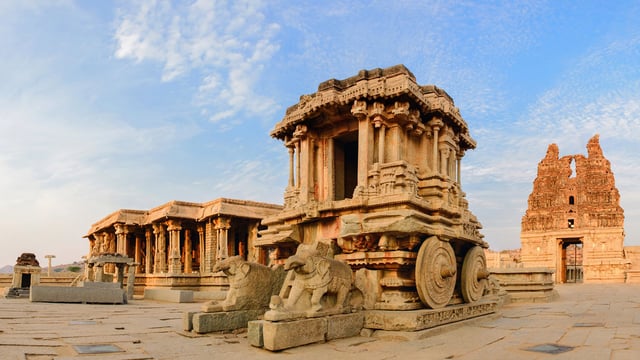
The Early Pandyas ruled over the southernmost region of the Indian peninsula, a territory traditionally known as Pandya Nadu. Their core dominion encompassed the modern districts of Madurai, Tirunelveli, Thoothukudi, Ramanathapuram, and Kanyakumari in Tamil Nadu.
- Madurai: Situated on the banks of the Vaigai River, Madurai served as the inland, primary political and cultural capital of the Pandyas throughout the Sangam Age.
- Korkai: Located at the mouth of the Thamirabarani River, Korkai was the early coastal capital and primary port city. It was globally renowned as the epicentre of the pearl fishery industry.
Dynastic Emblem and Royal Identity
The official emblem of the Early Pandyas was the Twin Fish (Kayal), symbolizing their maritime hegemony and control over coastal resources. The rulers assumed grand titles such as Minavar (Fisherman), Kavuriyar, Pancavar, and Vazhuthi to assert their political lineage.
Literary and Epigraphic Sources
Sangam Literature
The primary literary source for reconstructing early Pandyan history is the Sangam corpus, compiled during the three literary assemblies (Sangams) patronized explicitly by the Pandyan kings.
- Maduraikkanji: Authored by Mangudi Marudanar, this long poem provides a detailed, 360-degree description of the economic, social, and administrative life of the capital city, Madurai, under King Nedunjeliya.
- Nedunalvadai: Written by Nakkirar, it offers vivid descriptions of the royal palace, military camps, and the psychological state of King Nedunjeliya during war campaigns.
- Purananuru and Akananuru: These anthologies contain numerous poems celebrating the military exploits, generosity, and sacrificial rituals of various early Pandyan monarchs.
- Silappatikaram: The post-Sangam Tamil epic by Ilango Adigal uses the court of the Pandyan king Nedunjeliya at Madurai as the dramatic setting for its tragic climax involving the protagonist Kannagi.
Classical Greco-Roman Accounts
The trade wealth and political presence of the Pandyas were recorded extensively by ancient Western historians, who referred to the dynasty as Pandion.
- Megasthenes (4th Century BCE): In his work Indica, Megasthenes records a fascinating piece of trivia, noting that the Pandyan kingdom was ruled by Pandaia, a daughter of Herakles (often identified with Lord Krishna or Shiva). He noted that she was given an army of 500 elephants and a kingdom of 365 villages, requiring one village to pay tribute each day.
- Pliny the Elder and Ptolemy: Mention Modura (Madurai) as the royal capital and Korkai as a major international emporium for pearls.
- Strabo: Records that an embassy sent by King Pandion reached the court of the Roman Emperor Augustus Caesar around 20 BCE to formalize trade treaties.
Epigraphic Evidences
- Ashokan Rock Edicts (2nd and 13th): Maurya Emperor Ashoka (3rd Century BCE) explicitly mentions the Pandyas, alongside the Cholas, Cheras, and Satiyaputras, as independent, friendly frontline states (Pratyantas) existing outside the borders of the Maurya Empire.
- Hathigumpha Inscription of Kharavela: The Kalinga King Kharavela (2nd Century BCE) claims to have broken a 1,300-year-old confederacy of Tamil kingdoms (Tramira Desa Sanghatam) and asserts that he forced the Pandyan king to send a tribute of pearls, jewels, and elephants.
- Mangulam Inscription: Located near Madurai, these Tamil-Brahmi inscriptions dated to the 2nd Century BCE record assignments of rock-cut caves to Jain ascetics by a Pandyan king named Nedunjeliyan.
Prominent Rulers and Military Achievements
King Nedunjeliyan I (The Victor of Talaiyalanganam)
Nedunjeliyan I is regarded as the greatest warrior king of the Early Pandyan line. He ascended the throne as a youth, prompting his contemporary rivals to form a grand coalition against him.
- Battle of Talaiyalanganam: Nedunjeliyan single-handedly defeated a combined alliance of the Chola king, the Chera king, and five independent chieftaincies (Velirs) at Talaiyalanganam (near Thiruvarur). This victory consolidated Pandyan supremacy over the entire Tamil region during the peak of the Sangam Age.
- Patronage: He adopted the title Talaiyalanganattu Ceruvendra Nedunjeliyan and is celebrated as the patron of the poet Mangudi Marudanar.
King Palyagasalai Mudukudumi Peruvaludhi
This early monarch is historically significant for his focus on religious institutionalization and Vedic orthodoxy.
- Vedic Sacrifices: His title Palyagasalai translates to “One who constructed many sacrificial halls.” He performed numerous Vedic rituals like Asvamedha (horse sacrifice) and Rajasuya to legitimize his imperial authority.
- Velvikkudi Copper Plates: This later 8th-century epigraph confirms his ancient land grants, noting that he granted the village of Velvikkudi as a Brahmadeya (tax-free land grant) to a Brahmin family, proving early Brahmanical integration in South India.
King Ollaiyur Thanda Budha Pandyan
A notable ruler who was not only a warrior but also an accomplished poet. He added the territory of Ollaiyur (modern Pudukkottai region) to the Pandyan realm and has several verses credited to his name in the Purananuru anthology.
Administration and Military Structure
Central Government and Assemblies
The Pandyan state was a hereditary monarchy where the king functioned as the supreme judge, commander-in-chief, and legislator. To assist the king in governance, the administrative machinery was divided into two powerful representative assemblies:
- Aimperungulu (The Council of Five): Comprised of the chief priest (Purohit), the army commander (Senapati), ambassadors (Dutar), spies (Orrar), and ministers (Amaichar).
- Enperayam (The Great Assembly of Eight): Comprised of accountants, executive officials, treasury keepers, palace guards, and representatives of leading citizen bodies.
Military Organization
The Pandyas maintained a powerful standing army organized into four traditional divisions (Chaturanga): infantry, cavalry, war elephants, and chariots. Given their extensive coastline, they also maintained a functional naval force to guard their pearl fisheries and merchant convoys against piracy in the Gulf of Mannar.
Economic Life, Maritime Trade, and Urban Centers
Pearl Fishery and Sea Trade
The economic backbone of the early Pandyan kingdom was maritime trade, heavily fueled by its monopoly over premium-grade pearls.
- Korkai Port: Slaves and convicted criminals were used as deep-sea divers to extract oysters from the Gulf of Mannar. The pearls were processed at Korkai and exported to Rome, Egypt, and Greece.
- The Roman Trade Balance: In exchange for pearls, fine textiles, and pepper, the Pandyas received vast quantities of Roman gold and silver coins, which have been discovered in large hoards across Madurai and coastal Tamil Nadu.
Agriculture and Internal Economy
Agriculture flourished along the fertile river basins of the Vaigai and Thamirabarani. The Pandyas developed indigenous irrigation networks, digging large water tanks (Kulams) to store rainwater. Internal trade was highly structured, operating through specialized day markets (Nalangadi) and evening markets (Allangadi) in major urban centers.
Key Socio-Economic Centers of the Pandyan Realm
- Madurai: The ultimate political, luxury goods consumption, and textile manufacturing hub.
- Korkai: The premier global outlet for pearl extraction and maritime customs collection.
- Alagankulam: Located at the mouth of the Vaigai River, this major Sangam-era port has yielded Mediterranean pottery, Roman coins, and punch-marked coins, demonstrating direct trade connectivity with the Western world.
Society, Religion, and Culture
Structure of Sangam Pandyan Society
Social stratification during this era was based on eco-zones (Tinai) and occupational roles rather than a rigid, northern Varna system.
- Key Communities: The Paratavar (coastal fishermen and pearl divers), Maravar (martial warriors), Vellalar (land-owning agriculturists), and Kanikayar (courtesans and cultural performers).
- The Status of Poets: Bards (Panar) and female dancers (Viraliyar) occupied an esteemed position in the Pandyan court, frequently receiving gifts of gold flowers, lands, and chariots from the rulers.
Religious Syncretism
The religious fabric of the Early Pandyan kingdom was a fluid blend of indigenous tribal animism, Dravidian hero-worship, and northern heterodox/orthodox traditions.
- Deities: The Pandyas patronized Seyon (Murugan), the mountain deity; Mayon (Krishna/Vishnu), the pastoral deity; and Vendhan (Indra).
- Hero Stones (Viragal): Erected along crossroads to worship fallen soldiers who died defending cattle or village frontiers.
- Co-existence: As proven by the Mangulam inscriptions, Jainism enjoyed royal and merchant patronage alongside Buddhism and Vedic Hinduism.
The Three Tamil Sangams (Literary Conclaves)
According to late Tamil traditions and the commentary on the Iraiyanar Agaporul, the Pandyas were the exclusive patrons of all three legendary Tamil Sangams.
| Sangam Assembly | Traditional Venue | Presiding Sage / Scholars | Surviving Literary Work |
| First Sangam (Thenmadurai) | Mythical Madurai (swallowed by the sea) | Sage Agastya, Gods, and Sages | None survived |
| Second Sangam (Kapatapuram) | Coastal city (swallowed by the sea) | Sage Agastya and his disciple Tolkappiyar | Tolkappiyam (Earliest Tamil grammar work) |
| Third Sangam (Uttara Madurai) | Modern Madurai (Inland city) | Nakkirar and a college of 49 poets | Entire extant Sangam Corpus (Ettutogai and Pattupattu) |
Decline of the Early Pandyas
The Kalabhra Interregnum
Towards the end of the 3rd Century CE, the Sangam institutional framework, along with the political authority of the Early Pandyas, Cholas, and Cheras, collapsed rapidly. The region was invaded and occupied by a mysterious group of rulers known as the Kalabhras, often referred to in Brahmanical texts as the “Evil Rulers” due to their patronage of Buddhism and Jainism over Vedic systems.
Transition to the First Empire
The Pandyan lineage remained in political eclipse for nearly three centuries until the late 6th Century CE (c. 590 CE), when the Pandyan king Kadungon successfully overthrew the Kalabhras, liberating the southern Tamil regions and laying the foundation for the First Pandyan Empire of the early medieval period.
Last Modified: June 15, 2026