
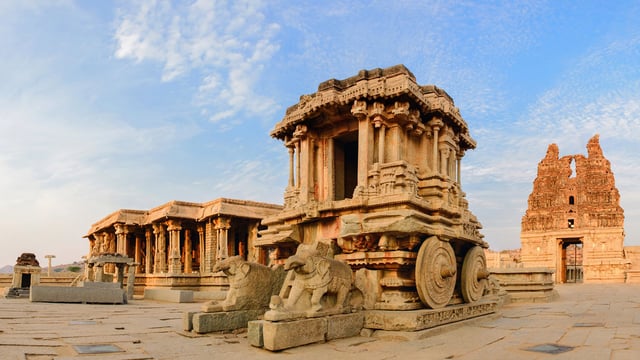
The Satavahana dynasty, also referred to as the Andhras in the Puranic literature, established their hegemony in the Deccan region post the decline of the Mauryan Empire and the subsequent fall of the Kanva dynasty. While Puranic texts designate them as Andhrabhrityas (servants of the Andhras), the dynastic inscriptions consistently employ the family name Satavahana.
Geographical Extension and Capitals
The nuclear area of Satavahana power shifted over time, spanning modern-day Maharashtra, Andhra Pradesh, and Telangana.
- Pratishthana (modern Paithan, Maharashtra): The early capital located on the banks of the Godavari River.
- Dhanyakataka (modern Dharanikota/Amaravati, Andhra Pradesh): The later capital, serving as a strategic eastern stronghold near the Krishna River to manage maritime trade.
Chronology and Political Status
The dynasty ruled from around the 1st century BCE to the early 3rd century CE. The Satavahanas acted as a political bridge between northern and southern India, preventing foreign Saka incursions from completely penetrating the southern peninsula.
Key Rulers and Political History
Simuka (c. 1st Century BCE)
Simuka is recognized as the founder of the Satavahana dynasty. He consolidated power by destroying the remnants of the Kanva dynasty and neutralizing Sunga influence in Central India.
Satakarni I
Satakarni I was the first major ruler to expand the empire aggressively. He conquered western Malwa, Anupa (Narmada valley), and Vidarbha. To legitimize his imperial sovereignty, he performed Vedic sacrifices including the Asvamedha (horse sacrifice) and Rajasuya. His achievements are documented in the Naneghat inscription issued by his queen, Nayanika.
Hala
Hala is celebrated primarily for his literary contributions rather than military conquests. He compiled the Gatha Saptasati (also known as Gaha Sattasai), a collection of 700 erotic poems written in Maharashtri Prakrit.
Gautamiputra Satakarni (c. 106 – 130 CE)
Gautamiputra Satakarni revived the fading fortunes of the dynasty after a period of Saka domination. He is described in the Nashik Prasasti inscription, issued by his mother Gautami Balasri, as the Ekabrahmana (peerless Brahmana) and the destroyer of the Sakas, Yavanas (Greeks), and Pahlavas (Parthians). He decisively defeated the Western Kshatrapa ruler Nahapana and counter-struck his coins to assert dominance.
Vasishthiputra Pulumavi (c. 130 – 154 CE)
Pulumavi expanded Satavahana territory toward the eastern Deccan (Andhra region). His coins featuring dual-masted ships reflect the growing maritime strength and trade operations of the empire during his reign.
Yajna Sri Satakarni (c. 165 – 194 CE)
Yajna Sri Satakarni was the last great ruler of the main line. He recovered some western territories previously lost to the Shakas (under Rudradaman I). His coins also depict ships, confirming ongoing naval and commercial vitality before the dynasty fractured into smaller principalities like the Ikshvakus, Abhiras, and Vakatakas.
Socio-Religious Conditions and Matronymics
The Institution of Matronymics
Satavahana rulers frequently used metronymics (names derived from the mother), such as Gautamiputra (son of Gautami) and Vasishthiputra (son of Vasishthi). However, the succession remained strictly patrilineal; the throne passed from father to son, indicating that the core structure of the state was patriarchal despite the high status accorded to royal women.
Religious Patronage and Social Assimilation
The Satavahanas were Brahmanical rulers who claimed to restore the four-fold varna system (chatuvarna samkarana). Concurrently, they practiced religious toleration and acted as major benefactors to Buddhist monastic orders. They institutionalized the practice of tax-free land grants (Agraharas) to both Brahmanas and Buddhist monks, a fiscal mechanism that sowed the seeds of later Indian feudalism. Foreign elements like the Sakas and Yavanas were systematically integrated into the socio-religious framework through marriages and adoption of Indian faiths.
Economy, Urbanization, and Trade Networks
Internal and External Trade Routes
The Deccan under the Satavahanas formed the nexus of trans-peninsular trade routes linking Uttarapatha (northern route) with Dakshinapatha (southern route). Cargo moved via passes in the Western Ghats (like Thalghat, Bhorghat, and Naneghat) to connect inland production centers with coastal ports.
Maritime Ports and International Markets
Trade with the Roman Empire reached its zenith during this era, a phenomenon heavily documented in the anonymous Greek text The Periplus of the Erythraean Sea and Pliny the Elder’s Naturalis Historia.
Major Trading Ports of the Satavahana Era
| Coastline | Port Name | Modern Location / Significance | Primary Commodities Handled |
| Western Coast | Barygaza (Bharuch) | Gujarat; controlled via northern alliances | Cottons, aromatic roots, wine imports |
| Western Coast | Sopara | Maharashtra; major early emporium | Textiles, ivory, Roman glass |
| Western Coast | Kalyan | Maharashtra; site of conflict with Sakas | Timber, spices, metalware |
| Eastern Coast | Maisolos (Masulipatnam) | Andhra Pradesh; prominent textile hub | Fine muslins, iron, steel |
| Eastern Coast | Motupalli | Andhra Pradesh; specialized entry point | Precious stones, silks |
Monetization and Currency Systems
The Satavahanas issued a vast volume of coinage to facilitate trade. Unlike their contemporaries who issued gold coins, the Satavahanas minted coins primarily out of lead, potin (an alloy of copper, zinc, lead, and tin), copper, and silver. Their silver coins were minted on the weight standard of the Saka Kshatrapa coinage and often bore bilingual legends in Prakrit and South-Indian Brahmani characters.
Guilds, Foreign Contacts, and Material Culture
The Shreni System (Guilds)
Inland craft production and commercial transactions were organized into autonomous corporations called Shrenis (guilds). Inscriptions at Nashik and Junnar record that these guilds acted as banks, accepting permanent endowments (Akshayanivi) from royals and merchants and paying fixed interest to designated beneficiaries, such as Buddhist monks.
Prominent Satavahana Guilds and Functions
- Kularikas: Potters’ guilds responsible for industrial-scale ceramic production.
- Odayantrikas: Hydraulic engineers who constructed and serviced water engines and irrigation pumps.
- Tilapisakas: Oil-millers who processed oilseeds for domestic distribution and export.
- Vadhikis: Carpenters and shipbuilders essential for riverine and maritime transport.
Material Culture and Architectural Legacies
The Satavahana period witnessed an architectural transition from timber installations to rock-cut and stone structures.
- Rock-Cut Architecture: The Western Ghats saw the excavation of magnificent Chaityas (prayer halls) and Viharas (monasteries), most notably at Karle (the largest Chaitya in India), Bhaja, Bedsa, Kanheri, and Nashik.
- The Amaravati Stupa: Located in the lower Krishna-Godavari valley, this stupa was enlarged using distinctive white marble reliefs depicting the life of Buddha and Jataka tales. The art style is defined by its narrative intensity, preference for sensuous human forms, and dynamic group compositions.
Essential Prelims Facts and Historical Trivia
- The Periplus Testimony: The Periplus of the Erythraean Sea notes that if Roman ships accidentally drifted into the port of Kalyan, they were escorted under military guard to Barygaza, reflecting the fierce naval and economic rivalry between the Satavahanas and the Western Kshatrapas.
- The Naneghat Pass Cisterns: The Naneghat pass features a large rock-cut stone pot used to collect transit tolls from merchants moving goods from the Konkan coast to the Deccan plateau.
- The Roman Drain: Pliny computed that Rome lost upwards of 55 million sesterces annually to India to pay for luxuries like spices and muslin, a drain verified by the discovery of Roman gold coin hoards across Satavahana territories.