
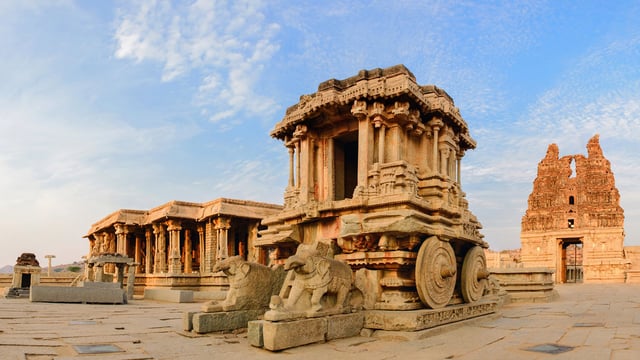
Narasimhavarman I (r. c. 630–668 CE) succeeded his father, Mahendravarman I, to the Pallava throne at Kanchipuram during a critical juncture in early medieval South Indian history. Inheriting a kingdom bruised by the territorial losses inflicted by the Western Chalukyas of Badami, he re-engineered Pallava statecraft, military apparatus, and maritime capabilities. His reign represents the pinnacle of Imperial Pallava hegemony over the Deccan and the deep South, characterized by decisive military victories, the expansion of Indian cultural influence across the Bay of Bengal, and unparalleled architectural innovations.
The Pallava-Chalukya War and Military Triumphs
The defining geopolitical event of Narasimhavarman I’s reign was the total subjugation of the Western Chalukya Empire, avenging his father’s defeat at the Battle of Pullalur.
The Battle of Manimangalam
Pulakeshin II, the ambitious Western Chalukya monarch, launched a multi-pronged invasion aimed at capturing the Pallava capital, Kanchipuram. Narasimhavarman I confronted the advancing Chalukyan forces at Manimangalam (located roughly 20 miles from Kanchipuram). Backed by his brilliant commander-in-chief, Siruthondar (also known as Paranjothi), Narasimhavarman I routed the Chalukyan army, forcing them into a chaotic retreat.
Sacking of Vatapi and Imperial Titles
Following the victory at Manimangalam, Narasimhavarman I launched a counter-offensive directly into the Chalukyan heartland. The Pallava forces marched upon the fortified enemy capital of Vatapi (modern Badami, Karnataka) in 642 CE. The siege ended with the storming and burning of the capital, during which Pulakeshin II was killed in battle. Narasimhavarman I occupied the Chalukyan kingdom for over a decade, adopting the victorious imperial title of Vatapikonda (Conqueror of Vatapi). To commemorate this triumph, an inscription was carved onto the Mallikarjuna temple rock at Badami in his 13th regnal year.
Naval Expeditions to Sri Lanka and Maritime Diplomacy
Narasimhavarman I pioneered South Indian naval statecraft, transforming the Coromandel Coast into a launchpad for trans-oceanic military intervention.
Alliance with Prince Manavarman
The Sinhalese prince Manavarman sought political asylum at the Pallava court after being exiled from Sri Lanka during an internal succession dispute. Manavarman joined the Pallava military apparatus and fought alongside Narasimhavarman I during the campaigns against the Chalukyas.
The Mahabalipuram Naval Fleet
In gratitude, Narasimhavarman I ordered the assembly of a massive naval armada at the port city of Mahabalipuram (Mamallapuram). The first expedition faced logistical setbacks, but the second naval campaign successfully invaded Sri Lanka, defeated the usurper King Hatthadatha, and reinstated Manavarman to the throne of Anuradhapura. This event is recorded in detail in the Sinhalese chronicle, the Mahavamsa, and established Pallava maritime supremacy across the Bay of Bengal.
Foreign Relations: Account of Xuanzang (Hiuen Tsang)
The Chinese Buddhist pilgrim Xuanzang visited the Pallava capital of Kanchipuram around 640 CE during the reign of Narasimhavarman I, leaving behind an invaluable socio-political record in his travelogue, Si-Yu-Ki.
Administrative and Socio-Religious Observations
Xuanzang noted that Kanchipuram (Kanchi-pulo) was a vast city about six miles in circumference, populated by courageous and deeply religious citizens who valued learning. He documented the peaceful coexistence of different faiths under state neutrality. The city housed nearly 100 Buddhist monasteries home to over 10,000 monks of the Sthavira (Theravada) school, alongside 80 Deva (Brahmanical) temples and a significant population of Digambara Jains.
Educational Eminence
The traveler described Kanchipuram as a renowned center of higher education, identifying it as the birthplace of Dharmapala, the celebrated Buddhist scholar who later became the abbot of Nalanda University.
The Mamalla Style of Architecture and Art Evolution
Narasimhavarman I assumed the title Mahamalla (The Great Wrestler), a moniker that inspired the transformation of the coastal village of Mamallapuram into a magnificent port city and religious complex characterized by the Mamalla Style of Dravidian architecture.
The Pancha Pandava Rathas
The architectural hallmark of his reign is the carving of monolithic, free-standing shrines directly out of single granite boulders. These shrines, structurally resembling monolithic stone chariots, served as architectural models for later South Indian vimanas.
| Ratha Name | Structural and Architectural Design Features |
| Dharmaraja Ratha | The largest structure; a multi-tiered, pyramidal square vimana that acted as the design archetype for classic Dravidian temples. It features early iconographic representations of Narasimhavarman I with labels. |
| Arjuna Ratha | A refined, two-tiered square shrine sharing a common platform with the Draupadi Ratha, decorated with reliefs of couples and deities. |
| Bhima Ratha | An oblong, two-storied structure featuring a distinctive wagon-vaulted (Sala-type) roof design, intended for a reclining deity. |
| Sahadeva Ratha | Exhibits an apsidal or horseshoe-shaped layout, commonly referred to as Gajaprishta (elephant-backed) architecture. |
| Draupadi Ratha | The smallest ratha; dedicated to Durga, designed as a simple square structure mimicking a rural mud hut with a thatched roof. |
The Great Open-Air Bas-Relief
Narasimhavarman I commissioned the creation of a massive open-air rock sculpture at Mamallapuram, executed on two large monolithic boulders with a central natural cleft. Art historians interpret the complex narrative in two ways:
- The Descent of the Ganges: Depicting Bhagiratha performing penance to bring the celestial river Ganges down to Earth to purify the ashes of his ancestors, utilizing the central cleft to represent the flowing river.
- Arjuna’s Penance: Depicting Arjuna performing rigorous ascetics to obtain the powerful Pasupatastra weapon from Lord Shiva to aid the Pandavas in the Mahabharata war.
- Iconographic Details: The relief contains over a hundred life-sized, anatomically precise carvings of gods, semi-divine beings (Nagas, Gandharvas), ascetics, and wild animals, including a famous family of elephants and a fasting cat.
Administrative Machinery, Revenue, and Social Structure
Narasimhavarman I consolidated a highly stratified bureaucratic administration designed to manage agrarian surpluses and trade revenues efficiently.
Territorial Governance
The empire was divided into Mandalams (provinces managed by royal princes), which were further split into Kottams (district units centered around fortified strongholds) and Nadus (agrarian village aggregates managed by local councils called Nattar).
The Agrarian and Pastoral Nexus
The state treasury relied extensively on land revenue (Kadamai) extracted from paddy-producing wetlands. The expansion of agricultural land was systematically driven by issuing Brahmadeya (tax-free settlements to learned Brahmins) and Devadana (temple lands) charters. These grants were legally protected by clauses such as A-chata-bhata-praveshya, which prohibited royal soldiers and tax collectors from entering the properties to disrupt economic production.
Merchant Guilds and Maritime Revenue
The port of Mamallapuram became an elite commercial trade zone. Merchant organizations like the Manigramam regulated the export of high-quality textiles, spices, and iron to Southeast Asian kingdoms. The state levied strict custom duties (Sunkan) and harbor tariffs to finance its standing army and naval forces.
Fact-Dense Trivia for UPSC Prelims
The Badami Rock Inscription
Narasimhavarman I’s victory inscription at Badami is written in classical Sanskrit using the southern Pallava Grantha script, serving as a vital chronological anchor for early medieval Indian history.
Commander Paranjothi and the Ganesha Idol
According to Tamil Shaivite hagiographical tradition, the Pallava commander-in-chief Paranjothi brought an idol of Vatapi Ganapati back to his native Tamil land as war plunder after sacking the Chalukyan capital. Paranjothi later renounced warfare, embraced Shaivism, and became celebrated as the Nayanar saint Siruthondar.
Label Inscriptions on Dharmaraja Ratha
The upper tiers of the Dharmaraja Ratha contain precise epigraphic labels recording the various titles of Narasimhavarman I, including Atyantakama (He of Boundless Desires), Srinidhi (Abode of Wealth), and Ranajaya (Victorious in Battle), which helped archaeologists definitively attribute the monument to his reign.
Absence of Sovereign Gold Coinage
Despite controlling vast international maritime trade routes, Narasimhavarman I’s domestic administration minted only small copper and silver coins featuring the emblem of a seated bull (Nandi) or a lion, alongside a ship with double masts. Gold dinars from foreign empires or barter trade systems remained the standard for high-value maritime transactions.
Last Modified: June 15, 2026