
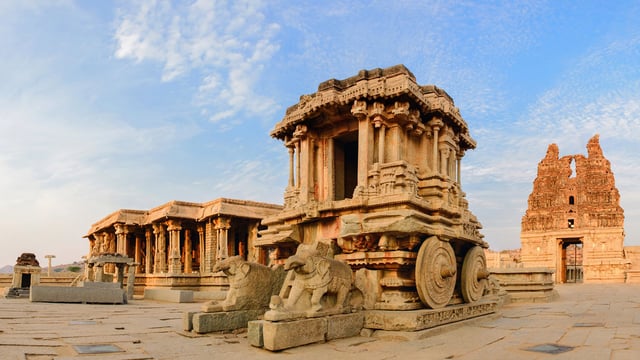
The temple complex at Khajuraho, situated in the Bundelkhand region of Madhya Pradesh, represents the zenith of the Central Indian or Bundelkhand sub-style of Nagara temple architecture. While the overall building activity spanned from 900 AD to 1130 AD under the Chandela Rajput dynasty, the foundational and classical phase materialised before 1000 AD.
Dynastic Phases of Construction up to 1000 AD
- Early Proto-Phase (c. 900–925 AD): Characterised by the transition from granite to sandstone masonry, producing early structures like the Chausath Yogini temple and the Lalguan Mahadeva temple.
- Consolidation Phase (c. 925–954 AD): Spearheaded by King Yashovarman (Lakshavarman), who constructed the monumental Lakshmana Temple to celebrate his political independence from the Gurjara-Pratiharas and to legitimise Chandela sovereignty.
- Zenith of Early Phase (c. 950–1002 AD): Commissioned under King Dhanga Deva, resulting in architectural masterpieces like the Vishvanatha Temple and the Parsvanatha Temple, where the characteristic multi-towered profile achieved absolute maturity.
Architectural Blueprint and Key Structural Elements
The early Khajuraho temples broke away from the traditional northern Nagara style by placing the entire structure on an elevated platform and fusing individual architectural components into a single, cohesive building envelope.
Core Structural Innovations
- Jagati (Elevated Plinth): Unlike early Gupta structures, early Khajuraho temples are built on a high, massive stone platform that elevates the temple well above the ground level.
- Lack of Prakara (Enclosure Wall): These temples lack defensive boundary walls and monumental gateways (gopurams), standing open to view from all sides.
- Integrated Interior Axis: The rooms of the temple form a continuous space along an east-west axis, allowing a devotee to walk straight through successive halls into the inner sanctum.
- Urushringas (Subsidiary Towers): The main tower (shikhara) over the sanctum is surrounded by multiple miniature towers that lean against it, creating a clustered, mountain-like peak appearance.
Structural Anatomy of the Architectural Components
| Component Name | Structural Description | Aesthetic or Ritual Function |
| Ardha-mandapa | The open entrance porch supported by pillars. | Functions as the transitional entryway into the temple. |
| Mandapa | The assembly hall preceding the main sections. | Used for public ritual gatherings, religious discourses, and music. |
| Maha-mandapa | A large, central transept hall with extended lateral transepts. | Features elevated balconies (jharokhas) to admit light and air. |
| Antarala | A narrow vestibule or passage chamber. | Connects the large public hall directly to the inner sanctum. |
| Garbhagriha | The square, dimly lit innermost chamber. | Houses the principal deity; topped by the highest shikhara. |
| Pradakshinapatha | An indoor circumambulatory passage. | Allows inner circumambulation around the garbhagriha, standard in Sandhara layouts. |
Typological Taxonomy of Landmark Early Khajuraho Shrines
| Temple Name | Approximate Date | Religious Dedication | Distinct Architectural / Historical Feature |
| Chausath Yogini | c. 900 AD | Shakta (Tantric) | The oldest temple at the site; entirely built of coarse granite; features an open-air hypaethral rectangular layout with 64 individual cell shrines. |
| Lakshmana | c. 954 AD | Vaishnavite (Vaikuntha) | Built by Yashovarman; a perfect Panchayatana complex; preserves its four corner subsidiary shrines completely intact on the jagati. |
| Parsvanatha | c. 954 AD | Jain (Digambara) | Originally dedicated to Adinatha; features a rectangular plan without open lateral balconies; possesses highly refined secular sculptures. |
| Ghantai | c. 995 AD | Jain | Preserves bell-and-chain motifs carved on its broken pillars, showing a structural fusion of Jain imagery with classical Nagara formats. |
| Vishvanatha | c. 1002 AD | Shaivite | Built by Dhanga Deva; features a multi-tiered Shekhari shikhara; contains a dedicated, standalone Nandi pavilion facing the main shrine. |
Socio-Economic Foundations of Chandela Monumental Infrastructure
The construction of these large sandstone monuments required a well-organized state economic system to extract, manage, and distribute regional resources.
Agrarian Transformations and Resource Mobilization
- Devadana Inscriptions: Chandela inscriptions record that monarchs granted tax-free villages (devadana) directly to the temples. The temple institutions collected agricultural surpluses, managed rural land distribution, and funded local irrigation systems like the construction of large stone step-wells (baolis).
- The Khajuraho Inscription of Dhanga Deva: Documents the donation of fertile agrarian lands along the Ken and Betwa river valleys to provide a continuous revenue stream for maintaining temple daily rituals and temple staff.
Trade Routes and Merchant Endowments
- The Shreni Intersect: Khajuraho sat at the crossroads of ancient trade routes linking Malwa, Central India, and the Gangetic plains. Wealthy merchant guilds, particularly those of betel-sellers and jewelers, financed individual sculptural panels and columns, as recorded in short dedicatory inscriptions on the temple bases.
- Labor Management: The state maintained specialized royal architectural departments staffed by hereditary lines of master architects (Sutradharas), stone-cutters, and artists (Shilpins), providing long-term employment funded by the crown’s military tribute collections.
Political Legitimization and Sectarian Balance
- Sovereignty Projections: The Chandelas used large-scale temple construction to claim political independence from their former Gurjara-Pratihara overlords. Constructing a grand monument was the standard method for a new king to announce his independent right to rule.
- The Tri-Sectarian Nexus: Before 1000 AD, the Chandela kings balanced state patronage equally across Vaishnavite, Shaivite, and Jain institutions. This tri-sectarian harmony prevented religious conflict and allowed the state to integrate diverse merchant and agrarian classes into a stable political order.
Artistic, Sculptural, and Iconographic Paradigms
Sculpture at Khajuraho was structurally integrated into the exterior and interior walls of the temples, following a highly calculated placement system.
Key Iconographic and Sculptural Themes
- Vaikuntha Vishnu: The Lakshmana temple houses a rare three-headed idol of Vishnu as Vaikuntha (the central head is human, flanked by the heads of a boar/Varaha and a lion/Narasimha), which Yashovarman seized from the Pratihara ruler Devapala.
- Surasundaris and Apsaras: Sinuous, deeply undercut female figures carved in three-dimensional relief on the exterior wall bands, depicted in everyday activities such as applying makeup, removing a thorn from a foot, writing letters, or wringing wet hair.
- Mithuna and Erotic Friezes: Placed prominently on the joining architectural segments (kapili junctions) between the main hall and the sanctum. These panels depict complex erotic combinations that scholars interpret as symbols of auspiciousness (alaṅkāra), Tantric rituals, or visual representations of the Kama aspect of human life alongside Dharma and Moksha.
Stylistic Attributes
- Triple Bands of Sculpture: Early Khajuraho temples feature two to three parallel horizontal rows of high-relief sculptures wrapping around the outer walls, creating a vibrant pattern of light and shadow on the facade.
- Anatomical Dynamism: Figures possess long, slender limbs, sharp facial angles, and exaggerated postures (tribhanga or triple-bend pose) that break away from the static, heavy modeling of early post-Gupta art.
Literature, Science, and Canonical Codification
The architectural achievements of the early Chandelas developed in tandem with the formal codification of technical sciences and court literature in Sanskrit.
Architectural Treatises and Mathematical Grids
- Vastu Purusha Mandala Layout: The ground plans were strictly based on geometric grids of squares, typically using the Manduka layout (8 × 8 = 64 squares) or the Paramasayika layout (9 × 9 = 81 squares). This geometric framework aligned the temple axis precisely with the cardinal directions and balanced the structural weight of the stone towers.
- Samarangana Sutradhara Integration: Although finalized slightly later under King Bhoja of Dhara, this text preserves the 10th-century Central Indian engineering traditions regarding the mathematical calculation of load-bearing columns and the proportional reduction of urushringa towers.
Court Literature and Playwrights
- Prabodha-Chandrodaya: Written by Krishna Mishra in the Chandela court, this allegorical play provides key insights into the competing philosophical systems of the era, illustrating the intellectual environment that shaped the complex symbolism of the temple carvings.
Scientific Advancements and Structural Engineering
Building tall, multi-towered sandstone structures without the use of cementing mortar required advanced applications of physics, structural engineering, and stone masonry.
Material Management and Stone Processing
- Sandstone Quarrying: Architects abandoned local granite in favor of fine-grained buff sandstone quarried from the nearby hills of Panna. This softer sedimentary stone allowed craftsmen to execute deep, lace-like undercuts and delicate facial expressions.
- Dry Ashlar Masonry: The temples were constructed entirely without mortar. Finely dressed sandstone blocks were fitted together using precise weight distribution, gravity, and interlocking joint systems like the tongue-and-groove and dovetail methods.
Structural Physics of the Shekhari Tower
- Load Redistribution: The complex clustered design of the Shekhari shikhara was a major engineering breakthrough. The weight of the heavy central tower was distributed outward and downward through the layers of smaller urushringas, channeling the downward thrust onto the thick, massive masonry walls of the garbhagriha.
- Trabeate Ceiling Engineering: Ceilings inside the mandapas were built using the trabeate or corbelling method, where horizontal stone slabs were layered overlappingly inward. These layers were held in place by heavy stone blocks on the exterior, creating high ceilings without the use of true radiating arches.
Crucial Facts for Civil Services Evaluation
The Vaikuntha Idol Looting Chain
The historical inscription on the Lakshmana temple documents a chain of military seizures for its main deity. The Vaikuntha image was originally acquired from Tibet by the king of Chamba, then seized by the Pratihara ruler Herambapala, later taken by Devapala, and finally captured by Chandela King Yashovarman to mark his imperial rise.
The Sandhara vs. Nirandhara Layout Division
Early Khajuraho temples are classified by whether they include an interior circumambulatory path. Temples like the Lakshmana and Vishvanatha are Sandhara temples (possessing an internal path), while the Adhinatha and Devi Jagadambi temples are Nirandhara temples (lacking an internal path, with devotees circumambulating outside on the open platform).
The Graha Lintel Tradition
The doorways of early Khajuraho temples feature a lintel carved with planetary deities. Temples built before 1000 AD show a transition from the Ashta-Graha (eight planets) format to the Nava-Graha (nine planets) format, serving as a reliable stylistic indicator for dating individual structures at the site.
Last Modified: June 15, 2026