
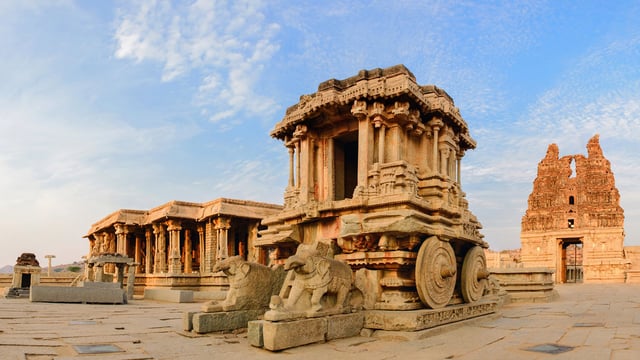
The Vesara style of temple architecture, often designated as the “Deccan Style,” represents a hybrid architectural idiom that fused elements of the northern Nagara and southern Dravida traditions. Emerging prominently in the mid-6th century AD, it flourished under the patronage of early medieval Deccan dynasties until its classical crystallization around 1000 AD.
Dynastic Trajectory and Geographical Distribution
- Early Chalukyas of Badami (c. 543–753 AD): Initiated the experimental synthesis of Northern and Southern styles at crucial political and religious nuclei including Aihole (the “cradle of Indian temple architecture”), Badami, and Pattadakal.
- Rashtrakutas of Manyakheta (c. 753–982 AD): Continued structural and rock-cut experiments across the Deccan, blending architectural components to project imperial authority.
- Western Chalukyas of Kalyani (Late 10th Century AD onwards): Refined the Vesara style into its highly ornate, mature phase, introducing stellate plans and sophisticated stone-turning techniques.
- Geographical Matrix: The style was concentrated in the hybrid cultural zone of the Deccan, primarily between the Vindhya Range and the Krishna-Tungabhadra river basins, bridging the architectural divide of the subcontinent.
Architectural Syncretism and Structural Anatomy
The defining characteristic of the Vesara style is its deliberate structural synthesis. It truncated the verticality of the Dravida superstructure while incorporating the decorative, tiered, and projected profiles of the Nagara tradition.
Elements Adopted from the Nagara Style
- Pragmatic Ground Plan: Utilization of the cruciform or star-shaped (stellate) layout via multiple wall projections (rathas).
- Decorative Motifs: Incorporation of miniature amalakas, kapota arches, and curvilinear mesh patterns (gavakshas) on the surface decorations of the towers.
Elements Adopted from the Dravida Style
- Horizontal Stratification: Retaining the concept of tiered horizontal storeys (talas) for the central tower elevation.
- Functional Components: Incorporation of open pillared corridors (mandapas), circumambulatory passages (pradakshinapatha), and integrated water reservoirs.
Core Structural Innovations Up to 1000 AD
- Reduced Vimana-Shikhara: The hybrid tower features horizontal tiers that are compressed vertically, resulting in a curved, stepped profile that lacks the rigid straight lines of a southern Vimana and the continuous curve of a northern Shikhara.
- Stellate (Star-Shaped) Plan: Achieved by rotating a square plan around a central axis, creating multiple decorative angles that maximized the surface area available for complex sculptural relief works.
- Highly Ornate Pillars: Transition from square rock-cut pillars to circular, lathe-turned, and highly polished stone columns with distinct vase-and-foliage (ghata-pallava) capitals.
Comparative Analysis of Vesara Architectural Hybrids
| Monument | Location & Period | Nagara Elements Displayed | Dravida Elements Displayed |
| Durga Temple | Aihole (c. 7th–8th Century AD) | Curvilinear Rekha-Prasada shikhara over the sanctum. | Apsidal ground plan mimicking Buddhist chaityas; pillared verandah. |
| Papanatha Temple | Pattadakal (c. 740 AD) | Elongated, northern-style northern curvilinear shikhara. | Low, horizontal profile; layout divided into multiple mandapas. |
| Virupaksha Temple | Pattadakal (c. 740 AD) | Intricate North Indian geometric window tracery (jalis). | Strict three-tiered pyramidal Vimana structure with a southern-style dome. |
| Kailasanatha (Cave 16) | Ellora (8th Century AD) | Northern structural ornamentation style and niche designs. | Southern Dravidian Vimana layout, prakara walls, and standalone gopuram. |
Socio-Economic Foundations of the Deccan Hybrid System
The construction of Vesara temples up to 1000 AD was deeply rooted in the shifting socio-economic landscape of the Deccan, acting as an engine for resource mobilization and state formation.
Agrarian Expansion and Institutional Wealth
- Land Grants (Devadana): Chalukyan and Rashtrakuta monarchs issued extensive land revenue grants to temples, converting them into corporate agrarian landlords. Epigraphic records at Aihole note that temples actively managed the reclamation of forest tracts into arable wet-farming lands.
- Rural Credit and Banking: The temple treasuries accumulated surplus grain, livestock, and precious metals. These assets were loaned out to village assemblies (Mahajanas) and agricultural cooperatives at standardized interest rates, anchoring rural stability during dynastic wars.
Trade Guilds and Urban Intersections
- The Ayyavole 500 Guild: The powerful merchant guild known as The Five Hundred of Ayyavole (headquartered at Aihole) heavily subsidized Vesara temple construction. In return, the temples provided commercial storage, served as legal courts for trade disputes, and legitimized the guild’s pan-Indian maritime trade networks.
- Artisanal Mobility: The hybrid nature of the architecture reflects the socio-economic mobility of master builders (Sutradharas). Royal inscriptions record that architects from both Kanchipuram (Southern school) and Aryavarta (Northern school) were brought to the Deccan, creating multi-ethnic artisan colonies.
Societal Integration and Political Legitimacy
- Varna Re-alignment: The construction of grand monuments allowed upwardly mobile agrarian communities and tribal chieftains in the Deccan to claim Kshatriya status by patronizing Brahminical rituals inside the newly built mandapas.
- Imperial Projection: By synthesizing northern and southern architectural styles, Deccan rulers visually asserted their geopolitical claim to be Sakalauttarapathanatha (Lord of all Northern India) and sovereigns of the South, using stone as an instrument of political propaganda.
Artistic, Sculptural, and Iconographic Paradigms
Sculpture in the Vesara style developed a distinctive plastic idiom characterized by dramatic dynamism, deep undercutting, and complex multi-limbed iconographic compositions.
Key Iconographic Innovations
- The Nataraja Transformation: Early Chalukyan sculptures at Badami (Cave 1) standardized the 18-armed dancing Shiva, showcasing a geometric arrangement of arms that mathematically represents sequential dance poses (karanas).
- The Varaha Narrative: The depiction of Vishnu as the cosmic boar lifting Bhudevi (the Earth goddess) became an imperial motif under the Chalukyas, symbolizing the monarch rescuing the state from political chaos.
- Ceiling Panels (Dikpalas): Unlike northern temples where ceilings were predominantly geometric, Vesara temples utilized central ceiling slabs to carve deep, high-relief panels of flying Gandharvas, balancing Vidyadharas, and the guardians of the eight directions.
Stylistic Attributes
- Anatomical Elongation: Figures possess long, slender limbs with fluid posture transitions (tribhanga or triple-bend pose), displaying a synthesis of the voluptuousness of Post-Gupta northern art and the structural leanings of southern art.
- Densely Carved Doorjambs: Sanctum doorways feature up to five concentric bands (shakhas) of intricate carvings, depicting foliated scrolls, demi-gods (ganas), and mithuna couples.
Literature, Epigraphy, and Canonical Codification
The development of the Vesara style occurred in tandem with the growth of Kannada and Sanskrit literature, alongside the epigraphic codification of early medieval administrative laws.
Canonical Architecture Treatises
- Suprabhedagama & Kamikagama: Southern Agamic texts that formally recognize “Vesara” as one of the three foundational stylistic orders of Indian architecture, defining it by its circular, apsidal, or octagonal profile variants.
- Dharasiva Inscriptions: Record the early mathematical classifications used by Deccan guilds to calculate the proportional reduction of the talas (tiers) when designing hybrid towers.
Epigraphic and Literary Records
- The Aihole Inscription (634 AD): Composed in classical Sanskrit by the court poet Ravikirti under Pulakeshin II, this inscription on the Meguti Jain Temple provides the precise chronological framework for early Vesara developments and establishes the synthesis of northern poetic meters (Kavya) with southern historical traditions.
- Kavirajamarga (c. 850 AD): The earliest available Kannada literary work, written during the reign of Rashtrakuta King Amoghavarsha I, defines the boundaries of the land where Kannada was spoken (between the Godavari and the Kaveri) — a geography that directly overlaps with the core territory of the Vesara architectural style.
Scientific Principles and Structural Engineering
The execution of complex hybrid plans demanded advanced mathematical computations, highly specialized stone processing techniques, and innovative structural masonry solutions.
Material Transformation and Mineralogy
- Transition from Sandstone to Schist: Early Chalukyan builders utilized local red-golden sandstone, which restricted deep undercutting. By the late 10th century, the mature Vesara style transitioned to chloritic schist (soapstone). This softer stone could be easily carved when green and hardened upon exposure to air, enabling intricate, lace-like ornamentation.
- Lathe-Turning Technology: The execution of perfectly circular, mirror-polished pillars was a significant mechanical innovation. Massive blocks of stone were mounted on mechanical, hand-turned lathes and rotated against abrasives to cut deep, uniform horizontal moldings into the column shafts.
Structural and Geometric Engineering
- Apsidal Layout Engineering: Building structures like the Durga Temple at Aihole required complex calculations to transition an orthogonal rectangular entrance porch into a semi-circular apsidal posterior, a feat achieved by using a series of radiating concentric stone beams.
- Dry Masonry and Iron Tie-Rod Systems: Vesara temples did not use lime mortar. Stability was achieved through the sheer dead-weight of interlocking stones using the tongue-and-groove joint system. In multi-tiered structures, internal iron clamps were used to resist lateral seismic forces common in the Deccan fault lines.
- Gnomon and Cardinal Alignment: Engineers used the Shanku (astronomical gnomon stick) to mark the shadow circles on the ground prior to laying foundations. This ensured that the stellar wall projections accurately caught the alternating light and shadow during the summer and winter solstices.
Essential Fact-File for Competitive Civil Services Evaluation
The UNESCO World Heritage Component
The Group of Monuments at Pattadakal represents the pinnacle of early Vesara experimentation. Out of the ten major temples here, four are in the pure Northern Nagara style (Sangamesvara, Kashi Vishvanatha, Galaganatha, Jambulinga) and six are in the Southern/Hybrid style (Virupaksha, Mallikarjuna, Papanatha), making it the ultimate site for studying subcontinental architectural synthesis.
The Inscriptional Profile of Master Builders
Vesara inscriptions explicitly name individual architects, a rarity in ancient Indian history. The Virupaksha temple at Pattadakal preserves the name of the chief architect, Gunda Anivaritachari, who was awarded the title of Tenkanadisoojahi (the architect of the South) by King Vikramaditya II.
The Lad Khan Temple Enigma
Located at Aihole (c. 5th–6th Century AD), this early structure was originally a village assembly hall or secular civic building later converted into a shrine for Shiva. It features a flat roof with a small, rudimentary shikhara placed awkwardly on top, illustrating the earliest phase before canonical temple geometry was formalized.
Last Modified: June 15, 2026