
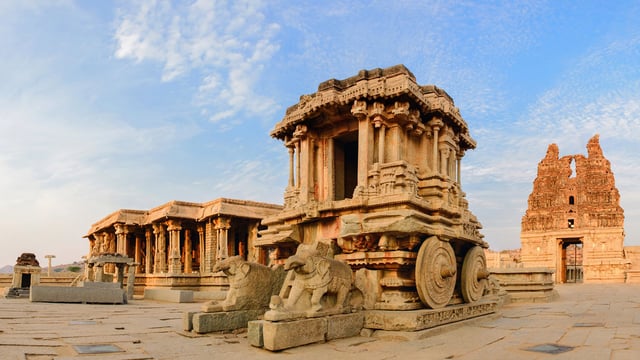
Mamallapuram, also known as Mahabalipuram, emerged as the premier maritime gateway, commercial emporium, and architectural showcase of the Imperial Pallava dynasty (c. 575–900 CE) during the post-Gupta and early medieval periods. Situated along the Coromandel Coast of the Bay of Bengal in modern-day Tamil Nadu, the site transitioned from an early proto-historic fishing hamlet into a highly planned port city. It served as the naval base and maritime counterpart to the inland administrative capital of Kanchipuram.
Chronological Core Shifts
- Sangam Foundations: Mentioned implicitly in early classical Tamil poetry, such as the Perumpanarrupadai, as a busy littoral trading post named Nirppeyarrun.
- The Pallava Gateway: Strategically developed by Narasimhavarman I (r. c. 630–668 CE), who assumed the title Mahamalla (The Great Wrestler), giving the port city its permanent historical name.
- Geopolitical Flashpoint: The city functioned as a vital center of power throughout the long Pallava-Chalukya conflict, serving as a heavily fortified naval assembly point for defensive operations and overseas expeditions.
Urban Topography and Maritime Infrastructure
Early medieval Mamallapuram was structured as a dual-purpose urban complex, integrating a highly active commercial port with a sacred monumental landscape.
Port Infrastructure and Navigation
- The Natural Harbor: The site utilized natural granite boulders and lagoons to shelter merchant vessels and the royal navy from the seasonal monsoons of the Bay of Bengal.
- Beacon System: The highest point of the rock citadel (atop the Olakkannesvara Temple) featured an early open-fire stone beacon system that served as a lighthouse to guide international vessels navigating the Coromandel Coast.
- Hydraulic Engineering: The city maintained an advanced network of rock-cut water cisterns and structural brick channels to harvest rainwater, ensuring a clean water supply for the transient merchant population and garrisoned troops.
Trans-Oceanic Commercial Networks
Mamallapuram was the primary launchpad for South Indian maritime trade and cultural expansion into Southeast Asia (Suvarnabhumi). Under the Pallavas, the port maintained direct trade links with Sri Lanka, the Sailendra Dynasty of Indonesia, the Champa Kingdom of Vietnam, and the Tang Dynasty of China. The city exported high-grade iron weaponry, cotton textiles (Kalinga cloth), and spices in exchange for Chinese silk, porcelain, and aromatic resins.
The Mamalla Style: Monolithic and Rock-Cut Architecture
Mamallapuram represents the physical transition of South Indian temple architecture from temporary structures to permanent stone monuments, a phase driven by Narasimhavarman I and known as the Mamalla Style.
The Pancha Pandava Rathas
The architectural hallmark of the site is the group of five monolithic, free-standing shrines carved directly out of single granite boulders. These shrines resemble stone models of ceremonial chariots, serving as prototypes for later classical Dravidian design.
| Ratha Name | Structural and Architectural Design Features | Iconographical/Deity Affiliation |
| Dharmaraja Ratha | The largest structure; a multi-tiered, pyramidal square Vimana (tower) that acted as the design archetype for the classic Dravidian temple style. It features early iconographic relief carvings of Narasimhavarman I. | Dedicated to Shiva / Harihara |
| Arjuna Ratha | A refined, two-tiered square shrine sharing a common platform with the Draupadi Ratha; decorated with reliefs of couples and deities. | Dedicated to Shiva |
| Bhima Ratha | An oblong, two-storied structure featuring a distinctive wagon-vaulted (Sala-type) roof design, intended for a reclining deity. | Dedicated to Vishnu (Anantasayana) |
| Sahadeva Ratha | Exhibits an apsidal or horseshoe-shaped layout, commonly referred to as Gajaprishta (elephant-backed) architecture. | Dedicated to Indra / Kartikeya |
| Draupadi Ratha | The smallest ratha; designed as a simple square structure mimicking a rural mud hut with a thatched-roof style. | Dedicated to Durga |
The Great Open-Air Bas-Reliefs
Mamallapuram houses the world’s largest open-air rock sculptures, executed on massive monolithic granite boulders with natural central fissures.
- The Descent of the Ganges: This interpretation views the relief as depicting Sage Bhagiratha performing rigorous penance to bring the celestial river Ganges down to Earth to purify the ashes of his ancestors. The central natural fissure in the rock was engineered to channel water from a reservoir above, mimicking the flowing river.
- Arjuna’s Penance: An alternative mythological interpretation views the relief as portraying Arjuna performing ascetics to obtain the powerful Pasupatastra weapon from Lord Shiva to aid the Pandavas in the Mahabharata war.
- Iconographic Details: The relief contains over a hundred lifelike, anatomically precise carvings of divinities, semi-divine beings (Nagas, Gandharvas), ascetics, and wild animals, including a family of life-sized elephants and a fasting cat.
The Transition to Structural Dressed-Stone Masonry
The final phase of Pallava architectural development at Mamallapuram saw a shift from rock-cut excavation to structural buildings made of dressed stone blocks, a style championed by Narasimhavarman II (Rajasimha) (r. c. 700–728 CE).
The Shore Temple
Positioned directly on the edge of the Bay of Bengal, the Shore Temple is one of the earliest free-standing structural stone temples in South India.
- Architectural Layout: Built using dressed blocks of local granite, the complex features a unique layout containing three separate shrines. Two shrines are dedicated to Shiva (facing east and west to capture the sunrise and sunset), while an intervening shrine houses a rock-cut image of a reclining Vishnu (Anantasayana).
- Engineering Resilience: The temple was engineered to withstand coastal erosion and salt-air weathering through the use of dense granite foundations and protective stone walls (Prakaras) that deflected the impact of the surf.
Administrative Machinery and Corporate Assemblies
The civic and commercial administration of Mamallapuram operated under a specialized early medieval legal framework tailored for international trade hubs.
The Nagaram Assembly
Unlike inland agrarian villages governed by a Sabha, the civic and commercial life of Mamallapuram was managed by the Nagaram—a corporate assembly composed entirely of elite merchants, traders, master artisans, and ship owners. The Nagaram enjoyed substantial administrative autonomy. It was responsible for regulating port marketplaces, fixing uniform weights and measures, collecting harbor tariffs, and maintaining municipal infrastructure without direct day-to-day royal interference.
Royal Custom Levies (Sunkan)
The Pallava central administration deployed specialized customs officials (Adhikaris) to the port to collect state tariffs (Sunkan) on imports and exports. The revenue gathered at Mamallapuram funded the empire’s permanent standing army and the naval fleet required for Indian Ocean campaigns.
Fact-Dense Trivia for UPSC Prelims
The Sri Lankan Naval Expedition
Narasimhavarman I assembled a massive naval armada at Mamallapuram to launch a successful overseas military campaign to Sri Lanka. The fleet invaded the island kingdom, defeated the usurper Hatthadatha, and successfully reinstated the exiled Sinhalese prince Manavarman to the throne of Anuradhapura, an event recorded in the chronicle Mahavamsa.
The “Seven Pagodas” Tradition
European maritime travelers, including Marco Polo, referred to Mamallapuram as the “Seven Pagodas.” This designation stemmed from an old sailors’ tradition that the Shore Temple was merely the last remaining monument of a series of seven structural stone temples, the other six having been submerged by the rising sea level. This narrative received partial archaeological validation during the 2004 Tsunami, when receding waters briefly exposed submerged structural foundations and carved granite blocks just off the coast.
Mahishasuramardini Cave Relief
Located within the rock citadel, this cave temple houses a highly celebrated high-relief sculptural panel depicting the goddess Durga riding her lion and battling the buffalo-headed demon Mahishasura. It is considered an artistic masterpiece for its dynamic portrayal of movement, tension, and psychological contrast.
Absence of Domestic Gold Mints
Despite its role as a major hub for international maritime trade, the Pallava administration at Mamallapuram did not issue a domestic gold currency. Local market transactions relied on copper and silver coins bearing the emblem of a bull or a two-masted ship, while high-value international trade was settled through a barter system or the exchange of imported Roman and Byzantine gold coins.
Last Modified: June 15, 2026