
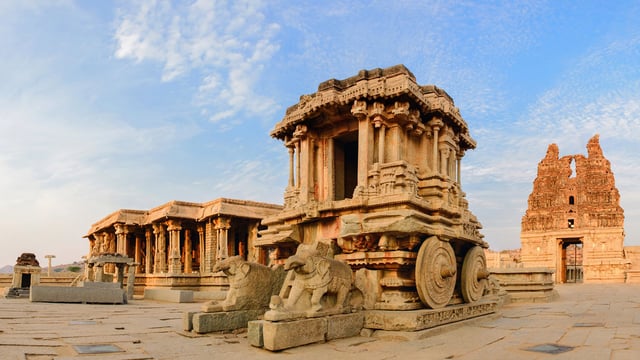
The Nagara style of temple architecture emerged during the late Gupta period (5th century AD) in Northern India and achieved its classical form by 1000 AD. It co-existed with and influenced contemporary developments in society, economy, art, and literature. This architectural style is geographically distributed across Northern, Western, Central, and Eastern India, bounded by the Himalayas in the north and the Vindhya range in the south, though its stylistic elements extended into parts of the Deccan.
Chronological Phases of Development
- Early Phase (5th to 6th Century AD): Characterized by flat-roofed, single-cell shrines with shallow porches, transitioning into low pyramidal structures (e.g., Dashavatara Temple at Deogarh, Parvati Temple at Nachna Kuthara).
- Formative Phase (7th to 8th Century AD): Introduction of the curvilinear shikhara and the development of a distinct cruciform ground plan (e.g., early temples at Aihole and Osian).
- Mature Phase (9th to 10th Century AD): Splendid development of regional schools with complex multi-layered shikharas, elaborate mandapas, and integrated sculptural programs (e.g., early Khajuraho group and early Bhubaneswar temples).
Architectural Blueprint and Structural Components
The Nagara style is fundamentally defined by a square ground plan that is projected externally through various gradations, and a curvilinear tower that tapers inward toward a single point. Unlike Dravidian temples, Nagara temples generally lack elaborate gateways (gopurams) and enclosed boundary walls, and they do not mandatorily feature large water tanks within the complex.
Core Structural Elements
- Jagati: The raised stone platform or plinth upon which the entire temple structure is elevated.
- Adhisthana: The molded base of the temple resting directly on the jagati, supporting the walls.
- Garbhagriha (Sanctum Sanctorum): The innermost square chamber that houses the principal deity, typically dark and unadorned to focus spiritual attention.
- Mandapa: The pillared assembly hall preceding the garbhagriha, used for congregational prayers, dances, and rituals. Larger temples feature Ardha-mandapa (entrance porch) and Maha-mandapa (main hall).
- Shikhara: The monumental tower rising over the garbhagriha. It curves inward gently and is topped by a large fluted stone disk called an Amalaka, which supports the spherical Kalasha (finial).
- Antarala: The narrow vestibule or passage connecting the mandapa to the garbhagriha.
Variations in Shikhara Styles
| Shikhara Type | Structural Characteristics | Prominent Historical Examples |
| Latina / Rekha-Prasada | Simple, single curvilinear tower with a square base and walls that curve inward toward the top. | Dashavatara Temple (Deogarh), early Bhubaneswar temples. |
| Phamsana | Broader base and lower height than Latina; composed of multiple horizontal slabs rising in a straight pyramidal slope. | Early Mandapas of Central Indian temples, Jagmohan of Konark (later period). |
| Valabhi | Rectangular base with a barrel-vaulted or wagon-vaulted roof, derived from ancient wooden chaitya halls. | Teli ka Mandir (Gwalior), Vaital Deula (Bhubaneswar). |
| Shekhari | A central Latina shikhara flanked or buttressed by miniature secondary towers (urushringas) of the same shape. | Kandariya Mahadeva Temple (Khajuraho). |
| Bhumija | Miniature shikharas arranged in horizontal and vertical rows, creating a grid-like pattern on the main tower faces. | Udayeshwara Temple (Udaipur, Madhya Pradesh). |
Regional Schools of Nagara Architecture (Up to 1000 AD)
Central Indian School (Bundelkhand and Malwa)
Developed under the patronage of the Gupta, Gurjara-Pratihara, and Chandela dynasties. These temples are characterized by an elongated jagati, elaborate panchayatana plans (one main shrine surrounded by four subsidiary shrines), and highly erotic and secular sculptural themes on outer walls.
- Key Monuments: Lakshmana Temple (954 AD) and Vishvanatha Temple (1002 AD) at Khajuraho; Sun Temple at Osian.
Odisha School (Kalinga)
The Kalinga sub-style classifies temple components into the Deula (shikhara/sanctum) and Jagamohana (assembly hall). The exterior walls are lavishly carved with intricate geometric, floral, and human figurines, while the interiors are strictly plain.
- Key Monuments: Parashuramesvara Temple (7th century AD), Muktesvara Temple (c. 950 AD)—often hailed as the “gem of Odishan architecture” for its exquisite torana (gateway)—and Lingaraja Temple (begun late 10th century AD) in Bhubaneswar.
Solanki School (Western Indian School)
Patronized by the Solanki (Chaulukya) rulers of Gujarat and Rajasthan. This style is renowned for its use of soft white marble, step-tank (kund) integrations, and lavishly carved pillars with dynamic brackets.
- Key Monuments: Sun Temple at Modhera (1026 AD, foundations laid earlier), and early structures at Mount Abu (Vimal Vasahi Temple, dedicated 1031 AD).
Socio-Economic Foundations of Temple Construction
The construction of Nagara temples up to 1000 AD was not merely a religious activity but a core driver of the socio-economic order of Northern India.
Agrarian Economy and Land Grants
- Feudal Economy: Temples were primary beneficiaries of the Agrahara and Devadana systems—royal land grants exempted from state taxes. The Prabandha literature records that temples acted as corporate landholders, managing irrigation projects, collecting agricultural surpluses, and redistributing wealth.
- Resource Mobilization: Temples functioned as institutional banks. They advanced loans to village assemblies (Sabhas or Mahajanas), traders, and cultivators at standardized interest rates, anchoring the agrarian economy during periods of political fragmentation.
Urbanization and Trade Guilds (Shrenis)
- Guild Patronage: Inscriptions from Sanchi, Gwalior, and Indore reveal that powerful merchant and artisan guilds—such as the Tailika Shreni (oil millers) and Vankara Shreni (weavers)—financed major structural elements of Nagara temples.
- Employment Hubs: Temple construction sites created long-term urban settlements, employing generations of Sutradharas (architects), Shilpins (sculptors), stone-cutters, metallurgists, and manual laborers, driving local market economies.
Social Stratification and Integration
- Legitimization of Royalty: Emerging regional dynasties (Chandelas, Pratiharas, Palas) utilized massive temple projects to project cosmic authority and legitimize their political sovereignty over newly conquered territories.
- Caste and Devotional Access: The spatial layout of the Nagara temple reflected the prevailing social hierarchy. While upper castes had access to the mandapa and areas near the garbhagriha, lower socio-economic groups were often restricted to peripheral viewing from the jagati, reinforcing caste stratifications even as the Bhakti movement began to encourage spiritual inclusivity.
Artistic and Sculptural Framework
Sculpture in the Nagara style was structurally integrated into the architectural surface, serving iconographic, narrative, and decorative functions.
Iconographic Themes and Spatial Placement
- River Goddesses: Ganga (standing on her vahana, the Makara) and Yamuna (standing on the Kurma) are universally carved at the base of the garbhagriha doorjambs, symbolizing purification before entry.
- Dikapalas: The guardians of the eight cardinal directions are systematically placed in niches on the exterior temple walls (bhadra and karna projections) to protect the sacred space.
- Mithuna Figures: Erotic pairs, Apsaras (celestial nymphs), and Surasundaris are prominently featured on the exterior walls, symbolizing fertility, auspiciousness, and the transition from the material world (samsara) to the spiritual realm within.
Evolution of Sculptural Mediums
The art moved away from the soft sandstone of the early Gupta period to harder materials like chlorite and schist in Odisha, and local granite and sandstone in Central India. The high-relief carvings became deeply undercut by the 10th century, creating dramatic contrasts of light and shadow on temple facades.
Literature and Scientific Canonization
The expansion of Nagara architecture was guided by a parallel codification of architectural science and aesthetic theory in Sanskrit literature.
Vastushastra Texts and Canonical Literature
- Samarangana Sutradhara: Attributed to King Bhoja of Dhara (early 11th century, consolidating 10th-century traditions), this text devotes extensive chapters to the selection of soil, cutting of stone, layout of the Vastu Purusha Mandala, and classification of Nagara temple types.
- Mayamata and Manasara: Early architectural treatises that fixed the proportions of columns, bases, and shikharas.
- Agni Purana and Matsya Purana: Contain specific sections outlining the iconographic measurements (Talamana) required for sculpting deities and building multi-storeyed shrines.
Mathematical and Engineering Applications
- Vastu Purusha Mandala: The metaphysical ground plan based on a grid of squares (typically 8 × 8 = 64 or 9 × 9 = 81). It combined astronomical alignment with sacred geometry, ensuring that the temple axis was precisely aligned with the cardinal directions using the Gnomon (shadow-stick) method.
- Corbelling Technique: Nagara architects did not use the true arch or dome. Instead, they relied on the Trabeate system and horizontal corbelling, where stone slabs were layered overlappingly inward until they closed at the apex under the heavy weight of the Amalaka. This required precise calculation of load-bearing capacities and stone counter-weighting.
- Metallurgy: Iron dowels and clamps were increasingly used by the 10th century AD to bind massive stone blocks together without mortar, as seen in the structural engineering of early Odishan temples.
Historical Trivia for Civil Services Evaluation
- The Teli ka Mandir Anomaly: Located in Gwalior Fort (8th century AD), this temple features a Nagara-style ground plan and decorative scheme but is topped by a Dravidian-influenced barrel-vaulted Valabhi shikhara, showcasing early structural synthesis.
- The Panchayatana Layout: The classic five-shrine layout mimics the cosmic Mount Meru. The Lakshmana Temple at Khajuraho is one of the best-preserved early examples where all four corner shrines remain fully intact on the main platform.
- The Torana of Muktesvara: The freestanding, semicircular stone archway at the Muktesvara Temple in Bhubaneswar exhibits strong Hellenistic and Buddhist decorative influences, adapted into classical Hindu temple architecture by the late 10th century AD.