
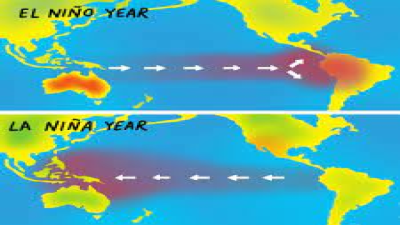
The El Niño/La Niña–Southern Oscillation (ENSO) is a complex climatic phenomenon that exerts a significant influence on weather patterns and environmental conditions around the world. ENSO refers to the cyclic variations in sea surface temperatures and atmospheric pressure in the equatorial Pacific Ocean, which lead to distinct phases known as El Niño and La Niña.
Understanding ENSO and Its Phases
ENSO is a natural climate phenomenon driven by the interaction between the ocean and the atmosphere in the tropical Pacific Ocean. It primarily involves two phases: El Niño and La Niña. During El Niño, warmer-than-average sea surface temperatures develop in the central and eastern Pacific, disrupting normal atmospheric circulation patterns. Conversely, during La Niña, cooler-than-average sea surface temperatures prevail, leading to different atmospheric effects.
Impacts on Weather Patterns
- Temperature and Precipitation Patterns: ENSO significantly influences global temperature and precipitation patterns. During El Niño, regions like Australia often experience droughts due to reduced rainfall, while parts of South America may face heavy rains and flooding. In contrast, La Niña can bring wetter-than-normal conditions to Australia and drier conditions to South America.
- Tropical Cyclones and Hurricanes: The intensity and frequency of tropical cyclones and hurricanes can be affected by ENSO. El Niño tends to suppress hurricane activity in the Atlantic Ocean, while La Niña can enhance it. For example, the strong El Niño in 2015 contributed to a relatively quiet Atlantic hurricane season.
Ecosystem and Environmental Impact
- Marine Ecosystems: ENSO’s temperature variations in the Pacific Ocean can disrupt marine ecosystems. Coral bleaching events, which result from elevated sea temperatures, can harm coral reefs, impacting biodiversity and fisheries.
- Fisheries: ENSO-related temperature changes influence fish migration patterns and availability. In the eastern Pacific, El Niño can lead to reduced fish populations, while La Niña can enhance fishing conditions.
Agriculture and Food Security
- Crop Yields: ENSO’s impacts on precipitation can affect crop yields in various parts of the world. Droughts during El Niño can lead to crop failures, affecting food production and prices. Conversely, La Niña-induced excessive rainfall can also damage crops.
- Food Prices: Fluctuations in crop yields due to ENSO can influence global food prices, potentially leading to food insecurity, especially in vulnerable regions.
Economic and Societal Ramifications
- Water Resources: ENSO-related droughts can strain water resources, affecting hydropower generation, irrigation, and drinking water availability.
- Disaster Management: The extreme weather events associated with ENSO, such as floods and droughts, challenge disaster management and response systems in affected countries.
- Economic Sectors: Industries like agriculture, fisheries, energy, and insurance are directly impacted by ENSO-driven weather anomalies. For instance, the 1997-1998 El Niño caused an estimated $35 billion in global economic losses.
Examples of ENSO Impacts
| Impact | El Niño | La Niña |
| Temperature | Warmer-than-average conditions globally | Cooler-than-average conditions globally |
| Precipitation | Droughts in Australia; Flooding in South America | Increased rainfall in Australia; Drier conditions in South America |
| Cyclone Activity | Reduced Atlantic hurricanes; More Pacific typhoons | Enhanced Atlantic hurricane activity |
| Coral Reefs | Coral bleaching due to elevated sea temperatures | Potential recovery as cooler waters prevail |
| Fisheries | Reduced fish populations in eastern Pacific | Enhanced fishing conditions in eastern Pacific |
| Agriculture | Crop failures due to droughts | Excessive rainfall damaging crops |
| Water Resources | Reduced water availability for hydropower and irrigation | Improved water availability for hydropower and irrigation |
The El Niño/La Niña–Southern Oscillation is a compelling testament to the intricate interplay between the ocean and the atmosphere, with widespread consequences for the global climate system. Its impacts reach far beyond weather patterns, affecting ecosystems, agriculture, economies, and societies.
Last Modified: February 22, 2024