
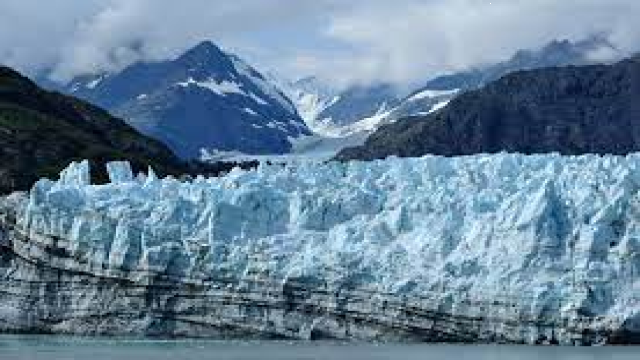
A Glacial Lake Outburst Flood (GLOF) refers to the sudden, catastrophic release of a massive volume of water from a glacial lake. As glaciers retreat due to global warming and climate change, they leave behind loose rock, sediment, and ice debris known as moraines. These moraines act as natural dams, trapping meltwater and forming proglacial or moraine-dammed lakes. The structural integrity of a moraine dam is inherently weak because it consists of unconsolidated boulders, gravel, sand, and an ice core. When this dam breaches or fails mechanically, thousands of cubic meters of water, heavy sediment, and large boulders cascade downslope with immense velocity, transforming a localized hydrological event into a major downstream disaster.
Key Triggering Mechanisms of GLOFs
- Avalanches and Rockfalls: A massive ice or rock avalanche plunging into a glacial lake generates displacement waves (seiches). These waves overtop and erode the unstable moraine dam, causing a rapid breach.
- Degradation of Internal Ice Core: The melting of dead ice cores trapped within the moraine matrix compromises its structural stability, leading to internal piping erosion and eventual collapse.
- Extreme Precipitation and Cloudbursts: Sudden heavy rainfall or cloudburst events rapidly increase the water level within the lake, causing overtopping and a subsequent runaway erosion of the dam structure.
- Cascading Disasters and Hydro-Meteorological Forcing: Earthquake-induced ground shaking can trigger sub-glacial or moraine failures, while rising ambient temperatures speed up glacier ablation (melting) rates, excessively filling the lakes beyond their maximum holding capacity.
Spatial and Geographical Distribution in India
In India, GLOF vulnerability is exclusively concentrated within the Indian Himalayan Region (IHR), which spans across the extra-peninsular mountain chain. The complex geology, seismic activity, and varying micro-climatic zones of the Himalayas create distinct pockets of high glacial lake density and vulnerability.
Classification of Himalayan Glacial Lakes by Position
- Moraine-Dammed Lakes: Formed when terminal or lateral moraines block meltwater. These represent the highest risk category due to the loose, unstable nature of the damming material.
- Supraglacial Lakes: Water bodies that accumulate on top of the glacier surface. They change dynamically over short durations and can drain quickly through internal glacial conduits.
- Ice-Dammed Lakes: Created when a moving glacier advances and blocks a main or tributary river valley. These are highly dynamic and prone to frequent periodic outbursts.
Vulnerability Distribution Across Himalayan States
| Himalayan Zone / Region | Vulnerability Level | Key Features and High-Risk Lakes |
| Sikkim & Eastern Himalaya | Critically High | Characterized by steep topography, high monsoon rainfall, and rapidly retreating glaciers. Critical lakes include South Lhonak Lake and Gurudongmar Lake. |
| Uttarakhand & Himachal Pradesh (Central/Western) | High | Highly susceptible to cloudburst-induced GLOFs and seismically active fault lines. Key risk zones include the Alaknanda, Bhagirathi, and Sutlej basins. |
| Jammu & Kashmir and Ladakh | Moderate to High | Features massive valley glaciers and cold desert climates. Risks are driven by sudden warming phases and high-altitude cloudbursts in the Indus and Shyok catchments. |
Notable GLOF Case Studies and Historical Triggers
South Lhonak Lake Disaster, Sikkim (October 2023)
A cloudburst combined with a suspected heavy rock/ice avalanche triggered a major GLOF at South Lhonak Lake in North Sikkim. The sudden surge of water severely damaged the 1,200 MW Teesta-III hydro-electric project at Chungthang and caused widespread destruction downstream along the Teesta River basin, resulting in significant loss of life and critical infrastructure failure.
Kedarnath Disaster, Uttarakhand (June 2013)
Prolonged multi-day heavy rainfall and a massive cloudburst led to the rapid breaching of the moraine-dammed Chorabari Lake, situated upstream of the holy town of Kedarnath. The resulting debris-laden flash flood wiped out civilian settlements, roads, and bridges in the Mandakini Valley.
Chamoli Flash Flood, Uttarakhand (February 2021)
A massive rock and ice avalanche from the Ronti peak collapsed into the Rishiganga valley. This generated a cascading flash flood event that obliterated the Rishiganga and Tapovan-Vishnugad hydropower projects, emphasizing how complex mountain hazards interact in the higher Himalayas.
Environmental and Anthropogenic Causal Factors
Climate Change and Accelerated Glacier Ablation
Rising global surface temperatures are causing rapid mass loss across Himalayan glaciers. The thinning of glaciers accelerates the growth of proglacial lakes, expanding their surface area and water volume, which places immense hydrostatic pressure on natural moraine walls.
Seismotectonic Vulnerability of the IHR
The Himalayas are an active collision mountain belt falling predominantly under Seismic Zones IV and V of India. Frequent tectonic tremors or earthquakes loosen slope materials, trigger rockfalls, and cause immediate physical fractures in moraine dams.
Encroachment of Infrastructure and Unregulated Tourism
The expansion of infrastructure—such as run-of-the-river hydroelectric projects, highways, and tourist resorts—in high-vulnerability eco-fragile zones increases the exposure of assets and human life to GLOF risks. Deforestation along valley slopes further reduces natural slope cohesion.
Disaster Risk Management and Mitigation Framework
India uses a multi-tiered structural and non-structural approach to mitigate GLOF risks, guided by scientific research institutions and national administrative policies.
Administrative and Institutional Framework
- National Disaster Management Authority (NDMA): Formulated the Comprehensive National Guidelines for Management of Glacial Lake Outburst Floods (GLOFs), establishing structural protocols, risk-mapping standards, and community training programs.
- National Centre for Polar and Ocean Research (NCPOR) & Wadia Institute of Himalayan Geology (WIHG): Nodal research institutes tracking glacier health, lake volume changes, and long-term climate dynamics in the region.
- Central Water Commission (CWC): Monitors downstream hydrological flows and issues flood forecasts based on early warning signals.
Structural and Engineering Interventions
- Controlled Siphoning and Pumping: Pumping out lake water using heavy-density polyethylene (HDPE) pipes to mechanically reduce the lake’s water level and lower the hydrostatic pressure on the moraine dam.
- Spillway Channels and Breaching: Excavating artificial open channels or spillways through the moraine barrier to let water drain out continuously and prevent dangerous overtopping.
- Geotechnical Slope Stabilization: Constructing retaining structures, wire-mesh gabions, and anchors along vulnerable lakeside slopes to prevent rockfalls and ice debris from plunging into the water.
Non-Structural and Technology-Driven Measures
- Satellite-Based Remote Sensing and Monitoring: Utilizing high-resolution optical and radar satellite data (such as RISAT and ISRO assets) to map hazardous lakes, create multitemporal inventories, and run simulation models.
- Early Warning Systems (EWS): Installing automated weather stations, water level sensors, and acoustic alarms in the upper catchments to transmit real-time data via satellite networks to downstream settlements.
- Hazard Zoning and Land-Use Planning: Restricting permanent infrastructure development within the designated GLOF run-out paths and low-lying river plains.
Trivia and Key Facts for UPSC Prelims
- The Third Pole: The Hindu Kush-Himalayan region contains the largest volume of ice outside the polar regions, making it highly sensitive to global temperature anomalies.
- Glacial Flour: The fine sediment transported during a GLOF event that gives downstream waters a milky appearance and significantly increases river siltation rates.
- Isostatic Rebound: The slow rise of land masses after the weight of ice sheets or glaciers is removed due to melting, altering local slope dynamics over geological timescales.
- Black Carbon Deposition: The settling of light-absorbing black carbon particles (from biomass burning and vehicular emissions) on Himalayan glaciers decreases surface albedo, speeding up glacier melt and the formation of supraglacial lakes.