
The Himalayas, often referred to as the “abode of snow,” are a majestic mountain range that spans across five countries: India, Nepal, Bhutan, China, and Pakistan. This awe-inspiring range is home to some of the world’s highest peaks, including Mount Everest and K2. Nestled within the Himalayas are numerous mountain passes, serving as crucial gateways for trade, travel, and exploration.
The Significance of Himalayan Passes
Himalayan passes play a vital role in connecting regions on either side of the mountain range. These high-altitude corridors facilitate trade, transportation, and cultural exchange between countries and communities. They have historically been used by traders, pilgrims, and adventurers, and today, they remain crucial for both local economies and international diplomacy.
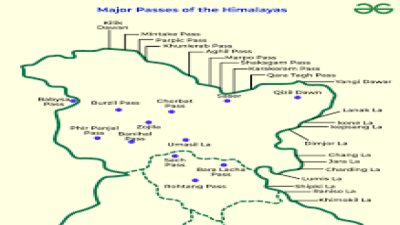
Major Himalayan Passes
| Pass Name | Elevation (Meters) | Location | Significance |
| Nathu La | 4,310 | India-China Border | Historic Silk Road trade route |
| Karakoram Pass | 5,540 | India-China Border | Ancient trade and pilgrimage route |
| Khardung La | 5,359 | India | World’s highest motorable pass |
| Lipulekh Pass | 5,334 | India-Nepal-China Border | Pilgrimage route to Kailash Mansarovar |
| Zoji La | 3,528 | India | Key link between Srinagar and Leh |
| Rohtang Pass | 3,979 | India | Access to Lahaul and Spiti Valleys |
| Throng La | 5,416 | Nepal | Vital part of Annapurna Circuit trek |
| Cho La | 5,420 | Nepal | Gateway to Gokyo Valley |
| Khunjerab Pass | 4,693 | Pakistan-China Border | Highest border crossing in the world |
| Niti Pass | 5,818 | India-China Border | Ancient trade route to Tibet |
| Shipki La | 4,590 | India-China Border | Trade route for Kinnaur and Tibet |
| Bomdila Pass | 2,530 | India | Connects Assam with Tibetan plateau |
| Jelep La | 4,267 | India-China Border | Part of the Old Silk Route |
Nathu La – The Silk Road Sentinel
- Elevation:4,310meters
- Location: India-China Border
- Nathu La, meaning “listening ears” in Tibetan, was a vital point on the ancient Silk Road, connecting Tibet with the Indian subcontinent. Today, it serves as an important trade route between India and China. Its strategic location makes it significant in the context of border relations between the two nations.
Khardung La – The World’s Highest Motorable Pass
- Elevation:5,359meters
- Location: India
- Khardung La, situated in the Ladakh region of India, holds the distinction of being the world’s highest motorable pass. It provides access to the Nubra Valley and is a popular destination for adventurers seeking the thrill of driving or biking at extreme altitudes.
Lipulekh Pass – Pilgrimage Route to Kailash Mansarovar
- Elevation:5,334meters
- Location: India-Nepal-China Border
- Lipulekh Pass is a sacred pilgrimage route leading to the holy Mount Kailash and Lake Mansarovar in Tibet. It is an integral part of the journey for Hindu and Buddhist pilgrims and holds great religious significance.
Rohtang Pass – Gateway to Lahaul and Spiti Valleys
- Elevation:3,979meters
- Location: India
- Rohtang Pass, located in Himachal Pradesh, serves as the gateway to the picturesque Lahaul and Spiti Valleys. It is a crucial link for transportation and tourism in the region, connecting the Kullu Valley to Lahaul.
Throng La – An Essential Trekking Point
- Elevation:5,416meters
- Location: Nepal
- Throng La is a high mountain pass on the Annapurna Circuit trek, one of the most famous trekking routes in Nepal. It offers stunning views of the Annapurna and Dhaulagiri mountain ranges and is a must-visit for trekkers and mountaineers.
Khunjerab Pass – The World’s Highest Border Crossing
- Elevation:4,693meters
- Location: Pakistan-China Border
- Khunjerab Pass is the highest paved international border crossing in the world, connecting Pakistan and China. It is a significant point for trade and tourism between the two nations.
Niti Pass – An Ancient Trade Route
- Elevation:5,818meters
- Location: India-China Border
- Niti Pass, situated on the border between India and Tibet, was historically used as a trade route to Tibet. It holds a unique position in history due to its role in facilitating trade and cultural exchange between India and Tibet.
Shipki La – A Trade Route to Tibet
- Elevation:4,590meters
- Location: India-China Border
- Shipki La is an essential trade route between the Kinnaur region of India and Tibet. It has been pivotal in promoting economic ties and cultural exchanges between the two regions.
Bomdila Pass – Gateway to the Tibetan Plateau
- Elevation:2,530meters
- Location: India
- Bomdila Pass, located in the Indian state of Arunachal Pradesh, connects the Assam Valley with the Tibetan plateau. It has been historically significant for trade and cultural interactions between the people of Assam and Tibet.
Jelep La – Part of the Old Silk Route
- Elevation:4,267meters
- Location: India-China Border
- Jelep La is another pass of historical importance, part of the Old Silk Route that connected India with Tibet and China. It has played a crucial role in trade and cultural exchange throughout history.
The major mountain passes of the Himalayas are not merely geographical features but vital connectors that link regions, cultures, and economies. They have witnessed centuries of trade, pilgrimage, and adventure, and continue to be of strategic importance in the modern era.
Last Modified: February 22, 2024