

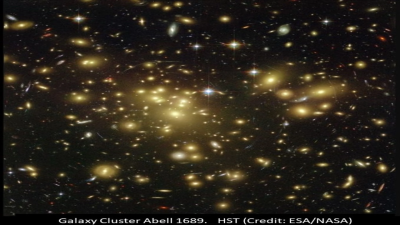
In the cosmic hierarchy, galaxies are rarely isolated. Driven by gravity, they organize into progressively larger structures, ranging from small groups to massive superclusters that form the “cosmic web.”
1. Groups of Galaxies
A galaxy group is the smallest organized collection of galaxies, typically containing fewer than 50 members bound together by gravity.
- Composition: Primarily consists of a few large galaxies surrounded by several dwarf galaxies.
- Scale: Usually spans a diameter of approximately 1 to 2 megaparsecs (Mpc).
- The Local Group: Our home group, containing the Milky Way, Andromeda, and Triangulum galaxies, along with roughly 50 dwarf satellite galaxies.
- Mass Distribution: Dark matter accounts for a significant portion of the group’s total mass, providing the gravitational cement to keep members from drifting apart.
2. Clusters of Galaxies
Clusters are much larger and more complex than groups, representing the largest gravitationally bound objects in the universe.
- Member Count: Contains hundreds to thousands of individual galaxies.
- Intracluster Medium (ICM): The space between galaxies in a cluster is filled with extremely hot, ionized gas (107 to 108 Kelvin) that emits X-rays. This gas often contains more “normal” matter than all the galaxies in the cluster combined.
- Classification:
- Regular Clusters: Symmetrical shapes with a high concentration of galaxies at the center (e.g., Coma Cluster).
- Irregular Clusters: Lacks a defined center and contains a higher proportion of spiral galaxies (e.g., Virgo Cluster).
- Virgo Cluster: The nearest large cluster to Earth, containing over 1,300 galaxies and forming the heart of the Local Supercluster.
3. Superclusters of Galaxies
Superclusters are massive collections of galaxy groups and clusters. They are among the largest known structures in the cosmos.
- Boundaries: Unlike groups and clusters, superclusters are often so large they are not yet fully gravitationally bound; they may be expanding with the universe.
- Laniakea Supercluster: Our home supercluster. It spans 500 million light-years and contains the mass of 100 quadrillion suns. The name “Laniakea” means “immense heaven” in Hawaiian.
- Saraswati Supercluster: A major discovery by Indian astronomers (IUCAA) in 2017. It is one of the largest known structures, located about 4 billion light-years away.
- Filaments and Voids: Superclusters reside along “filaments” of dark matter and gas, separated by “voids”—vast, nearly empty spaces containing very few galaxies.
4. Structural Comparison Table
| Feature | Galaxy Group | Galaxy Cluster | Galaxy Supercluster |
| Member Count | < 50 | 50 – 1,000+ | Multiple Clusters/Groups |
| Size (approx.) | 1–2 Mpc | 2–10 Mpc | 100+ Mpc |
| Gravitational Status | Fully Bound | Fully Bound | Partially/Not fully bound |
| Key Example | Local Group | Virgo Cluster | Laniakea Supercluster |
| Dominant Matter | Dark Matter | Dark Matter + Hot Gas | Dark Matter Filaments |
5. Important UPSC Facts & Trivia
- The Great Attractor: This is a gravitational anomaly located within the Laniakea Supercluster. It is a massive concentration of mass that is pulling the Milky Way and surrounding clusters toward it.
- Cosmic Web: On the largest scales, the universe looks like a web. Superclusters form the nodes or intersections, while filaments of gas and dark matter connect them, surrounding massive empty voids.
- Hubble’s Law and Clusters: While the universe is expanding, the galaxies within a group or cluster do not move away from each other because their local gravity is stronger than the expansion of space.
- Shapley Supercluster: The most massive concentration of matter in the nearby universe, exerting a significant gravitational pull on our entire Local Group.
The table below illustrates some Prominent Galaxy Clusters and Superclusters
| Name | Size (Light-years) | Number of Galaxies |
| Coma Cluster | 20 million | 1,000+ |
| Virgo Supercluster | 110 million | 10,000+ |
| Sloan Great Wall | 1.4 billion | N/A |
| Boötes Void | 330 million | N/A |
| The Great Wall | 500 million | N/A |