

Earthquakes are natural disasters that have both fascinated and terrified humanity for centuries. Understanding their occurrence and impact is crucial for preparedness and disaster management. One of the key aspects of earthquake analysis is locating the epicenter, the point on the Earth’s surface directly above the earthquake’s origin, known as the focus or hypocenter. Seismic waves play a pivotal role in this process, as they carry valuable information about an earthquake’s source and its characteristics.
The Nature of Seismic Waves
Seismic waves are waves of energy that travel through the Earth as a result of sudden energy release from an earthquake, volcanic activity, or other sources. These waves propagate in all directions from the earthquake’s focus, reaching the Earth’s surface and beyond. There are two main types of seismic waves: body waves and surface waves.
Body Waves: The P and S Waves
- Primary Waves (P Waves): P waves are the fastest seismic waves and are the first to arrive at seismograph stations after an earthquake. They are compressional waves, which means they cause particles in the Earth to move back and forth in the same direction as the wave is traveling. P waves can travel through both solid and liquid materials, making them the first to be detected even from the Earth’s core.
- Secondary Waves (S Waves): S waves are slower than P waves and arrive at seismograph stations after the P waves. Unlike P waves, S waves are shear waves, causing particles to move perpendicular to the wave’s direction of propagation. These waves cannot travel through liquids, which is why they disappear in the Earth’s outer core. The presence or absence of S waves at a seismograph station helps seismologists determine the nature of the Earth’s interior.
Surface Waves: The Love and Rayleigh Waves
- Love Waves: Love waves are a type of surface wave that travels along the Earth’s surface horizontally with a side-to-side motion. They are slower than both P and S waves but faster than Rayleigh waves. Love waves can cause significant damage to structures, and their characteristics provide valuable insights into the near-surface geology.
- Rayleigh Waves: Rayleigh waves are also surface waves that roll along the ground with an elliptical motion. They are slower than P, S, and Love waves, but they have the highest amplitude and can cause considerable shaking during an earthquake. Rayleigh waves are crucial in determining the magnitude and impact of an earthquake.
Triangulation: Pinpointing the Epicenter
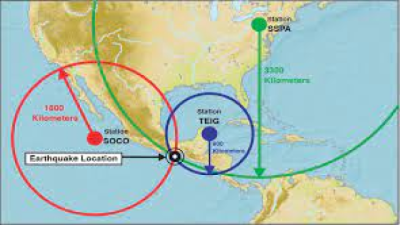
To determine the epicenter of an earthquake, seismologists rely on the concept of triangulation. When an earthquake occurs, the seismic waves radiate outward in all directions. Seismograph stations around the world record the arrival times of these waves. By analyzing the time differences between the arrival of P and S waves at different stations, seismologists can calculate the distance of the seismic waves from each station to the earthquake’s epicenter.
The Travel-Time Graph
Seismologists use the data collected from various seismograph stations to plot a travel-time graph. This graph represents the time taken for seismic waves to travel from the epicenter to each seismograph station. The distance is plotted on the horizontal axis, and the time is plotted on the vertical axis. Each seismic wave type (P and S waves) will have a distinct line on the graph.
Locating the Epicenter
To locate the epicenter, seismologists draw circles on the travel-time graph around each seismograph station. The radius of each circle represents the distance between the epicenter and the respective station. Since the epicenter is the common point of origin for all seismic waves, it lies at the intersection of these circles.
Example: Determining the Epicenter
Let’s consider a hypothetical scenario where an earthquake occurs, and seismograph stations in three different cities record the following P and S wave arrival times:
| Station | P Wave Arrival Time (seconds) | S Wave Arrival Time (seconds) |
| A | 10 | 30 |
| B | 20 | 55 |
| C | 8 | 24 |
Using this data, we can calculate the distance between the epicenter and each station using the formula:
Distance (in kilometers) = (Time of arrival * Speed of respective wave) / 2
Assuming the P wave speed is 6 km/s and the S wave speed is 3.5 km/s, the calculated distances are as follows:
| Station | Distance from Epicenter (in km) |
| A | 30 |
| B | 52.5 |
| C | 14 |
By plotting these distances on the travel-time graph and drawing circles around each station, the intersection point of these circles will give us the epicenter’s approximate location.
Seismic waves are indispensable tools in determining the epicenter of an earthquake. By analyzing the arrival times of these waves at different seismograph stations, seismologists can pinpoint the earthquake’s origin, allowing for better preparedness and understanding of seismic activity.
Last Modified: February 22, 2024