

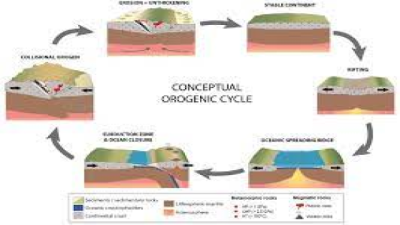
Orogeny, the process of mountain formation, has played a pivotal role in shaping the Earth’s landscape over millions of years. It involves complex geological processes driven by tectonic forces, such as plate collisions and subduction. Understanding the various stages of orogeny is crucial in comprehending the dynamic evolution of our planet.
Stage 1: Foreland Basin Formation
During the early stages of orogeny, as tectonic plates collide, one plate is pushed over the other. The overriding plate creates compressional forces, leading to the formation of a foreland basin on the other side of the orogenic belt. Foreland basins are sedimentary depocenters that accumulate sediments eroded from the uplifting mountains.
- Example: The evolution of the Swiss Alps and the adjacent Jura Mountains showcases a classic foreland basin system. The Alpine foreland basin, which includes Lake Geneva, formed as a response to the collision between the European and African plates.
Stage 2: Thrust Faulting and Folding
As the tectonic forces continue to act upon the colliding plates, the rocks in the orogenic belt undergo intense deformation, resulting in thrust faulting and folding. Thrust faults are low-angle reverse faults where older rocks are thrust over younger rocks.
- Example: The Himalayan mountain range provides an excellent example of thrust faulting and folding. The collision between the Indian and Eurasian plates caused intense compression, leading to the formation of the Himalayas and the Tibetan Plateau.
Stage 3: Metamorphism and Magmatism
During the middle stages of orogeny, high pressures and temperatures generated by the tectonic forces induce metamorphism of rocks. Regional metamorphism affects a vast area, leading to the development of new minerals and the recrystallization of existing ones. Additionally, the subduction of oceanic plates may trigger magmatism, resulting in volcanic activity and the formation of plutons.
- Example: The Andes mountain range is a prime example of metamorphism and magmatism. The subduction of the Nazca Plate beneath the South American Plate has led to the development of numerous volcanoes along the Andean volcanic arc.
Stage 4: Uplift and Erosion
As orogeny progresses, the mountains experience vertical uplift due to continued tectonic forces. However, simultaneously, weathering and erosion wear down the mountains, shaping their landscapes and forming sedimentary basins.
- Example: The Appalachian Mountains in North America exemplify the uplift and erosion stage of orogeny. Originally formed during the Paleozoic Era, the Appalachian Mountains have undergone significant erosion over millions of years, resulting in the relatively subdued landscape seen today.
Stage 5: Post-Orogeny Subsidence
After the peak of mountain-building activity, the orogenic belts may undergo subsidence due to the cooling and contraction of the Earth’s crust. This subsidence leads to the formation of sedimentary basins adjacent to the mountains.
- Example: The North Sea Basin in Europe is a classic post-orogeny subsidence basin. It formed as a result of the tectonic forces acting on the Caledonian orogeny during the Paleozoic Era.
Key Data Table
| Mountain Range | Orogeny Type | Maximum Elevation (meters) | Age of Orogeny (Million Years) |
| Himalayas | Collision | 8,848 | ~50 |
| Andes | Subduction | 6,961 | ~40 |
| Rocky Mountains | Compression | 4,399 | ~80 |
| Alps | Collision | 4,810 | ~65 |
| Appalachians | Collision | 2,037 | ~300 |
Orogeny is a complex and dynamic geological process that has significantly influenced the Earth’s topography throughout its history. Understanding the various stages of orogeny helps geologists interpret the formation and evolution of mountain ranges worldwide.
Last Modified: February 22, 2024