

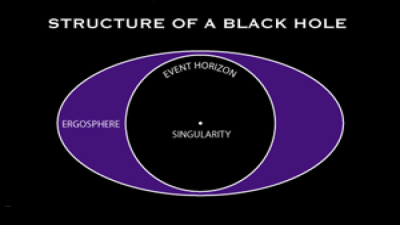
Black holes are some of the most enigmatic objects in the universe. They possess an extraordinary structure that defies conventional understanding.
Event Horizon
The Point of No Return At the heart of every black hole lies the event horizon, a boundary beyond which nothing, not even light, can escape. It is the point of no return, where the gravitational pull becomes so intense that not even the fastest particles can break free. The size of the event horizon, known as the Schwarzschild radius, is directly related to the mass of the black hole. For example, a black hole with the mass of our Sun would have an event horizon radius of approximately 3 kilometers.
Singularity
The Infinite Density Core Deep within the black hole exists the singularity, a region of infinite density and space-time curvature. According to general relativity, the singularity is a point of zero volume and infinite gravitational force. It defies our current understanding of physics and marks the breakdown of classical laws. At the singularity, the laws of physics, as we know them, cease to exist.
Accretion Disks
Feeding the Black Hole Accretion disks play a significant role in the structure and behavior of black holes. When matter falls into a black hole, it forms a disk-like structure around it, known as an accretion disk. The matter in the disk spirals inward due to gravitational forces, releasing an enormous amount of energy in the form of X-rays and other high-energy radiation. This process is responsible for the powerful emission observed in active galactic nuclei and quasars.
Theoretical Framework
General Relativity and Quantum Mechanics Understanding the structure of black holes requires a combination of general relativity, which governs the behavior of gravity on large scales, and quantum mechanics, which describes the behavior of matter and energy on the smallest scales. Unfortunately, a complete theory that unifies these two fundamental pillars of physics, known as a theory of quantum gravity, has yet to be discovered. However, various theoretical models, such as loop quantum gravity and string theory, offer insights into the nature of black holes at the intersection of these two realms.
The table described below illustrates important structural information about different types of� Black Holes.
| Type of Black Hole | Mass Range | Notable Features |
| Stellar Black Hole | A few to tens of solar masses | Event horizon, singularity, accretion disk |
| Intermediate-Mass Black Hole | A few hundred to several thousand solar masses | Event horizon, singularity, possible mergers |
| Supermassive Black Hole | Millions to billions of solar masses | Event horizon, singularity, accretion disk, active galactic nuclei |
Black holes continue to captivate the imagination of scientists and the public alike. Their structure, with event horizons and singularities, challenges our understanding of the universe and the laws that govern it.
Last Modified: February 22, 2024