

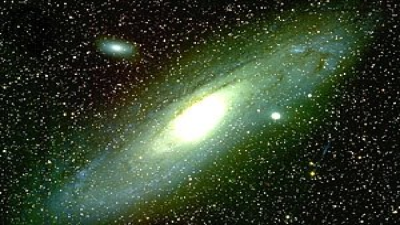
The Andromeda Galaxy, also known as Messier 31 or M31, is a celestial beauty that has captivated astronomers and stargazers alike for centuries. Situated a staggering 2.537 million light-years away from Earth, Andromeda is our closest galactic neighbor, forming a mesmerizing tapestry in the night sky.
A Stellar Journey Through Time and Space
The Andromeda Galaxy was first documented by the Persian astronomer Abd al-Rahman al-Sufi in the 10th century. However, it was not until the 20th century that Edwin Hubble’s observations revealed Andromeda as a separate galaxy, beyond the confines of our own Milky Way. This groundbreaking discovery expanded our understanding of the vastness of the universe and revolutionized the field of astronomy.
The Andromeda Galaxy at a Glance
Spanning an estimated 220,000 light-years, the Andromeda Galaxy is approximately 2.5 times larger than the Milky Way. It is a spiral galaxy with a prominent central bulge, surrounded by grand spiral arms that extend outward. With billions of stars, nebulae, and clusters, Andromeda hosts a diverse range of celestial objects, making it a captivating subject of study.
- Structure and Composition: The Andromeda Galaxy is composed of various components that contribute to its overall structure. The central bulge is a densely packed region consisting of older stars. Surrounding the bulge, the spiral arms wind their way through the galaxy, showcasing regions of active star formation. These spiral arms are adorned with young, hot, and massive blue stars, as well as stunning nebulae, where gas and dust give birth to new stars. Additionally, Andromeda possesses a vast halo of globular clusters, which are tightly bound groups of stars that orbit the galaxy.
- Cosmic Collision: The Fate of Andromeda and the Milky Way: One of the most captivating aspects of the Andromeda Galaxy is its impending collision course with our very own Milky Way. Recent research indicates that the two galaxies are hurtling towards each other at a speed of about 110 kilometers per second. While the collision is expected to occur in about 4 billion years, the resulting merger will create a new galaxy, often referred to as “Milkomeda.” This extraordinary event will reshape both galaxies, triggering star formation and potentially leading to the formation of a supermassive black hole.
- Observations and Discoveries: Scientists have conducted numerous observations and studies to unravel the secrets of the Andromeda Galaxy. Notably, the Hubble Space Telescope has played a vital role in capturing breathtaking images and gathering valuable data about Andromeda’s structure, stellar populations, and star-forming regions. Other ground-based telescopes and observatories have also contributed significant insights, revealing information about its rotation, dark matter distribution, and supermassive black hole at its center.
The table below illustrates key data on the Andromeda Galaxy
| Property | Value |
| Distance from Earth | 2.537 million light-years |
| Diameter | Approximately 220,000 light-years |
| Type | Spiral galaxy |
| Stellar Population | Mixture of young and old stars |
| Central Bulge | Dense region of older stars |
| Spiral Arms | Active regions of star formation |
| Globular Clusters | Vast halo of tightly bound star groups |
| Collision with Milky Way | Expected in approximately 4 billion years |
The Andromeda Galaxy stands as a mesmerizing testament to the infinite wonders of the cosmos. Its rich structure, diverse celestial objects, and impending collision with our Milky Way fuel our curiosity and drive scientific exploration.
Last Modified: February 22, 2024