

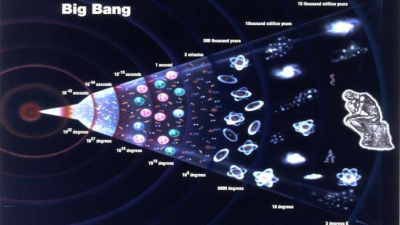
The study of the origin of the universe, known as Cosmogony, has transitioned from philosophical speculation to a rigorous branch of observational physics.
1. The Big Bang Theory (The Standard Model)
Proposed initially by Georges Lemaître in 1927 and later bolstered by Edwin Hubble’s observations, this is the most widely accepted scientific explanation for the universe’s origin.
- The Singularity: The theory posits that approximately 13.8 billion years ago, the universe began as a point of infinite density and temperature.
- Expansion, Not Explosion: The “Big Bang” was not an explosion in space, but an expansion of space itself.
- Key Evidence:
- Redshift of Galaxies: Hubble observed that distant galaxies move away from us at speeds proportional to their distance.
- Cosmic Microwave Background Radiation (CMBR): Discovered by Penzias and Wilson in 1964, this “afterglow” is the thermal remains of the Big Bang.
- Abundance of Light Elements: The observed ratios of Hydrogen and Helium in the universe match the predictions of Big Bang Nucleosynthesis.
2. Steady State Theory
Proposed by Sir Fred Hoyle, Hermann Bondi, and Thomas Gold in 1948, this theory was the primary rival to the Big Bang for decades.
- Core Premise: The universe has no beginning and no end. It looks the same at all times and at all points (Perfect Cosmological Principle).
- Continuous Creation: To account for the observed expansion of the universe while maintaining a constant density, the theory proposed that matter is continuously created in the empty spaces between galaxies.
- Obsolescence: The discovery of the CMBR and the fact that galaxies in the distant past (observed at high redshifts) look different from local galaxies led to the rejection of this model.
3. Pulsating (Oscillating) Universe Theory
This model suggests a cyclic universe that undergoes an infinite series of expansions and contractions.
- Mechanism: The universe expands from a Big Bang until gravitational attraction halts the expansion, leading to a “Big Crunch.” Following the collapse, a new Big Bang occurs (the “Big Bounce”).
- Current Status: Most modern observations, particularly the discovery of Accelerated Expansion driven by Dark Energy, suggest that the universe lacks sufficient gravity to trigger a collapse, making this theory less likely under current physics.
4. The Inflationary Theory
Developed by Alan Guth in the 1980s, this is an extension of the Big Bang Theory rather than a replacement.
- The Horizon Problem: Standard Big Bang theory couldn’t explain why widely separated regions of the universe have the same temperature.
- Exponential Expansion: Inflation proposes that between 10-36 and 10-32 seconds after the Big Bang, the universe expanded faster than the speed of light.
- Result: This rapid stretching smoothed out any irregularities, explaining the uniformity and “flatness” of the observable universe.
Comparison of Major Cosmological Theories
| Theory | Proponent | Primary Concept | Status |
| Big Bang | Georges Lemaître | Origin from a hot, dense singularity. | Widely Accepted |
| Steady State | Fred Hoyle | Eternal universe with continuous matter creation. | Disproven |
| Pulsating | Various | Cycle of Big Bang and Big Crunch. | Unlikely |
| Inflationary | Alan Guth | Brief period of super-fast expansion. | Accepted Add-on |
5. Modern Emerging Concepts
- Multiverse Theory: Suggests our universe is just one of many “bubbles” in a larger inflationary vacuum.
- String Theory Landscape: Proposes the universe might have originated from the interactions of multidimensional “branes.”
- Holographic Principle: A theoretical framework suggesting that the entire universe can be seen as two-dimensional information on a cosmological horizon.
UPSC Facts and Trivia
- The Term “Big Bang”: It was actually coined by Fred Hoyle (a critic of the theory) during a BBC radio broadcast as a way to mock the idea.
- Hubble Constant (H0): The unit of measurement used to describe the expansion rate of the universe.
- Lambda-CDM Model: The current “concordance model” of the Big Bang, where “Lambda” refers to the Cosmological Constant (Dark Energy) and “CDM” stands for Cold Dark Matter.
- Nobel Prize Connection: The discovery of the accelerating expansion of the universe (proving Dark Energy) won the Nobel Prize in Physics in 2011.