

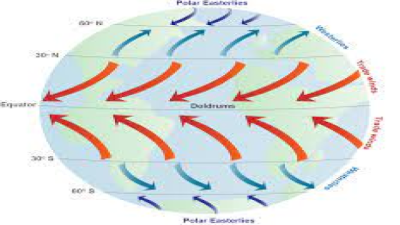
The Coriolis force is a critical phenomenon in the Earth’s dynamics, influencing various natural processes, including ocean currents. This force, resulting from the Earth’s rotation, has a profound impact on the direction and behavior of ocean currents across the globe.
Understanding the Coriolis Force
The Coriolis force is an apparent deflection experienced by moving objects, including air masses and ocean currents, due to the Earth’s rotation. As the Earth spins on its axis, objects in motion are subject to a deflection to the right in the Northern Hemisphere and to the left in the Southern Hemisphere. This effect is caused by the conservation of angular momentum as the Earth rotates, and it becomes more pronounced at higher latitudes.
The Coriolis Effect on Ocean Currents
Ocean currents are vast, continuous movements of seawater that play a crucial role in redistributing heat, nutrients, and energy around the planet. The Coriolis force significantly influences the direction of these currents, leading to the formation of distinct gyres in each hemisphere.
Gyres in the Northern Hemisphere
In the Northern Hemisphere, the Coriolis force causes ocean currents to be deflected to the right. As a result, we observe the formation of five major gyres:
- North Atlantic Gyre
- South Atlantic Gyre
- North Pacific Gyre
- South Pacific Gyre
- Indian Ocean Gyre
These gyres are large, circular systems of rotating currents that cover vast areas of the ocean and play a vital role in global climate patterns.
Gyres in the Southern Hemisphere
In the Southern Hemisphere, the Coriolis force leads to ocean currents being deflected to the left. The major gyres in this hemisphere include:
- South Atlantic Gyre
- South Pacific Gyre
- Indian Ocean Gyre
Notably, the Antarctic Circumpolar Current (ACC) is the world’s largest and most influential ocean current, encircling Antarctica. It is driven by the combined effects of the Coriolis force, wind patterns, and the geography of the Antarctic continent.
Effect on Ocean Current Patterns
The Coriolis force contributes to the establishment of specific ocean current patterns, such as western boundary currents and eastern boundary currents.
- Western Boundary Currents
Western boundary currents are fast, narrow, and deep currents that flow along the western edges of ocean basins. These currents are intensified by the Coriolis force, leading to their swift movement. Examples of western boundary currents include the Gulf Stream in the North Atlantic Ocean and the Kuroshio Current in the North Pacific Ocean.
- Eastern Boundary Currents
In contrast, eastern boundary currents flow along the eastern margins of ocean basins. Due to the Coriolis force, these currents are slow and broad, carrying cold water from higher latitudes towards the equator. The California Current in the North Pacific Ocean and the Canary Current in the North Atlantic Ocean are examples of eastern boundary currents.
Key Data: Major Ocean Gyres
| Hemisphere | Gyre | Ocean | Area (Million km²) |
| Northern | North Atlantic Gyre | Atlantic Ocean | 75.8 |
| Northern | North Pacific Gyre | Pacific Ocean | 61.2 |
| Northern | Indian Ocean Gyre | Indian Ocean | 25.6 |
| Southern | South Atlantic Gyre | Atlantic Ocean | 20.3 |
| Southern | South Pacific Gyre | Pacific Ocean | 23.5 |
| Southern | Indian Ocean Gyre | Indian Ocean | 17.7 |
The Coriolis force is a fundamental factor influencing the behavior of ocean currents worldwide. By causing deflection to the right in the Northern Hemisphere and to the left in the Southern Hemisphere, this force shapes the formation of ocean gyres and contributes to the establishment of western and eastern boundary currents.
Last Modified: February 22, 2024