

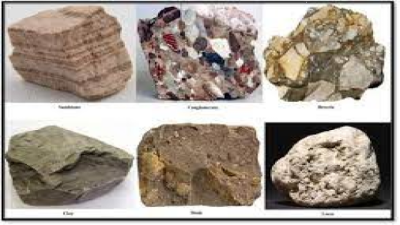
Sedimentary rocks are a fascinating geological formation that provides crucial insights into Earth’s history and processes. These rocks are created through the accumulation and solidification of sediment over time, often occurring in layers. They hold clues to ancient environments, climate changes, and the evolution of life on our planet.
Types of Sedimentary Rocks
Sedimentary rocks can be broadly categorized into three main types: clastic, chemical, and organic.
Clastic Sedimentary Rocks
Clastic sedimentary rocks are formed from the accumulation of mineral and rock fragments, known as clasts. These clasts are often transported by wind, water, or ice before being deposited and compacted. The size of the clasts determines the rock’s classification, with examples including:
- Conglomerate: Composed of rounded pebbles and gravel, often cemented by finer materials.
- Sandstone: Made up of sand-sized grains that are compacted and cemented together.
- Shale: Comprising fine-grained particles like clay and silt, compacted into thin layers.
Chemical Sedimentary Rocks
Chemical sedimentary rocks form when minerals precipitate out of a solution, often due to evaporation. These rocks are often found in areas with high evaporation rates, such as deserts or salt flats. Notable examples include:
- Limestone: Composed primarily of calcium carbonate, often formed from the remains of marine organisms like coral.
- Halite (Rock Salt): Consisting of sodium chloride crystals, typically formed in evaporative basins.
- Chert: Made up of microcrystalline quartz, often originating from the remains of microscopic marine organisms.
Organic Sedimentary Rocks
Organic sedimentary rocks are derived from the accumulation and compression of organic materials. These rocks often have a high carbon content and are associated with environments like swamps, bogs, and shallow seas. Key examples are:
- Coal: Formed from the remains of plant material subjected to heat and pressure over millions of years.
- Oil Shale: Rich in organic matter, containing kerogen that can be converted into oil through heating.
Sources of Sedimentary Rocks
Sedimentary rocks originate from various sources, reflecting the diverse processes that contribute to their formation.
- Weathering and Erosion: The breakdown of existing rocks by weathering agents like wind, water, and ice produces sediments that eventually form sedimentary rocks.
- Transportation and Deposition: Eroded materials are transported by agents such as rivers, wind, and glaciers. When these agents lose energy, they deposit the sediments in layers.
- Compaction and Cementation: Over time, the weight of overlying sediments compresses the lower layers, leading to compaction. Minerals carried by water can also precipitate and act as natural cement to bind the particles.
- Chemical Processes: Dissolved minerals in water can precipitate out and accumulate to form chemical sedimentary rocks, often in environments with high evaporation rates.
- Organic Accumulation: Organic sedimentary rocks result from the accumulation of plant and animal remains, which undergo compaction and chemical changes over time.
Examples of Sedimentary Rocks
| Type | Rock Name | Composition | Formation Process | Example Locations |
| Clastic | Conglomerate | Pebbles, gravel | Compaction and cementation of rounded clasts | Riverbeds, alluvial fans |
| Clastic | Sandstone | Sand-sized grains | Compression and cementation of sand-sized particles | Deserts, riverbanks |
| Clastic | Shale | Clay, silt | Compaction of fine-grained particles in layers | Ocean floors, lakes |
| Chemical | Limestone | Calcium carbonate | Precipitation from calcium-rich waters | Coral reefs, caves |
| Chemical | Halite | Sodium chloride crystals | Evaporation of saline waters | Salt flats, deserts |
| Chemical | Chert | Microcrystalline quartz | Deposition of microscopic marine organisms | Deep ocean sediments |
| Organic | Coal | Compressed plant matter | Accumulation and compaction of organic materials | Swamps, peat bogs |
| Organic | Oil Shale | Organic-rich sediment | Heat and pressure convert organic material into oil | Lake beds, seabeds |
Sedimentary rocks play a pivotal role in unraveling Earth’s history and geologic processes. As layers upon layers accumulate, they provide a window into the past, showcasing the dynamic changes that have shaped our planet over millions of years.
Last Modified: February 22, 2024