

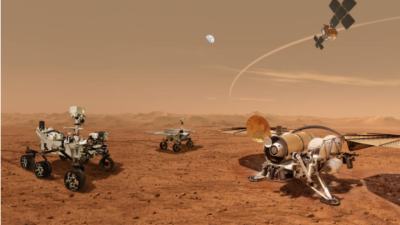
Mars, our neighboring planet, has captivated the curiosity of scientists and space enthusiasts alike for decades. With its rugged terrain, polar ice caps, and intriguing geological features, Mars presents an enticing question whether life exist beyond Earth on the Red Planet.
Martian Habitability Factors
To assess the possibility of life on Mars, scientists consider several key factors:
- Liquid Water: Water is a crucial ingredient for life as we know it. While Mars is predominantly dry, evidence of liquid water in the past has been uncovered. Scientists have discovered ancient riverbeds, minerals that form in the presence of water, and recurring slope lineae (dark streaks) that suggest the occasional flow of liquid water on the planet’s surface.
- Atmospheric Conditions: Mars has a thin atmosphere, primarily composed of carbon dioxide. However, the planet’s atmosphere provides some protection against harmful solar radiation, and recent studies have revealed the presence of trace amounts of methane, a potential biological indicator.
- Energy Sources: Life requires a source of energy to sustain itself. Mars receives sufficient sunlight, albeit at around half the intensity of Earth, making solar power a viable energy option. Moreover, Mars possesses geothermal energy, as evidenced by volcanic features and past volcanic activity.
Martian Exploration Findings
Exploration missions to Mars have provided valuable insights and data supporting the possibility of life on the planet.
- Water Ice: Multiple missions, including the Phoenix lander and the Mars Reconnaissance Orbiter, have confirmed the presence of water ice beneath the surface of Mars. These discoveries suggest the potential for subsurface ecosystems that could rely on this water source.
- Organic Molecules: NASA’s Curiosity rover made a significant discovery by detecting organic molecules in Martian rocks. Organic molecules are the building blocks of life and provide further evidence that Mars may have had the necessary conditions for life to emerge.
- Perchlorates: Perchlorates, compounds found in Martian soil, were detected by the Phoenix lander and the Curiosity rover. While perchlorates can be harmful to some forms of life, certain microorganisms on Earth can use them as an energy source, raising the possibility of a similar adaptation on Mars.
Current and Future Missions
Numerous missions are currently underway or planned for the future, aiming to gather more data and search for signs of life on Mars.
- Mars 2020 Rover: NASA’s Mars 2020 mission, with the Perseverance rover, is designed to explore a region of Mars known as Jezero Crater. The rover will collect samples of Martian rocks and soil, which will be returned to Earth by a future mission for detailed analysis.
- ExoMars: The joint European-Russian ExoMars mission includes the Rosalind Franklin rover, scheduled to launch in 2022. This mission aims to drill beneath the Martian surface and analyze samples for signs of past or present life.
- Mars Sample Return: The Mars Sample Return campaign, a collaborative effort between NASA and the European Space Agency (ESA), plans to collect samples from Mars and return them to Earth. This initiative will allow scientists to conduct detailed laboratory analyses to search for potential biosignatures.
The following table summarizes key data related to Mars and its potential for life.
| Factors | Mars | Earth |
| Distance from the Sun | Approximately 227.9 million km | Approximately 149.6 million km |
| Average Temperature | -63°C (-81°F) to -8°C (18°F) | 15°C (59°F) |
| Atmosphere Composition | 95% carbon dioxide, 2.7% nitrogen, and 1.6% argon | 78% nitrogen, 21% oxygen |
| Surface Water | Evidence of past liquid water, subsurface ice | Vast oceans and freshwater bodies |
| Magnetic Field | Weak, limited protection from solar radiation | Strong, shields from harmful solar radiation |
While the question of whether life exists or has existed on Mars remains unanswered, scientific discoveries and ongoing missions indicate that the Red Planet possesses the necessary ingredients and conditions for life to thrive.
Last Modified: February 22, 2024