

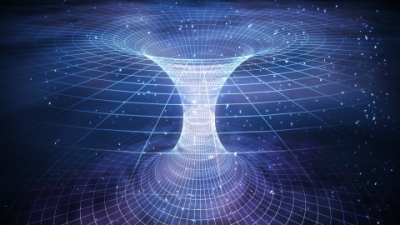
A wormhole is a speculative structure linking disparate points in spacetime, based on a special solution of the Einstein field equations. Formally known as an Einstein-Rosen Bridge, it functions as a “shortcut” through the universe, theoretically allowing matter to travel across vast distances or even different epochs of time more quickly than light would through ordinary space.
Theoretical Foundations and General Relativity
Wormholes are consistent with the General Theory of Relativity, which posits that gravity is the result of the curvature of spacetime.
The Schwarzschild Wormhole
The first theoretical discovery of a wormhole came from analyzing the Schwarzschild metric, which describes the geometry of spacetime around a non-rotating black hole. In 1935, Albert Einstein and Nathan Rosen showed that the mathematical solution allowed for a bridge connecting two different universes or two parts of the same universe.
Wormhole Stability and Exotic Matter
While mathematically possible, Schwarzschild wormholes are “non-traversable.” They collapse too quickly for even light to pass through. For a wormhole to be traversable, it would require a hypothetical substance known as Exotic Matter. This matter must possess negative energy density and negative pressure to exert a “repulsive” gravitational effect, keeping the “throat” of the wormhole open against the inward pull of gravity.
Key Structural Components of a Wormhole
The geometry of a wormhole can be visualized in three primary parts:
- Mouths: The two openings or “portals” located at different points in spacetime. From the outside, a mouth would appear as a spherical, three-dimensional hole in space, much like a black hole but reflecting light from the other side.
- Throat: The narrow passage connecting the two mouths. The stability of this region is the primary challenge in theoretical physics.
- Event Horizon: In non-traversable wormholes (like the Einstein-Rosen bridge), the throat contains a double event horizon that prevents information transfer.
Comparison: Black Holes vs. Wormholes
| Feature | Black Hole | Wormhole |
| Observation | Confirmed (e.g., M87″, Sagittarius A”) | Purely Theoretical / Mathematical |
| Structure | Singularity at the center | A passage (throat) between two points |
| Passability | One-way (nothing escapes the horizon) | Potentially two-way (if traversable) |
| Matter Requirement | Ordinary mass/energy | Requires Exotic Matter (Negative Energy) |
| Time Travel | Not applicable to transit | Theoretically possible via time dilation |
Wormholes and the Possibility of Time Travel
Wormholes are not just shortcuts through space; they are shortcuts through spacetime. According to the “Kip Thorne” model, if one mouth of a traversable wormhole is accelerated to near-light speed (utilizing time dilation) and then brought back, a time difference would exist between the two mouths. A traveler entering the “older” mouth would exit the “younger” mouth, effectively traveling into the past of that specific spatial location.
The Role of Quantum Entanglement: ER = EPR
A modern breakthrough in theoretical physics is the ER = EPR conjecture, proposed by Leonard Susskind and Juan Maldacena in 2013.
- ER (Einstein-Rosen): Represents wormholes.
- EPR (Einstein-Podolsky-Rosen): Represents quantum entanglement.
- The Concept: The conjecture suggests that two entangled particles are actually connected by a microscopic wormhole. This links the macro-scale physics of General Relativity with the micro-scale physics of Quantum Mechanics, providing a potential path toward a “Theory of Everything.”
Challenges and Scientific Critiques
Despite their popularity in science fiction, several scientific hurdles remain:
- Violations of Energy Conditions: Traversable wormholes violate the Average Null Energy Condition (ANEC), which generally holds that energy density cannot be negative.
- Causality Paradoxes: If wormholes allow for back-in-time travel, they could create paradoxes (e.g., the Grandfather Paradox), which violates the principle of causality.
- Stephen Hawking’s Chronology Protection Conjecture: Hawking suggested that the laws of physics naturally conspire to prevent time travel on macroscopic scales, likely causing a wormhole to destroy itself via a radiation feedback loop the moment it becomes a “time machine.”
Important Facts for UPSC Prelims
- First Proposed: 1935 by Albert Einstein and Nathan Rosen.
- Term Coined: The term “wormhole” was coined by American theoretical physicist John Archibald Wheeler in 1957.
- Casimir Effect: A quantum mechanical phenomenon that provides a theoretical basis for the existence of negative energy, potentially needed to stabilize a wormhole.
- White Holes: Theoretical opposites of black holes that eject matter and light; some theories suggest a wormhole connects a black hole to a white hole.
- Detection: Scientists have proposed that wormholes could be detected through gravitational microlensing—if a wormhole passes in front of a distant star, its unique gravitational signature would distort the light differently than a star or a black hole.