

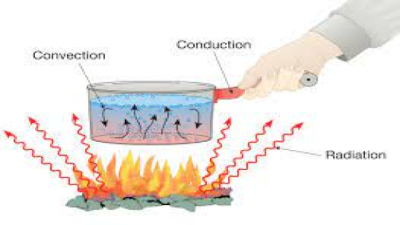
Heat transfer, the process by which energy in the form of heat flows from a region of higher temperature to a region of lower temperature, plays a crucial role in various natural and industrial processes. Conduction is one of the primary modes of heat transfer that occurs within solids, liquids, and gases.
Understanding Conduction
Conduction is the transfer of heat through direct molecular interaction within a substance, without any overall movement of the substance itself. In materials with free electrons (like metals), heat is transferred by the movement of these electrons in response to a temperature gradient. In non-metals, heat is transmitted through lattice vibrations, where atoms oscillate around their equilibrium positions.
Mechanism of Conduction
The primary mechanism behind conduction is the transfer of kinetic energy from high-energy particles to low-energy particles in the material. As a result, regions of higher temperature have more energetic particles that collide with neighboring particles, transferring their energy. This leads to a chain reaction of collisions that propagate the heat energy through the material.
Examples of Conduction
- Metal Spoon in Hot Tea
When a metal spoon is placed in a hot cup of tea, the end of the spoon in contact with the tea becomes warm. The heat from the hot tea is transferred to the spoon through conduction. The particles in the spoon closest to the tea gain energy and vibrate more, passing this energy along the length of the spoon.
- Cooking Utensils on a Stovetop
When cooking, the heat from the stovetop is conducted through the base of the cooking utensil to the food. This is why the handle of the utensil remains cooler than the base – the heat is conducted away from the handle.
Applications of Conduction
Conduction has various real-world applications across industries:
- Thermal Insulation
Understanding conduction is crucial for designing effective thermal insulation materials. By using materials with low thermal conductivity, such as foams or fiberglass, heat transfer through conduction can be minimized. This principle is employed in buildings, refrigeration systems, and space exploration.
- Electronics Cooling
In the electronics industry, excessive heat can damage components. Therefore, efficient heat sinks and thermal paste are used to conduct heat away from sensitive electronic components, preventing overheating.
- Cooking and Food Processing
Conduction is integral to cooking processes. Pans, griddles, and baking sheets are designed to effectively conduct heat to cook food evenly.
Thermal Conductivity of Common Materials
Below is a table presenting the thermal conductivity of various common materials:
| Material | Thermal Conductivity (W/m·K) |
| Copper | 401 |
| Aluminum | 237 |
| Glass | 0.8 – 1.4 |
| Wood | 0.04 – 0.12 |
| Air (at STP) | 0.025 |
| Water | 0.6 |
Conduction is an essential heat transfer mechanism that underpins many everyday processes and technological advancements. Understanding how heat is conducted through different materials has enabled us to harness its principles for applications ranging from cooking to electronics.
Last Modified: February 22, 2024