

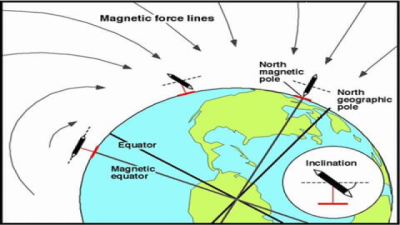
The Earth’s magnetic field is a fascinating and essential aspect of our planet, playing a crucial role in various natural processes and serving as a navigational aid for both humans and animals. One significant property of the Earth’s magnetic field is its inclination, commonly known as magnetic dip. Understanding Magnetic Dip
Magnetic dip, also referred to as magnetic inclination, is the angle between the horizontal plane and the magnetic field lines at a particular location on the Earth’s surface. Unlike magnetic declination, which deals with the angle between magnetic north and true north, magnetic dip focuses on the vertical component of the Earth’s magnetic field. At the magnetic equator, the magnetic dip is zero, meaning that the magnetic field lines run parallel to the Earth’s surface. As one moves towards the magnetic poles, the magnetic dip increases, with the field lines eventually becoming perpendicular to the Earth’s surface.
Measurement and Variations
The measurement of magnetic dip is essential for understanding the behavior of the Earth’s magnetic field at different locations. Magnetic dip can be determined using an instrument called a dip circle or inclinometer. This device consists of a magnetic needle that is free to rotate in both horizontal and vertical planes. By observing the angle at which the magnetic needle inclines from the horizontal, the magnetic dip can be calculated.
The magnetic dip is not constant worldwide but varies depending on the geographical location. Near the magnetic equator, where the magnetic field lines are mostly parallel to the Earth’s surface, the dip is minimal. As one moves towards the magnetic poles, the dip increases. For instance, at the magnetic poles, the magnetic dip is approximately 90 degrees, indicating that the magnetic field lines are entirely vertical.
Factors Influencing Magnetic Dip
Several factors influence the magnetic dip at a particular location on the Earth’s surface. One of the primary factors is the latitude of the location. As mentioned earlier, the magnetic dip is highest at the magnetic poles (close to 90 degrees) and decreases as one moves towards the magnetic equator (close to 0 degrees).
Another crucial factor is the altitude above sea level. The magnetic dip can slightly vary with changes in altitude, although this effect is relatively minor compared to the latitude-based variation.
The Earth’s magnetic field is not static, and it undergoes changes over time. This phenomenon is known as secular variation. As the Earth’s molten outer core generates the magnetic field through geodynamo processes, fluctuations occur in the field’s strength and orientation. Consequently, the magnetic dip at a specific location may change over the years.
Significance of Magnetic Dip
Understanding magnetic dip is vital for various scientific and practical applications. Here are some areas where magnetic dip plays a crucial role:
- Navigation: Sailors and navigators use magnetic dip, along with magnetic declination, to determine their exact position concerning true north. This information is essential for accurate navigation, especially when using magnetic compasses.
- Geology and Mineral Exploration: Magnetic dip data helps geologists and mineral exploration teams identify and map subsurface rock formations and mineral deposits. Different rock types exhibit varying magnetic properties, and studying magnetic dip aids in understanding the geological structure of an area.
- Aurora Borealis and Aurora Australis: The auroras, commonly known as the Northern and Southern Lights, occur near the magnetic poles. Understanding the magnetic dip is crucial for studying these mesmerizing light displays and their connection to solar activity.
- Climate and Paleomagnetism: Magnetic dip data, when combined with other magnetic field measurements, can provide valuable insights into the Earth’s past climate and geological history. This branch of study is known as paleomagnetism.
The table below illustrates Magnetic Dip Values at Select Locations
| Location | Latitude (°) | Magnetic Dip (°) |
| Magnetic Equator | 0 | 0 |
| New York, USA | 40.71 | 65.2 |
| London, UK | 51.51 | 67.5 |
| Tokyo, Japan | 35.68 | 59.2 |
| Magnetic North Pole | ~90 | 90 |
Magnetic dip is a fundamental aspect of the Earth’s magnetic field that showcases the fascinating interplay between the planet’s geology and its interactions with the solar wind. Understanding magnetic dip not only aids in navigation and exploration but also provides valuable insights into the Earth’s geological past and its dynamic magnetic behavior.
Last Modified: February 22, 2024