

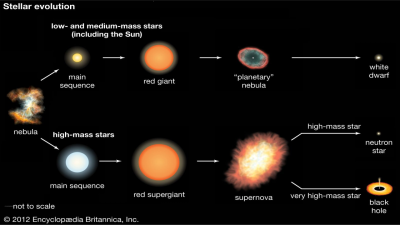
Stars, the celestial bodies that illuminate our night sky, undergo a fascinating process of evolution throughout their lifetimes. From their formation in stellar nurseries to their ultimate fate, stars are shaped by a variety of factors that influence their development and behavior.
Mass
One of the most crucial factors determining a star’s evolution is its initial mass. The mass of a star influences its luminosity, temperature, and lifetime. Massive stars, with masses greater than eight times that of our Sun, burn their fuel at a faster rate and have shorter lifespans compared to low-mass stars. This is due to the higher gravitational pressure and temperatures at the core of massive stars, which facilitates nuclear fusion more efficiently.
- Example: Blue Giants, also known as O-type stars, are massive stars with temperatures exceeding 30,000 Kelvin. These stars burn their fuel rapidly and have relatively short lifetimes of a few million years. In contrast, low-mass stars, such as red dwarfs, have much longer lifetimes, potentially exceeding tens of billions of years.
Composition
The composition of a star, particularly the abundance of elements like hydrogen, helium, and heavier elements, significantly affects its evolution. The primordial composition of a star, determined by the composition of the interstellar medium from which it forms, impacts its overall structure, fusion processes, and eventual fate. Stars primarily consist of hydrogen, which serves as the primary fuel for nuclear fusion in their cores. The presence of heavier elements, such as carbon, oxygen, and iron, influences the internal conditions of a star, altering its fusion reactions and energy generation. The abundance of heavy elements affects the star’s luminosity, size, and the subsequent formation of planets around it. For instance, stars with higher metallicity, a term astronomers use to describe the abundance of heavy elements, tend to have a higher probability of hosting planetary systems. This is because the presence of heavier elements provides the necessary building blocks for planet formation.
Stellar Interactions
Interactions between stars can significantly influence their evolution. Stellar interactions include binary star systems, where two stars orbit around their common center of mass, as well as close encounters between individual stars. In binary star systems, the gravitational interaction between the stars can lead to mass transfer, where material from one star is transferred to its companion. This mass transfer can alter the evolution of both stars, leading to phenomena such as mass gain or loss, stellar mergers, and the formation of exotic objects like white dwarfs, neutron stars, or even black holes. An example of stellar interactions is a type Ia supernova, which occurs in a binary system where one star is a white dwarf and the other is a companion star. The white dwarf accretes matter from its companion until it reaches a critical mass, triggering a runaway nuclear fusion reaction that results in a supernova explosion. The table below describes the various factors influencing evolution of stars in a comprehensive manner.
| Factor | Description |
| Mass | The mass of a star determines its life cycle. Higher-mass stars have more intense fusion reactions and shorter lives. |
| Composition | The composition of a star, particularly the abundance of heavy elements, affects its structure and evolution. |
| Rotation | Stellar rotation affects the rate of nuclear fusion and can influence a star’s mass loss and angular momentum. |
| Metallicity | Metallicity refers to the abundance of elements other than hydrogen and helium. It impacts stellar evolution. |
| Magnetic Fields | Magnetic fields can affect stellar winds, mass loss, and angular momentum, impacting the evolution of stars. |
| Stellar Activity | Stellar activity, such as flares and sunspots, can affect a star’s luminosity, temperature, and mass loss. |
| Binary Interactions | Stellar interactions in binary systems can lead to mass transfer, accretion, mergers, or even supernova explosions. |
| Stellar Winds | Stellar winds carry away mass from stars, affecting their evolution and enriching the surrounding interstellar medium. |
| Age | The age of a star determines its evolutionary stage, with different processes dominating at different ages. |
| Initial Conditions | The initial conditions of a star, such as its density and temperature, play a role in shaping its evolution. |
| Stellar Feedback and Supernovae | Stellar feedback, including supernova explosions, can trigger star formation and influence the evolution of galaxies. |
The evolution of stars is a complex process influenced by various factors, including mass, composition, and stellar interactions. The mass of a star determines its luminosity, temperature, and lifetime, with massive stars burning their fuel faster and having shorter lifespans. The composition of a star, particularly the abundance of heavy elements, affects its internal conditions, fusion processes, and the formation of planetary systems.
Last Modified: April 16, 2026