

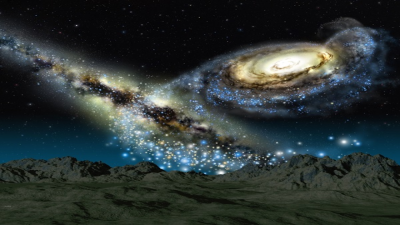
The Milky Way Galaxy is part of a vast cosmic neighborhood, surrounded by various galaxies that form the Local Group.
Andromeda Galaxy
- Type: Spiral
- Distance from Milky Way: 2.537 million light-years
- Notable Features: The Andromeda Galaxy, also known as Messier 31 or M31, is the largest neighboring galaxy to the Milky Way. It is on a collision course with our galaxy and is expected to merge with the Milky Way in about 4 billion years. The Andromeda Galaxy contains a vast number of stars, globular clusters, and a supermassive black hole at its center.
Triangulum Galaxy
- Type: Spiral
- Distance from Milky Way: 2.723 million light-years
- Notable Features: Also called Messier 33 or M33, the Triangulum Galaxy is the third-largest member of the Local Group. It is the smallest spiral galaxy in the group and exhibits active star formation, with several HII regions and massive star clusters.
Large Magellanic Cloud
- Type: Irregular
- Distance from Milky Way: 163,000 light-years
- Notable Features: The Large Magellanic Cloud (LMC) is a satellite galaxy of the Milky Way and is visible to the naked eye from the Southern Hemisphere. It is rich in gas and dust, resulting in active star formation. The LMC hosts notable objects such as the Tarantula Nebula and the 30 Doradus star-forming region.
Small Magellanic Cloud
- Type: Irregular
- Distance from Milky Way: 200,000 light-years
- Notable Features: The Small Magellanic Cloud (SMC) is another satellite galaxy of the Milky Way. It has an irregular shape and is known for its active star-forming regions. The SMC hosts objects like the N66 HII region and the Supernova Remnant 1E 0102.2-7219.
Sculptor Galaxy
- Type: Dwarf elliptical
- Distance from Milky Way: 10 million light-years
- Notable Features: The Sculptor Galaxy, also known as NGC 253, is the closest elliptical galaxy to the Milky Way. Despite being relatively small, it exhibits intense starburst activity and is a source of X-ray and radio emissions. The Sculptor Galaxy is notable for its prominent dust lanes and numerous star clusters.
The table below illustrates important features of the neighbors of the Milky Way Galaxy.
| Galaxy Name | Type | Distance from Milky Way (in million light-years) | Notable Features |
| Andromeda Galaxy | Spiral | 2.537 | Largest neighboring galaxy, approaching Milky Way |
| Triangulum Galaxy | Spiral | 2.723 | Smallest spiral galaxy in the Local Group |
| Large Magellanic Cloud | Irregular | 163 | Visible to the naked eye from the Southern Hemisphere |
| Small Magellanic Cloud | Irregular | 200 | Irregular shape and contains active star-forming regions |
| Sculptor Galaxy | Dwarf elliptical | 10 | Closest elliptical galaxy to the Milky Way |
The Milky Way Galaxy is surrounded by various neighboring galaxies that form the Local Group. These include the Andromeda Galaxy, the Triangulum Galaxy, the Large and Small Magellanic Clouds, and the Sculptor Galaxy. Each of these galaxies has distinct characteristics, such as their type, distance from the Milky Way, and notable features.
Last Modified: April 16, 2026