

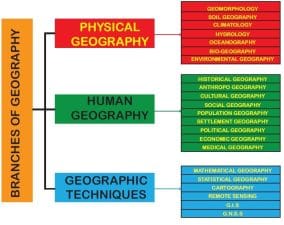
Geography as a scholarly discipline explores the Earth’s surface through two fundamental methodologies. These approaches define how geographers organize spatial data and analyze the complex interactions between the environment and human activity.
Systematic Geography: The Topical Approach
Systematic geography, also known as the Topical Approach, focuses on a specific geographical element or phenomenon and examines its distribution across the globe or a defined territory. This method was popularized by Alexander von Humboldt.
Characteristics of Systematic Geography
- Element-Centric: The primary focus is on a single variable (e.g., climate, soil, or industry) rather than a specific location.
- Global Integration: It seeks to identify universal laws and patterns by studying the variation of a specific factor across the entire Earth’s surface.
- Analytical Nature: It provides a thematic understanding, allowing for specialized research into specific sectors like meteorology or demography.
Regional Geography: The Areal Differentiation Approach
Regional geography treats a specific area as a single unit and examines the synthesis of all geographical factors within that space. This approach was pioneered by Karl Ritter.
Characteristics of Regional Geography
- Area-Centric: It identifies the “personality” of a region by studying how relief, climate, and human activities converge in that specific location.
- Spatial Hierarchy: Regions are studied at various scales, from macro-regions (continents) to micro-regions (valleys or districts).
- Synthetic Nature: It aims to understand the uniqueness of a place, a concept known as Areal Differentiation.
Comparative Summary: Systematic vs Regional Geography
| Feature | Systematic Geography | Regional Geography |
| Pioneer | Alexander von Humboldt | Karl Ritter |
| Unit of Study | A specific phenomenon (e.g., Rainfall) | A specific area (e.g., The Sahara) |
| Focus | Identification of general laws/patterns | Identification of unique characteristics |
| Method | Analytical and Topical | Synthetic and Holistic |
| Example | Studying global wheat production | Studying the agriculture, climate, and soil of Punjab |
Branches of Geography via Systematic Approach
The systematic approach categorizes geography into three primary domains based on the nature of the phenomena studied: Physical, Human, and Biogeography.
Physical Geography and its Sub-disciplines
Physical geography focuses on the natural environment and the physical processes that shape the Earth.
Geomorphology
- This branch studies the configuration of the Earth’s surface, including landforms like mountains, plateaus, and plains.
- It examines the processes (endogenic and exogenic) that create and modify these features.
- It shares a close relationship with Geology.
Climatology
- It involves the study of the atmosphere and its constituent elements such as temperature, humidity, and atmospheric pressure.
- It analyzes the spatial and temporal distribution of climatic zones.
Oceanography (Hydrology)
- It focuses on the Earth’s water bodies, specifically the oceans and seas.
- Key areas of study include the ocean floor topography, salinity, tides, currents, and marine life.
Soil Geography (Pedology)
- This branch investigates the processes of soil formation (pedogenesis), soil profiles, fertility, and their spatial distribution across different terrains.
Human Geography: The Study of Man-Made Landscapes
Human geography explores the relationship between the physical environment and the social, economic, and cultural developments of human beings.
Social and Cultural Geography
- It examines the spatial distribution of social groups and their cultural traits.
- It studies how different societies perceive and utilize their environment.
Population and Settlement Geography
- Population: Focuses on vital statistics such as density, growth, sex ratio, migration, and occupational structure.
- Settlement: Analyzes the morphology and distribution of rural and urban settlements.
Economic Geography
- This branch studies how humans earn a living and the spatial organization of economic activities.
- Primary Activities: Agriculture, mining, fishing, and forestry.
- Secondary Activities: Manufacturing and industrial processing.
- Tertiary Activities: Trade, transport, tourism, and services.
Historical and Political Geography
- Historical Geography: Studies how geographical features change over time and the historical evolution of regions.
- Political Geography: Focuses on political boundaries, international relations between states, and the spatial aspects of voting behavior (electoral geography).
Biogeography: The Interface of Physical and Human Geography
Biogeography serves as a bridge, studying the distribution of flora and fauna and their relationship with the environment.
- Plant Geography: Studies the spatial pattern of natural vegetation.
- Zoo Geography: Focuses on the distribution of animal species and their habitats.
- Ecology/Ecosystem Study: Examines the scientific study of the habitats of species.
- Environmental Geography: Addresses issues related to environmental degradation, conservation, and sustainable management.
UPSC Trivia: Concepts to Remember
- Areal Differentiation: The core concept of geography that explains why the Earth’s surface varies from one place to another.
- Determinism vs Possibilism: A classic debate in human geography; Determinism suggests nature controls man, while Possibilism suggests man can modify nature.
- The Quantitative Revolution: A period in the mid-20th century where statistical and mathematical models were introduced to systematic geography to make it more scientific.