

The universe is not a chaotic distribution of matter but a highly organized, hierarchical structure. From the infinitesimal scales of subatomic particles to the gargantuan filaments of the cosmic web, every component is linked by the fundamental forces of nature.
1. The Microscopic Foundation: Subatomic to Atomic Scales
At its most basic level, the universe is built from quantum entities governed by the Standard Model of particle physics.
- Elementary Particles: The smallest known building blocks are Quarks and Leptons (e.g., electrons). These are governed by the Strong, Weak, and Electromagnetic forces.
- Atomic Level: Protons and neutrons combine to form nuclei, which, when paired with electrons, create atoms.
- Abundance: Hydrogen (~74%) and Helium (~24%) are the most abundant elements, produced during Big Bang Nucleosynthesis. Heavier elements (metals in astronomical terms) are created later via Stellar Nucleosynthesis (inside stars) and supernovae.
- Molecular Clouds: Atoms combine into molecules in dense, cold regions known as Giant Molecular Clouds (GMCs). These are the “stellar nurseries” where gravity begins its work.
2. Stellar and Planetary Systems: The Solar Scale
Gravity becomes the dominant organizing force as matter clumps together to form discrete celestial bodies.
- Planetary Systems: These consist of a central star and various gravitationally bound objects, including planets, moons, asteroids, and comets.
- Stellar Populations: ” Population I: Young, metal-rich stars (e.g., The Sun).
- Population II: Older, metal-poor stars found in galactic halos.
- Population III: Theoretical first-generation stars that were massive and metal-free.
- Star Clusters: ” Open Clusters: Groups of young stars, loosely bound (e.g., Pleiades).
- Globular Clusters: Ancient, densely packed spheres of stars (e.g., Omega Centauri).
3. Galactic Structures: The Building Blocks of the Cosmos
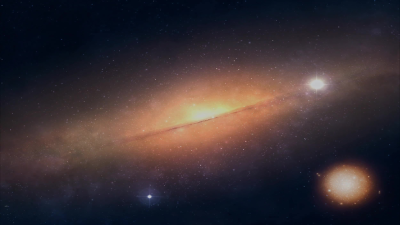
Galaxies are massive systems containing stars, stellar remnants, interstellar gas, dust, and dark matter.
- Morphological Classification: Based on the Hubble Tuning Fork diagram:
- Spiral: Disk-shaped with spiral arms (e.g., Milky Way, Andromeda).
- Elliptical: Smooth, featureless, and often containing older stars.
- Irregular: No distinct shape, often the result of galactic collisions.
- The Milky Way: A barred spiral galaxy. We reside in the Orion-Cygnus Arm, approximately 26,000 light-years from the Galactic Center, which houses a supermassive black hole called Sagittarius A“.
4. The Cosmic Web: Large-Scale Organization
Beyond individual galaxies, the universe resembles a vast network or “web.” This is the largest scale at which structure is observed.
Galaxy Groups and Clusters
- Galaxy Groups: Small aggregates of fewer than 50 galaxies. The Local Group contains the Milky Way, Andromeda, and about 50 smaller dwarf galaxies.
- Galaxy Clusters: The largest gravitationally bound objects in the universe, containing hundreds to thousands of galaxies.
- Intracluster Medium (ICM): A “soup” of hot, X-ray-emitting plasma that exists between galaxies in a cluster.
Superclusters
Superclusters are massive collections of clusters and groups. They are among the largest structures in the universe but are often not gravitationally bound, meaning the expansion of the universe may eventually pull them apart.
- Laniakea Supercluster: Our home supercluster, which encompasses the Milky Way and roughly 100,000 other galaxies.
- Saraswati Supercluster: A major discovery by Indian astronomers (2017), located 4 billion light-years away.
Filaments and Voids
- Filaments: Long, thread-like structures of galaxies and dark matter that form the boundaries of voids. They act as “cosmic highways” directing matter into clusters.
- Voids: Enormous, empty spherical spaces between filaments. While they make up the majority of the universe’s volume, they contain very little matter.
- Boötes Void: One of the largest known voids, spanning nearly 330 million light-years.
5. Summary Table: The Cosmic Hierarchy
| Rank | Structure | Approximate Scale | Key Characteristic |
| 1 | Subatomic/Atomic | <10-10 meters | Governed by Quantum Forces |
| 2 | Planetary System | 100 – 200 AU | A star and its orbiting bodies |
| 3 | Star Cluster | 10 – 100 Light-years | Groups of stars with common origin |
| 4 | Galaxy | 10^5 Light-years | Billions of stars bound by gravity |
| 5 | Galaxy Group | 1 – 2 Megaparsecs | Local collections (e.g., Local Group) |
| 6 | Galaxy Cluster | 2 – 10 Megaparsecs | Gravitationally bound “nodes” of the web |
| 7 | Supercluster | 100+ Megaparsecs | Massive chains of clusters |
| 8 | Cosmic Web | Giga-parsec scales | The network of filaments and voids |
6. Essential Principles and Modern Discoveries
- The Cosmological Principle: Assumes that on a scale larger than 100 Megaparsecs, the universe is Homogeneous (uniform density) and Isotropic (looks the same in all directions).
- Dark Matter and Dark Energy: Dark Matter (~27%): Provides the “gravitational glue” that allows galaxies and clusters to form.
- Dark Energy (~68%): A repulsive force that drives the accelerated expansion of the universe.
- The Great Attractor: A gravitational anomaly in the Laniakea Supercluster that reveals the motion of our galaxy toward a specific point in space.
- Baryon Acoustic Oscillations (BAO): Regular, periodic fluctuations in the density of the visible baryonic matter of the universe, used as a “standard ruler” to measure cosmic distances.
7. Timeline of Structural Formation
- Planck Epoch: The universe is a singularity.
- Recombination (380,000 years): The universe becomes transparent; the Cosmic Microwave Background (CMB) is released.
- Cosmic Dark Ages: A period before the first stars formed.
- Cosmic Dawn: The first stars (Population III) ignite, reionizing the universe.
- Galaxy Formation: Small protogalaxies merge to form the massive galaxies we see today.
- Dark Energy Dominance: Roughly 5-6 billion years ago, the expansion of the universe began to accelerate.