

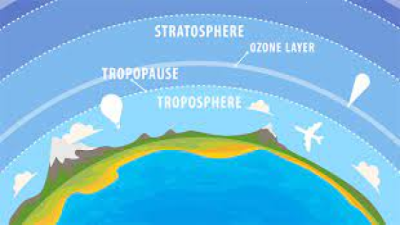
The Earth’s atmosphere is a complex and dynamic system composed of several layers that play crucial roles in regulating our climate and weather patterns. Among these layers, the troposphere and tropopause stand out as key components that directly impact our daily lives.
Understanding the Troposphere
The troposphere is the lowest layer of the Earth’s atmosphere, extending from the surface up to an average altitude of about 8 to 15 kilometers (5 to 9 miles), varying with location and weather conditions. This layer contains the air we breathe and is where most of Earth’s weather phenomena occur. As one ascends through the troposphere, the temperature generally decreases due to the decreasing pressure and the absorption of solar energy by the Earth’s surface.
Dynamic Weather Patterns
The troposphere is a bustling arena of weather activities. It’s where clouds form, precipitation takes place, and winds blow. The temperature variations within the troposphere lead to the creation of convection currents. Warm air at the surface rises, cools as it ascends, and eventually condenses into clouds, releasing moisture as rain or snow. This convection process is responsible for the formation of thunderstorms, hurricanes, and other weather events.
Tropopause: The Boundary Above
Above the troposphere lies the tropopause, which serves as a crucial transition zone between the troposphere and the stratosphere. The tropopause isn’t a distinct, fixed altitude; instead, its height varies with location, season, and latitude. On average, it’s situated around 8 kilometers (5 miles) above the poles and 15 kilometers (9 miles) above the equator.
Distinct Characteristics
The tropopause is marked by a significant temperature inversion, where temperatures cease to decrease with altitude and instead start to rise. This inversion occurs due to the presence of the ozone layer within the stratosphere. Ozone absorbs ultraviolet (UV) radiation from the Sun, leading to a temperature increase in the stratosphere, which in turn influences the tropopause. This temperature inversion acts as a barrier, limiting the vertical movement of air, and plays a critical role in shaping weather patterns and air circulation.
Aviation and Climate Impact
The altitude of the tropopause has implications for aviation and climate studies. Commercial airplanes generally cruise at altitudes near the tropopause because it provides a smoother flight with less turbulence. Additionally, the tropopause plays a pivotal role in regulating the exchange of air between the troposphere and the stratosphere. This exchange has a direct impact on the distribution of greenhouse gases, such as carbon dioxide, which influence the Earth’s overall climate.
Troposphere and Tropopause
| Characteristic | Troposphere | Tropopause |
| Altitude | Surface to 8-15 km (5-9 mi) | Variable, around 8 km at poles and 15 km at equator |
| Temperature Change | Decreases with altitude | Temperature inversion, starts to rise with altitude due to ozone layer |
| Weather Phenomena | Cloud formation, weather events | Acts as a barrier to vertical air movement |
| Aviation Relevance | Location of commercial flights | Smooth cruising due to reduced turbulence |
| Climate Influence | Exchange of greenhouse gases | Impacts the distribution of greenhouse gases |
The troposphere and tropopause are fundamental components of Earth’s atmospheric system, orchestrating weather patterns, influencing climate dynamics, and playing a role in aviation operations. While the troposphere hosts a variety of weather phenomena, the tropopause acts as a dynamic boundary with unique characteristics.
Last Modified: February 22, 2024