

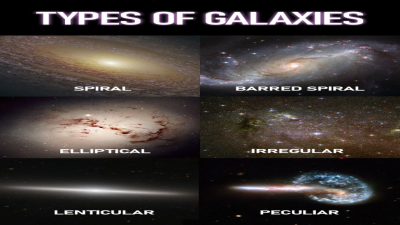
Galaxies are dynamic systems that evolve over billions of years. Their structure is defined by the arrangement of stars, gas, and dark matter, while their evolution is driven by star formation, supermassive black hole activity, and gravitational interactions with other galaxies.
Structural Components of a Galaxy
Most galaxies (especially spirals) share a fundamental structural blueprint composed of four distinct regions.
1. The Galactic Nucleus and Central Bulge
The nucleus is the high-density core of the galaxy.
- Supermassive Black Hole (SMBH): Almost every large galaxy contains an SMBH at its center. Our galaxy has Sagittarius A*. If the SMBH is actively consuming matter, the galaxy becomes an Active Galactic Nucleus (AGN) or a Quasar.
- The Bulge: A spherical concentration of primarily older, “Red” stars (Population II). It contains very little gas and dust, resulting in low star-formation rates.
2. The Galactic Disk
The disk is the flattened, rotating region extending from the bulge.
- Spiral Arms: These are “density waves” where gas and dust are compressed. They are the primary sites of Star Formation, characterized by young, hot, blue stars (Population I).
- Interstellar Medium (ISM): The matter (gas and dust) between stars. A rich ISM is the fuel for a galaxy’s growth.
3. The Galactic Halo and Globular Clusters
- Stellar Halo: A vast, sparse spherical region surrounding the disk. It contains some of the oldest stars in the universe.
- Globular Clusters: Densely packed groups of hundreds of thousands of stars found within the halo.
- Dark Matter Halo: An invisible but massive envelope that provides the gravitational scaffolding for the galaxy. It accounts for roughly 90% of a galaxy’s total mass.
Evolution of Galaxies
Galactic evolution describes how a galaxy changes from a small, chaotic cloud of gas into a massive, organized system.
1. Formation (Protogalaxies)
Shortly after the Big Bang, dark matter “halos” began to pull in surrounding hydrogen and helium gas. This gas cooled and collapsed to form the first stars, creating “protogalaxies.” Under the Hierarchical Model, small protogalaxies merged over time to form the large galaxies we see today.
2. Star-Forming Phase (Active Evolution)
During this phase, galaxies are typically spiral or irregular. They are rich in cold gas, which collapses to form stars at a steady or “burst” rate. The Milky Way is currently in this phase, producing about 1–2 new stars per year.
3. Galactic Mergers and Interactions
Galaxies rarely evolve in isolation.
- Tidal Stripping: Larger galaxies can pull gas and stars away from smaller neighbors.
- Major Mergers: When two large spiral galaxies collide, the gravitational turbulence destroys their disks and exhausts their gas. This typically transforms them into a single, massive Elliptical Galaxy.
4. Quenching and Maturity
A galaxy is “quenched” when it loses its cold gas and star formation stops. This can happen due to:
- AGN Feedback: Energy from the central black hole blows gas out of the galaxy.
- Galactic Cannibalism: Mergers that use up all remaining fuel.
- Environmental Stripping: In dense clusters, the hot intergalactic medium “washes” the gas out of a galaxy.
Comparison of Structural and Evolutionary States
| Feature | Young/Active Galaxy (Spiral) | Mature/Evolved Galaxy (Elliptical) |
| Dominant Stars | Population I (Young, Blue) | Population II (Old, Red) |
| Gas Content | High | Extremely Low |
| Shape | Organized Disk/Spiral Arms | Featureless Ellipsoid |
| Star Formation | Ongoing | Ceased (Quenched) |
| Primary Motion | Ordered Rotation | Random Stellar Orbits |
Key Trivia and Facts for UPSC
- The Milky Way-Andromeda Collision: In about 4.5 billion years, our galaxy will collide with the Andromeda galaxy. The result will likely be a giant elliptical galaxy nicknamed “Milkomeda.”
- Redshift and Age: By observing the redshift of galaxies, astronomers can “look back in time.” The furthest galaxies we see appear small and irregular because they are in their earliest stages of evolution.
- Baryonic Matter: Only ~10% of a galaxy’s mass is visible matter (stars/gas). The rest is the Dark Matter Halo, which prevents the galaxy from flying apart during rotation.
- Cosmic Year: It takes the Sun approximately 225–250 million years to complete one orbit around the Galactic Center. This period is known as a Galactic Year.