

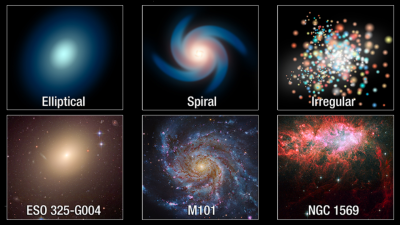
A galaxy is a massive, gravitationally bound system consisting of stars, stellar remnants, interstellar gas, dust, and dark matter. Galaxies range in size from dwarfs with just a few hundred million stars to giants with one hundred trillion stars. They are the fundamental “building blocks” of the large-scale structure of the universe, organized into groups, clusters, and superclusters.
Hubble Sequence (Tuning Fork Diagram)
Developed by Edwin Hubble in 1926, this classification scheme remains the standard for identifying galaxies based on their visual morphology. It divides galaxies into three primary categories: Ellipticals, Spirals, and Lenticulars, with Irregulars forming a fourth distinct group. 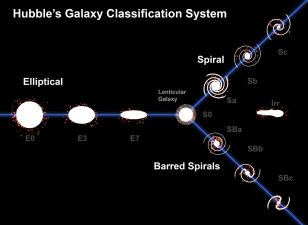
Types of Galaxies
Astronomers classify galaxies based on their visual morphology, primarily using the Hubble Sequence (Tuning Fork Diagram), which categorizes them by shape, symmetry, and star-forming activity.
1. Elliptical Galaxies (E)
Elliptical galaxies are the most abundant type in the universe. They are characterized by a smooth, featureless light profile and a lack of a flattened disk.
- Morphology: They range from nearly spherical (E0) to highly elongated (E7).
- Composition: These galaxies are “red and dead,” meaning they consist of older, low-mass stars (Population II) with very little cool gas or dust.
- Star Formation: Negligible; they have exhausted the materials required to create new stars.
- Scale: They include Dwarf Ellipticals and Giant Ellipticals (the latter are often found at the centers of massive galaxy clusters).
- Examples: M87 (Virgo Cluster), Messier 32.
2. Spiral Galaxies (S)
Spiral galaxies are defined by a rotating flattened disk, a central bulge, and a surrounding halo.
- Structure: They possess prominent “spiral arms” where active star formation occurs, rich in young, blue stars (Population I).
- Subtypes: Classified from Sa (tightly wound arms, large bulge) to Sc (loosely wound arms, small bulge).
- The Milky Way: Our home galaxy is a spiral system, specifically a barred variety.
- Examples: Andromeda Galaxy (M31), Whirlpool Galaxy (M51).
3. Barred Spiral Galaxies (SB)
A variation of the spiral galaxy where the central bulge is elongated into a bar-shaped structure of stars.
- Function of the Bar: The bar acts as a “nursery” by funnelling gas inward toward the center, triggering bursts of star formation.
- Classification: Roughly two-thirds of all spiral galaxies, including the Milky Way, exhibit some form of a central bar.
- Example: NGC 1300.
4. Lenticular Galaxies (S0)
Lenticular galaxies serve as a transitional state between elliptical and spiral galaxies.
- Structure: They possess a central bulge and a disk but lack the spiral arm structure.
- Composition: Like ellipticals, they have little interstellar matter and consist primarily of older stars.
- Distinction: Unlike spirals, they have lost or used up most of their gas and thus have a low star-formation rate.
- Examples: Messier 85, NGC 5866.
5. Irregular Galaxies (Irr)
Galaxies that do not possess a regular or symmetrical shape (no bulge or disk) are classified as irregular.
- Origin: Often formed through gravitational “tidal” interactions or collisions between larger galaxies.
- Features: They are frequently rich in gas and dust, making them sites of intense, chaotic star formation.
- Example: Large Magellanic Cloud (LMC), a satellite galaxy of the Milky Way.
6. Dwarf Galaxies
Dwarf galaxies are small systems containing only a few billion stars (compared to the Milky Way’s ~200-400 billion).
- Significance: They are considered the “building blocks” of larger galaxies through a process called hierarchical clustering.
- Abundance: They are the most numerous galaxy type in the Local Group.
- Examples: Fornax Dwarf, Sagittarius Dwarf Elliptical Galaxy.
Comparison of Galactic Characteristics
| Galaxy Type | Shape/Structure | Star Age | Star Formation | Interstellar Gas |
| Elliptical | Ellipsoidal; no disk | Old | Low/None | Low |
| Spiral | Disk with spiral arms | Mixed (Young & Old) | High (in arms) | High |
| Lenticular | Disk; no arms | Old | Low | Low |
| Irregular | Chaotic; no symmetry | Mostly Young | Very High |
Galactic Structure
Beyond their outward shapes, galaxies possess a distinct internal architecture composed of stars, gas, dust, and an invisible framework of dark matter. The structure of a galaxy is determined by its mass, angular momentum, and evolutionary history. While morphology varies across the Hubble Sequence, most spiral and lenticular galaxies share a common structural blueprint consisting of four main regions.
1. The Galactic Nucleus and Bulge
The nucleus is the absolute center of a galaxy, usually characterized by extreme stellar density and high-energy activity.
- Supermassive Black Hole (SMBH): Modern cosmology suggests almost every large galaxy harbors an SMBH at its core. In the Milky Way, this is Sagittarius A*.
- The Bulge: A tightly packed, somewhat spherical group of stars surrounding the nucleus. In spiral galaxies, the bulge primarily contains older, “Red” stars (Population II) and very little dust.
2. The Galactic Disk
The disk is the flattened region extending outward from the bulge. It is the most active part of a spiral galaxy.
- Spiral Arms: These are regions of higher density (density waves) where gas and dust are compressed to trigger the birth of new stars. They are populated by young, hot, blue stars (Population I).
- Thin and Thick Disks: Astronomers often divide the disk into a “thin disk” (containing gas and young stars) and a “thick disk” (containing older stars that have migrated vertically over time).
3. The Galactic Halo
The halo is a vast, spherical region that encompasses the entire visible galaxy.
- Globular Clusters: The halo is home to ancient, densely packed clusters of stars that are among the oldest objects in the universe.
- Dark Matter Halo: This is an invisible component that extends far beyond the visible stars. It provides the gravitational “well” necessary to prevent the galaxy from flying apart due to its high rotational velocity.
4. Interstellar Medium (ISM)
The “empty” space between stars is filled with the Interstellar Medium, which consists of gas (mostly hydrogen and helium) and microscopic dust particles.
- Molecular Clouds: Dense regions within the ISM where gravity overcomes internal pressure to form new stars.
- Contribution to Structure: The presence or absence of ISM determines whether a galaxy is “Active” (forming stars) or “Quiescent” (dormant).
Structural Variations by Galaxy Type
The distribution of the components mentioned above differs significantly depending on the galaxy’s classification.
| Structural Feature | Spiral Galaxy | Elliptical Galaxy | Irregular Galaxy |
| Symmetry | High (Rotational) | High (Spherical/Ellipsoid) | Low (Asymmetric) |
| Disk Presence | Prominent | Absent | Absent or Distorted |
| Bulge Size | Variable (Sa to Sc) | Entire galaxy is “Bulge-like” | None |
| Gas/Dust Ratio | High (in Disk) | Extremely Low | Very High |
| Dominant Motion | Ordered Rotation | Random Orbiting | Chaotic Motion |
Dynamics of Galactic Structure
The stability and shape of a galaxy are governed by the balance between gravity and motion.
- Rotation Curves: Observations show that the orbital speed of stars does not decrease at the edge of the galactic disk, as expected by Newtonian gravity. This “Flat Rotation Curve” is the primary evidence for the Dark Matter Halo.
- Density Waves: Spiral arms are not rigid structures like fan blades; they are areas of increased density that stars move in and out of, similar to a traffic jam on a highway.
- Galactic Cannibalism: Structures are often modified when a large galaxy’s gravity strips stars and gas from a smaller neighbor (e.g., the Milky Way interacting with the Sagittarius Dwarf Galaxy).
Key Facts for UPSC Prelims
- Galactic Year (Cosmic Year): The time it takes for the Sun to orbit the center of the Milky Way, approximately 225–250 million years.
- Baryonic vs. Dark Matter: Only about 10% of a galaxy’s mass is made of visible “baryonic” matter (stars/gas); the remaining 90% is dark matter.
- Metallicity: Stars in the disk have higher “metallicity” (elements heavier than Helium) compared to stars in the halo, indicating they were formed from recycled stellar material.
- The Zone of Avoidance: The region of the sky obscured by our own Milky Way’s dust and stars, making it difficult to see galaxies located directly behind the galactic plane.