

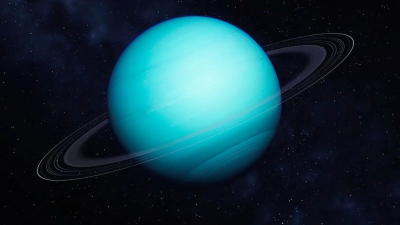
Uranus, the seventh planet from the Sun, is a fascinating celestial body that has intrigued scientists and astronomers for centuries. Known as an ice giant, Uranus boasts a unique set of characteristics and features that set it apart.
Composition and Atmosphere
Uranus is predominantly composed of hydrogen and helium, similar to Jupiter and Saturn, but it also contains a significant amount of ice, such as water, ammonia, and methane. These ices give Uranus its distinctive blue-green color. The atmosphere of Uranus is primarily composed of hydrogen (82%) and helium (15%), with traces of methane (2%) and other hydrocarbons. The presence of methane is responsible for the unique coloration of Uranus.
The Tilted Planet
One of the most remarkable features of Uranus is its extreme axial tilt. While most planets in the solar system have a relatively small tilt, Uranus rotates on its side, almost perpendicular to its orbital plane. This unusual characteristic results in extreme seasonal variations, with each pole experiencing 42 years of continuous sunlight followed by 42 years of darkness.
Rings of Uranus
Similar to Saturn, Uranus possesses a system of rings encircling its equator. However, these rings are much fainter and less prominent compared to Saturn’s majestic ring system. The rings of Uranus were first discovered in 1977 by astronomers using ground-based telescopes. To date, 13 rings have been identified, with the brightest and most significant ones named after astronomers, such as William Herschel and William Lassell.
Moons and Shepherding Satellites
Uranus has a diverse collection of moons, with a total of 27 known satellites. The five largest moons are Miranda, Ariel, Umbriel, Titania, and Oberon, named after characters from the works of William Shakespeare and Alexander Pope. Each of these moons possesses its own unique characteristics and geological features. For example, Miranda showcases an incredibly varied landscape, including cliffs, canyons, and unusual geological formations.
Scientific Discoveries
In recent years, astronomers have made significant discoveries and advancements in the study of Uranus. In 2019, researchers using the Gemini North telescope captured images of storms in Uranus’ atmosphere, providing insights into the planet’s weather patterns and atmospheric dynamics. The study revealed the presence of powerful storm systems in Uranus’ northern hemisphere, which were not previously observed. Moreover, the exploration of Uranus has been a subject of interest for scientists. Proposed missions, such as the Uranus Pathfinder and the Ice Giants Orbiter, aim to further study and explore the mysteries of this distant planet. These missions would provide invaluable data and help unravel the secrets of Uranus, shedding light on its formation, atmospheric conditions, and internal structure. The following table illustrates key data with respect to Uranus
| Uranus | |
| Diameter | 51,118 km |
| Mass | 86.8 Earth masses |
| Average Density | 1.27 g/cm³ |
| Orbital Period | 84 Earth years |
| Average Distance from the Sun | 2.9 billion km |
| Number of Moons | 27 |
| Rings | 13 |
Uranus remains an enigmatic and captivating planet, standing out in the solar system with its distinctive characteristics. Its composition, extreme axial tilt, faint rings, and diverse moons make it an intriguing subject for scientific study and exploration. As technology advances, we can expect to uncover more secrets about Uranus, deepening our understanding of the formation and evolution of the solar system.
Last Modified: April 16, 2026