

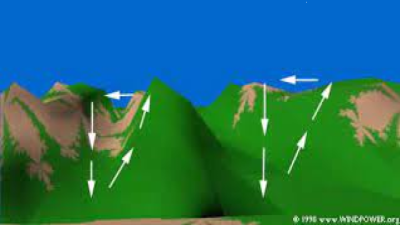
The intricate interplay between topography and atmospheric conditions gives rise to a fascinating meteorological phenomenon known as local winds near mountains. These localized air movements, often influenced by geographical features, can exhibit distinctive patterns that affect regional climates, ecosystems, and human activities.
Understanding Local Winds
Local winds, also referred to as orographic winds, are wind patterns that form due to the interaction between the complex terrains of mountains and the surrounding air masses. These winds can vary in speed, direction, and duration, creating microclimates and influencing weather conditions in specific areas.
Mechanisms of Formation
Local winds near mountains arise from two primary mechanisms: daytime heating and nighttime cooling. During the day, the sun heats up the Earth’s surface, causing the air near the mountains to warm and rise. This creates a low-pressure zone near the mountains. Conversely, at night, the Earth’s surface loses heat rapidly, causing the air near the mountains to cool and sink, resulting in a high-pressure zone. These pressure differences drive the movement of air and the formation of local winds.
Types of Local Winds
Valley Breeze and Mountain Breeze
- Valley Breeze: During the day, the sun heats the valley floor, causing the air to warm and rise. Cooler air from the mountains then flows into the valley, creating a valley breeze.
- Mountain Breeze: At night, the mountains cool down faster than the valleys. The cold air descends from the mountains into the valley, creating a mountain breeze.
Anabatic and Katabatic Winds
- Anabatic Winds: These are upslope winds that occur during the day due to the heated air rising along the mountain slopes.
- Katabatic Winds: Also known as downslope winds, katabatic winds form at night when the cooled air descends from the mountains to the lower elevations.
Föhn Winds
- Föhn winds: They are also called chinook winds, occur when moist air approaches the windward side of a mountain range. As the air rises and cools, it releases moisture as precipitation. Once the air descends on the leeward side, it warms and dries, leading to warmer and drier conditions.
Real-world Examples
- Santa Ana Winds (California, USA): These are strong, dry katabatic winds that descend from the Great Basin towards the coastal regions of Southern California. They are known for exacerbating wildfire conditions.
- Mistral (France): The mistral is a strong cold wind that originates in the Alps and rushes down into the Rhône Valley. It is a katabatic wind that can impact agriculture and local ecosystems.
- Chinook Winds (Rocky Mountains, USA and Canada): These föhn winds bring rapid temperature increases in the midst of winter, melting snow rapidly and affecting local climates and communities.
Impact on Local Environments
Local winds near mountains have profound effects on the environment and human activities:
- Climate: Local winds can modify regional climates, making certain areas warmer or cooler than expected based on their latitude.
- Agriculture: These winds influence growing seasons and affect crop growth. For example, the mistral in France can cause damage to crops and affect fruit trees.
- Transportation: Strong local winds can impact aviation and maritime operations, leading to turbulence and challenging navigation.
- Wildfires: Winds like the Santa Ana winds can intensify wildfire conditions, spreading flames rapidly and making firefighting efforts more challenging.
- Tourism: Some regions, like those experiencing chinook winds, attract tourists seeking unique weather experiences and winter sports.
Local Winds Examples
| Wind Type | Location | Impact and Characteristics |
| Santa Ana | California, USA | Increases wildfire risk and spreads flames rapidly. |
| Mistral | France | Affects agriculture and local ecosystems. |
| Chinook | Rocky Mountains, USA/Canada | Rapidly melts snow and influences local climates. |
Local winds near mountains epitomize the intricate dance between atmospheric dynamics and geographical features. As we uncover the mechanisms, types, and impacts of these winds, we gain a deeper appreciation for the multifaceted ways in which nature shapes our world.
Last Modified: February 22, 2024