

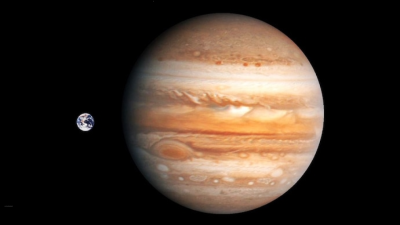
Jupiter, the largest planet in our solar system, holds a significant influence over the celestial dynamics and planetary environment within our cosmic neighborhood. While Earth and Jupiter may seem worlds apart, the immense size and gravitational pull of this gas giant have substantial effects on the life and conditions on our home planet.
Shielding Earth from Asteroid Impacts
Jupiter’s colossal size and strong gravitational force act as a cosmic shield, protecting Earth from potentially catastrophic asteroid impacts. Due to its gravitational pull, Jupiter often attracts asteroids and comets towards itself, either causing them to collide with its surface or altering their paths. This phenomenon, known as gravitational perturbation, helps divert many space debris that would otherwise have posed a threat to Earth. For instance, the Shoemaker-Levy 9 comet, discovered in 1993, collided with Jupiter in 1994, providing scientists with invaluable data on the potential impacts Earth could have experienced.
Stabilizing the Inner Solar System
Jupiter’s massive gravitational influence plays a crucial role in maintaining the overall stability of the inner solar system. Its gravity regulates the orbits of neighboring planets, especially Mars, Earth, and Venus. The intricate dance of these celestial bodies is necessary to prevent potential chaos and collisions. Jupiter’s presence ensures that these planets remain in relatively stable orbits, promoting long-term habitability on Earth. Without Jupiter’s stabilizing effect, Earth’s orbit could be susceptible to drastic changes, leading to extreme climate variations and potential habitability challenges.
Influence on Solar Radiation
Jupiter’s strong magnetic field and its interaction with the solar wind have a significant impact on the radiation levels reaching Earth. The magnetosphere surrounding Jupiter acts as a shield against high-energy particles from the Sun, deflecting them away from our planet. This shield helps protect Earth’s delicate atmosphere and biosphere from excessive radiation exposure. Consequently, Jupiter indirectly contributes to the preservation of life on Earth by reducing the risks associated with solar flares and other solar events that could have detrimental effects on our planet.
Role in Shaping the Early Solar System
Jupiter’s presence during the early formation of the solar system had profound implications for the development of Earth and other terrestrial planets. Its gravitational forces influenced the distribution of matter in the protoplanetary disk, determining the size and composition of celestial bodies that eventually formed. Jupiter’s immense gravity acted as a barrier, preventing a significant amount of material from reaching the inner solar system, thereby influencing the composition and density of planets like Earth. This unique role played by Jupiter helped shape Earth’s geology, composition, and potentially even the emergence of life itself.
The following table illustrates key aspects about ‘Effect of Jupiter on Life of Earth’
| Key Aspect | Data |
| Diameter of Jupiter | Approximately 143,000 kilometers |
| Gravitational force of Jupiter | Roughly 24.79 m/s² |
| Magnetic field strength | 20,000 times stronger than Earth’s magnetic field |
| Distance from Earth | Varies between 588 and 968 million kilometers |
| First observed by | Ancient astronomers, likely as early as the 7th BCE |
While the distance between Jupiter and Earth may seem vast, the effects of this massive gas giant extend far beyond its immediate vicinity. From deflecting potentially hazardous asteroids to stabilizing the inner solar system, Jupiter’s gravitational influence plays a vital role in shaping the conditions that sustain life on Earth. Furthermore, its shielding effect against harmful solar radiation and its role in the early solar system’s development highlight the intricate interconnections among celestial bodies in our cosmic neighborhood.
Last Modified: February 22, 2024