
Ahmadnagar emerged as a sovereign political entity during the late 15th-century disintegration of the Bahmani Sultanate (1347–1527 CE). Under the unified Bahmani state, the northwestern region of Junnar-Daulatabad was a strategic province (Taraf) governed by Malik Hasan Bahri, a prominent leader of the Dakhni (indigenous Deccani Muslim) faction. Following the execution of the reformist Prime Minister Mahmud Gawan in 1481 CE, central Bahmani authority collapsed. Malik Hasan’s son, Malik Ahmad, defeated the puppet Bahmani royal forces at the Battle of Jeur in 1490 CE. He declared formal independence and founded the Nizam Shahi Dynasty, shifting his administrative headquarters from Junnar to a newly established, strategically secure capital named Ahmadnagar along the Sina River.
Geopolitical Matrix and Territorial Boundaries
The Nizam Shahi Kingdom of Ahmadnagar occupied a critical geopolitical corridor in the western Deccan plateau, acting as a buffer zone between Gujarat and Malwa to the north, and the rival Sultanates of Bijapur and Golconda to the south. At its territorial peak, the sultanate’s boundaries extended across the Godavari river basin, encompassing major portions of modern western Maharashtra, from the borders of Berar down to Sholapur, and stretching westward to secure vital access points along the Konkan maritime coast.
The Architectural Legacy and Urban Design of the Nizam Shahis
Fortress Engineering and Military Citadels
The military architecture of Ahmadnagar combined Persian defensive engineering with traditional Indian stone masonry to withstand the introduction of heavy gunpowder artillery in Deccan warfare.
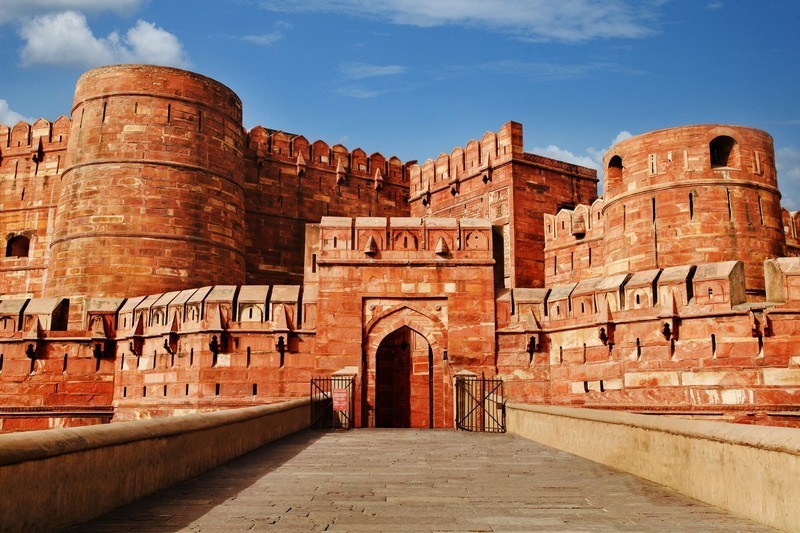
- Ahmadnagar Fort: Constructed initially of mud by Malik Ahmad in 1494 CE and later rebuilt in dressed basalt stone by Hussain Nizam Shah I, this oval fort features a massive 30-foot stone wall reinforced with 24 semi-circular bastions and surrounded by a deep water-filled moat.
- The Daulatabad Fort Adaptations: The Nizam Shahi rulers fortified the captured rock-cut citadel of Daulatabad, maintaining its complex subterranean trap passages and adding heavy artillery platforms like the Mendha Burj.
Royal Palaces and Hydrological Infrastructure
- Farah Bagh: A massive palace complex completed during the reign of Murtaza Nizam Shah I, featuring a two-story octagonal structure built in the center of a large tiered water tank. The palace served as a royal recreational retreat and showcased classic Persian hasht-behisht (eight paradises) design principles.
- Hast Bahisht Bagh: Built by Malik Ahmad, this formal garden palace integrated continuous running water channels, fountains, and pools within residential pavilions, pioneering the synthesis of Persian Charbagh layouts with local Deccani microclimate management.
- The Underground Aqueducts: Ahmadnagar featured an advanced network of underground water channels known as Chalkana, which utilized gravity to transport water from hilltop springs directly into the public fountains, stepwells, and palaces of the urban core.
Socio-Political Factionalism and the Habshi Powerbrokers
The Dakhni versus Afaqi Court Conflict
The domestic politics of Ahmadnagar were shaped by the ongoing structural rivalry between the Dakhnis (indigenous Deccani Muslims) and the Afaqis (foreign Muslim immigrants from Persia and Central Asia). The Nizam Shahi rulers frequently aligned with the Dakhni faction to balance the influence of the Afaqi-dominated courts of Bijapur and Golconda. This internal polarization led to frequent palace coups, shifting administrative policies, and vulnerability to external interventions.
The Rise of Malik Ambar and Guerrilla Warfare
Following the temporary capture of Ahmadnagar by the Mughal Empire in 1600 CE, the Abyssinian military slave (Habshi) Malik Ambar emerged as the de facto regent and prime minister of the displaced Nizam Shahi court at Khadki (later renamed Aurangabad).
- Administrative and Revenue Reforms: Malik Ambar introduced a systematic land revenue system based on actual crop measurement (Zabt), which was modeled on Raja Todar Mal’s reforms and conducted in coordination with indigenous Maratha revenue officials.
- Vargiri Military Strategy: He institutionalized Vargiri (guerrilla warfare), utilizing light, highly mobile Maratha cavalry units to cut off the supply lines of the numerically superior Mughal armies, successfully delaying the final Mughal annexation of the western Deccan for decades.
The Geopolitical Oscillations and Regional Alliances
The Conflict over Sholapur and the Western Ports
Ahmadnagar engaged in a multi-decade rivalry with the Adil Shahi dynasty of Bijapur for control of the fertile Sholapur district and the lucrative trade routes leading to western Konkan ports like Chaul and Dabhol. These ports were essential for exporting local textiles and importing high-quality warhorses from Arabia and Persia, which were required to maintain the state’s heavy cavalry divisions.
The League of the Sultanates and the Battle of Talikota (1565 CE)
Aggressive interventions by the Vijayanagara regent Aliya Rama Raya eventually forced the rival Deccan Sultanates to set aside their internal disputes. Hussain Nizam Shah I of Ahmadnagar entered a grand coalition with Bijapur, Golconda, and Bidar. At the decisive Battle of Talikota (Battle of Rakshasi-Tangadi) in 1565 CE, the allied forces defeated the Vijayanagara army. Hussain Nizam Shah I personally directed the central artillery divisions and executed Rama Raya on the battlefield, leading to the destruction of Hampi and altering the political map of South India.
Chronology of the Nizam Shahi Dynasty
- 1490 CE: Malik Ahmad defeats the Bahmani forces at Jeur, establishes the Nizam Shahi Dynasty, and declares independence.
- 1494 CE: Foundation of the new capital city, Ahmadnagar, along the Sina River.
- 1565 CE: Hussain Nizam Shah I joins the Deccan coalition to defeat the Vijayanagara Empire at the Battle of Talikota.
- 1574 CE: Ahmadnagar invades and annexes the neighboring Imad Shahi Sultanate of Berar, expanding its eastern frontier.
- 1595–1600 CE: Chand Bibi defends the Ahmadnagar Fort against the invading forces of Mughal Emperor Akbar; the city falls temporarily to the Mughals in 1600 CE.
- 1607–1626 CE: Malik Ambar acts as regent, shifts the capital to Khadki, and uses guerrilla warfare to resist Mughal expansion.
- 1633 CE: Mughal Emperor Shah Jahan launches a final campaign, captures the fort of Daulatabad, and annexes the Ahmadnagar Sultanate into the Mughal Empire.
Cultural Legacy, Art, and Literature of Ahmadnagar
The Ahmadnagar School of Miniature Painting
The Nizam Shahi court patronized a distinct school of Deccani miniature art that developed independently of the Mughal style. It was characterized by the use of rich, warm color palettes, highly stylized landscapes featuring indigenous palms and flowering trees, and figures dressed in local traditional attire.
- Tarif-i-Hussain Shahi: An illustrated manuscript commissioned around 1565 CE to celebrate the military achievements and courtly life of Hussain Nizam Shah I, containing fourteen early Deccani miniatures that blend Persian color tones with traditional South Indian visual aesthetics.
Patronage of Literature and Music
The rulers of Ahmadnagar maintained Persian as the official language of diplomacy and administration while actively supporting the development of Dakhni Urdu and Marathi prose. The court attracted prominent poets, historians, and musicians from across West Asia, establishing the city as a major intellectual center on the western plateau.
Essential Facts for UPSC Prelims and Historical Trivia
The Malik-i-Maidan Cannon
Following the Battle of Talikota, the Nizam Shahi dynasty celebrated their victory by maintaining the Malik-i-Maidan (Lord of the Battlefield), one of the largest bell-metal cannons of the medieval world. Cast in bronze by a Turkish engineer named Muhammad Bin Hasan Rumi, this massive artillery piece was later positioned on the fortifications of Bijapur to deter northern Mughal expansion.
Chand Bibi’s Defiance
Chand Bibi, a Nizam Shahi princess who served as the regent of both Bijapur and Ahmadnagar at different times, became a legendary figure in Deccani history for leading the defense of Ahmadnagar Fort against the Mughal forces led by Prince Murad in 1595 CE. Her leadership delayed the Mughal advance, making her a symbol of regional resistance against northern centralization.
The Annexation of Berar
In 1574 CE, under Murtaza Nizam Shah I, Ahmadnagar became the first Deccan Sultanate to successfully annex a neighboring breakaway state by invading and absorbing the Imad Shahi Sultanate of Berar, expanding its territory prior to facing direct Mughal pressure.
The Maratha Transition Network
The administrative structure of Ahmadnagar served as a major training ground for local Maratha aristocrats. Prominent families, including Shahaji Bhonsle (the father of Chhatrapati Shivaji Maharaj), served as high-ranking military commanders (Mansabdars) and revenue officials under the late Nizam Shahi kings. This experience provided the military and institutional framework that later aided the rise of the independent Maratha Empire.
Last Modified: June 22, 2026