
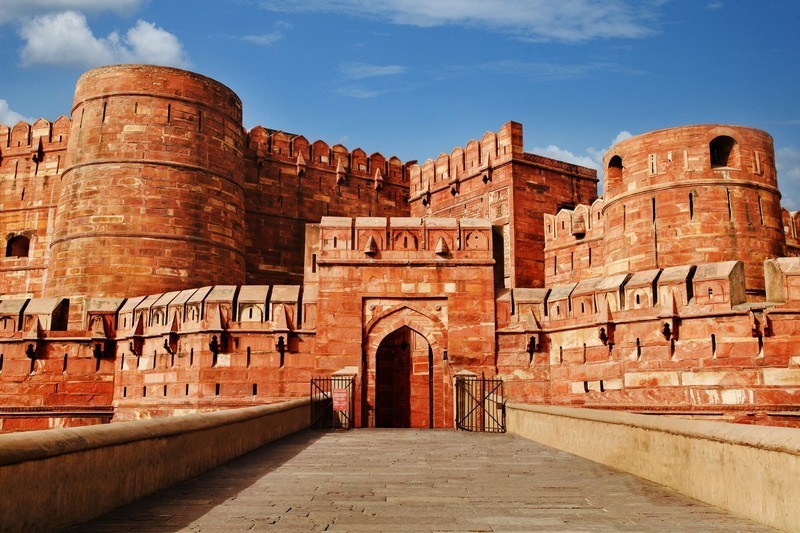
Deccani art and architecture evolved distinctively between the 14th and 17th centuries under the Bahmani Sultanate (1347–1527 CE) and its five successor Deccan Sultanates (Bijapur, Ahmadnagar, Golconda, Bidar, and Berar). This architectural style represented a unique fusion of the military-sloping traditions of the Delhi Sultanate (Tughlaq style), sophisticated structural engineering from Timurid Persia and the Ottoman Empire, and the indigenous stone-carving traditions of the local Hindu kingdoms (Chalukya, Kakatiya, and Hoysala).
Transition of Capital Centers
The artistic center of gravity shifted geographically over time, leaving distinct monumental footprints across the Deccan plateau. The early phase (1347–1425 CE) was anchored at Gulbarga (Ahsanabad), characterized by heavy, austere, and fortress-like masonry. The mature phase (1425–1527 CE) moved to Bidar (Muhammadabad), which embraced open courtyards, extensive glazed tilework, and Persian urban planning. Following the fragmentation of the Bahmani state, individual sultanates developed specialized regional sub-styles, such as the grand dome engineering of Bijapur and the minaret-centric layouts of Golconda.
Monolithic Fortifications and Military Engineering
The Triple-Moat Systems and West Asian Defenses
Deccani military architecture introduced advanced West Asian engineering to counter the introduction of heavy gunpowder artillery in South Indian warfare. Fortresses like Bidar, Gulbarga, and Daulatabad featured multi-tiered defense systems, including double or triple-concentric stone walls, glacis (sloped banks), and deep moats carved directly out of solid laterite bedrock.
Strategic Gateways and Heavy Bastions
- Gumbad Darwaza and Sharaza Darwaza: Located at Bidar Fort, these monumental entry gates feature Persian-style low-slung arches flanked by defensive stone relief carvings of lions (Sharaza), designed to project imperial power while serving as tactical choke points.
- Munda Burj and Kal Burj: Massive circular bastions constructed from dressed basalt stone blocks fitted without mortar (cyclopean masonry at its base) to absorb the kinetic energy of heavy cannon fire.
- The Bara Gazi Tope: A legendary 29-foot bronze-and-iron alloy cannon mounted on the battlements of Gulbarga Fort, representing the peak of medieval metallurgical casting and artillery deployment.
Masterpieces of Bahmani Architecture
The Architectural Anomalies of Gulbarga
The early Bahmani phase concentrated on establishing religious and funerary legitimacy independent of the Delhi Sultanate. The structural monuments of this era showcase a transition from thick, inward-sloping Tughlaq walls to delicate local decorative elements.
Spatial Design of the Jami Masjid of Gulbarga (1367 CE)
Commissioned by Muhammad Shah I and designed by the Persian architect Rafi bin Shams bin Mansur, this structure is a major anomaly in Indian Islamic architecture due to its completely covered layout:
- Absence of Courtyard: Unlike traditional mosques that feature an open-air central courtyard (sahn), the entire 38,000 square foot area is roofed over to protect the congregation from the harsh Deccani summer climate.
- Dome Matrix: The roof comprises a central high dome placed on a square clerestory, balanced by four medium corner domes and 63 smaller cupolas resting on intersecting longitudinal vaults.
- Spanish-Arched Facades: The interior features wide, low arches that resemble the architectural composition of the Great Mosque of Córdoba.
The Haft Gumbaz and Royal Necropolis
Located east of Gulbarga, the Haft Gumbaz (Seven Domes) serves as the burial ground for early Bahmani rulers. The tombs illustrate a clear architectural progression:
- Tomb of Alauddin Hasan Bahman Shah: Displays thick, battering (sloping) walls, basic battlements, and a low, heavy dome modeled closely on the Tomb of Ghiyasuddin Tughlaq in Delhi.
- Double Tomb of Tajuddin Firoz Shah: A unique two-chambered structure featuring highly ornate plaster moldings, geometric stone-latticework screens (jalis), and continuous Persian-style arched recesses, showing the gradual indigenization of the style.
The Mature Phase: Bidar and Timurid Transformations
The Madrasa of Mahmud Gawan (1472 CE)
Built by the Persian-born Prime Minister Mahmud Gawan, this residential university represents the direct transplantation of the Central Asian Timurid style (specifically mimicking the Madrasa of Ulugh Beg in Samarkand) into medieval India.
Structural Layout and Kashi-kari Decoration
The Madrasa is a three-story rectangular complex measuring 205 feet by 180 feet, featuring an open central courtyard and a four-iwan plan (four grand vaulted entry halls acting as lecture zones). The street-facing facade was originally flanked by two minarets standing over 131 feet tall, decorated with vibrant Kashi-kari (glazed tile mosaic work) imported from Kashan, Iran. The zigzag chevron patterns in turquoise, green, and yellow tiles are interspersed with bold calligraphic bands in the Thuluth script containing Quranic verses.
Elite Palaces within Bidar Citadel
- Rangin Mahal: Built under the late Bahmani rulers and modified by the Barid Shahi dynasty, this palace is famous for its mother-of-pearl inlay work set into black basalt wood frames, alongside stylized multi-colored tile mosaics.
- Solah Khamba Masjid (1424 CE): Named after the sixteen massive circular monolithic stone pillars that support the central prayer hall, featuring a heavy dome with a lotus-leaf base.
Regional Sub-Styles of the Successor Deccan Sultanates
| Sultanate / Dynasty | Architectural Sub-Style Characteristics | Representative Masterpieces | Key Structural Innovation |
| Bijapur (Adil Shahi) | Focuses on grand scale, massive hemisphereal domes, lotus-bud petal decorations, and slender minaret-like turrets. | Gol Gumbaz, Ibrahim Rauza, Miya Mahal | Intersecting arched arches forming a pendentive ring that supports huge domes without internal pillars. |
| Golconda (Qutb Shahi) | Emphasizes verticality, granite construction, extensive stuccowork, and multiple decorative minarets on roof edges. | Charminar, Golconda Fort, Tombs of Qutb Shahi Rulers | Synthesis of Persian arch forms with local Hindu lotus, chain, and pendant motifs executed in hard granite. |
| Ahmadnagar (Nizam Shahi) | Characterized by simple, low-slung garden pavilions and functional military architecture. | Farah Bagh, Tomb of Ahmad Nizam Shah | Integration of continuous water channels, fountains, and pools within residential palace complexes (Hadiqa). |
| Bidar (Barid Shahi) | Noted for small, highly ornate garden tombs with bulbous domes and fine wood carvings. | Tomb of Ali Barid Shah, Rangin Mahal expansions | Perfected the Charbagh (four-quartered Persian garden) layout for individual funerary monuments. |
The Structural Miracles of Bijapur and Golconda
Gol Gumbaz: The Triumph of Structural Engineering
Built by Muhammad Adil Shah (r. 1627–1656 CE) in Bijapur, the Gol Gumbaz stands as one of the largest single-chamber structures in the world. The main hall is a square space measuring 135 feet on each side, completely free of internal pillars or support columns.
- The Whispering Gallery: Located inside the drum of the dome, 109 feet above the floor, this circular gallery is acoustically engineered so that the softest sound is echoed ten times across the diameter.
- Intersecting Arches: The weight of the massive hemispherical brick dome (with an internal diameter of 144 feet) is distributed through a system of eight intersecting arches that form a circular platform (pendentive), counterbalancing the lateral thrust.
Ibrahim Rauza: The Taj Mahal of the Deccan
The Ibrahim Rauza is the twin mausoleum complex of Ibrahim Adil Shah II, completed in 1626 CE. It features deep, ornate stone carvings, hanging stone balconies supported by brackets, and open-work stone inscriptions. The flat stone ceiling of its burial chamber is composed of stone slabs joined with a highly durable lime-mortar mortar, a major feat of tension engineering.
Charminar and the Urban Planning of Hyderabad
Constructed in 1591 CE by Muhammad Quli Qutb Shah to mark the cessation of a plague, the Charminar served as the architectural anchor for the new city of Hyderabad. It is a square structure with four grand arches facing the cardinal directions. Each corner features a 184-foot minaret divided into four tiers with decorative arcades, combining civic utility, Islamic architectural forms, and Hindu-style decorative stucco moldings.
Deccani Painting and Calligraphy
The Synthesis of Bijapur and Golconda Schools
Deccani painting flourished as a distinct school of Indo-Islamic miniature art, developing independently of the contemporary Mughal atelier. It combined early Vijayanagara wall painting styles with imported Safavid Persian miniatures and European portraiture techniques introduced via Western coastal ports.
Stylistic Attributes of Deccani Miniatures
- Color Palette: Characterized by the use of rich, luminous colors, particularly deep blues, mineral greens, and a heavy application of gold leaf (puriz).
- Elongated Figures: Human figures are depicted with elongated bodies, fine facial features, and flowing, transparent drapery reflecting local fashion trends.
- Deccani Flora and Fauna: Backgrounds feature highly stylized representations of local landscapes, emphasizing local plants, palm trees, and water features filled with dynamic wildlife.
Key Manuscripts and Illustrated Texts
- Nujum-ul-Ulum (Stars of Sciences – 1570 CE): An encyclopedic manuscript illustrated at Bijapur under Ali Adil Shah I, containing 876 miniatures detailing Deccani innovations in astronomy, astrology, and military weaponry.
- Tarif-i-Hussain Shahi: An illustrated manuscript from Ahmadnagar celebrating the military achievements of Nizam Shahi rulers, demonstrating a strong fusion of local traditional costumes and Persian color tones.
- Kitab-i-Nawras: A collection of musical compositions written by Ibrahim Adil Shah II in Dakhni Urdu, which inspired various ragamala miniature paintings that synchronized visual art with classical Indian musical modes (ragas).
The Industrial Heritage of Bidriware
Metallurgical Composition and Craft Origin
Bidriware is a unique metal-inlay handicraft that developed in Bidar during the 14th century under early Bahmani patronage, brought to India by Syrian craftsmen. The process involves casting an alloy composed of roughly 94% zinc and 6% copper.
The Blackening Chemistry of Bidar Soil
The unique finish of Bidriware relies on the specific chemical properties of the soil collected from the unlit, historic cellars of the Bidar Fort. This soil, which contains high concentrations of ammonium chloride, is mixed with water and applied to the metal surface. The solution oxidizes the zinc-copper alloy, turning it a deep black color while leaving the inlaid silver or gold wire unaffected. This creates a sharp, durable visual contrast that was highly prized for royal huqqas, basins, and betel boxes (pandans).
Essential Historical Facts and Examination Trivia
The Tomb of Sufi Saint Hazrat Khwaja Bande Nawaz
Located at Gulbarga, this shrine features interior walls decorated with gold leaf and bright lacquer eco-friendly frescoes, reflecting a direct synthesis of local folk art and formal courtly iconography.
The Malik-i-Maidan Metallurgical Mystery
The Malik-i-Maidan (Lord of the Battlefield) cannon, captured by the Adil Shahis at the Battle of Talikota, was cast from bell metal (eight parts copper to two parts tin). The surface remains smooth and stays cool to the touch even under direct sunlight, showing the advanced state of Deccani metallurgical science.
The Qanat or Karez Hydrological System
The architectural layout of Bidar and Bijapur was directly integrated with the Karez system—subterranean gravity-fed water networks engineered by Persian water resource experts to supply the fountains, gardens, and palaces of the ruling class.
The Concept of Rauza
Unlike traditional isolated tombs, Deccani architecture perfected the Rauza concept—a unified architectural complex where the final resting place of a ruler and a functioning mosque are built facing each other on a single raised stone platform, surrounded by formal gardens.
Last Modified: June 22, 2026