
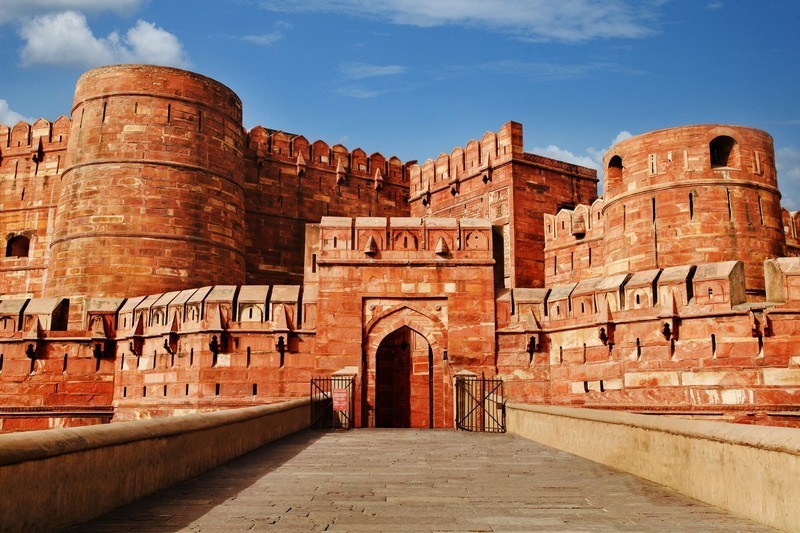
The unified Bahmani Sultanate (1347–1527 CE), established by Alauddin Hasan Bahman Shah after fracturing from the Delhi Sultanate, served as the dominant Islamic polity in the medieval Deccan plateau. The kingdom’s administrative structure was divided into major provinces called Tarafs, governed by powerful Tarafdars. By the late 15th century, intense court factionalism between the Dakhnis (indigenous Deccani Muslims) and the Afaqis (foreign Muslim nobility from Persia, Central Asia, and Turkey) severely undermined central authority at Bidar. This internal decay culminated in the execution of the reformist Prime Minister Mahmud Gawan in 1481 CE, triggering the fragmentation of the empire into five independent successor states, collectively known as the Deccan Sultanates.
The Five Breakaway Dynasties
The five successor states carved up the vast Bahmani territories, establishing unique regional power centers across the central and western Deccan plateau prior to European colonial entrenchment.
- Bijapur (Adil Shahi Dynasty): Founded by Yusuf Adil Khan in 1489 CE, this state controlled the southwestern Deccan, the fertile Raichur Doab, and the vital Konkan coast.
- Ahmadnagar (Nizam Shahi Dynasty): Founded by Malik Ahmad Nizam Shah in 1490 CE, it dominated the northwestern Deccan and pioneered advanced local mobile warfare tactics.
- Golconda (Qutb Shahi Dynasty): Founded by Sultan Quli Qutb-ul-Mulk in 1518 CE, this eastern sultanate covered the Telugu-speaking Telangana region and controlled global diamond networks.
- Berar (Imad Shahi Dynasty): Founded by Fathullah Imad-ul-Mulk in 1490 CE in the northern fertile Purna River valley, it was the first province to declare de facto independence.
- Bidar (Barid Shahi Dynasty): Founded by Qasim Barid I in 1492 CE around the old Bahmani capital core, it operated as a small but highly strategic central buffer state.
Socio-Political Matrix of the Five Deccan Sultanates
| Sultanate | Dynastic Line | Core Region | Capital Cities | Year of Foundation & Founder | Final Fate / Year of Annexation |
| Bijapur | Adil Shahi | Southwestern Deccan, Karnataka | Bijapur (Vijayapura) | 1489 CE; Yusuf Adil Khan | Annexed by Mughal Emperor Aurangzeb (1686 CE) |
| Ahmadnagar | Nizam Shahi | Northwestern Deccan, Maharashtra | Junnar, Ahmadnagar, Daulatabad | 1490 CE; Malik Ahmad Nizam Shah | Annexed by Mughal Emperor Shah Jahan (1633 CE) |
| Golconda | Qutb Shahi | Eastern Deccan, Telangana & Andhra | Golconda, Hyderabad | 1518 CE; Sultan Quli Qutb-ul-Mulk | Annexed by Mughal Emperor Aurangzeb (1687 CE) |
| Berar | Imad Shahi | Northern Deccan, Vidarbha | Ellichpur (Achalpur), Gawilgarh | 1490 CE; Fathullah Imad-ul-Mulk | Annexed by the Ahmadnagar Sultanate (1574 CE) |
| Bidar | Barid Shahi | Central Deccan Plateau | Bidar (Muhammadabad) | 1492 CE; Qasim Barid I | Annexed by the Adil Shahi Dynasty of Bijapur (1619 CE) |
Geopolitical Dynamics, Strategic Doabs, and Regional Conflict
The Raichur Doab Dispute
The defining military and economic flashpoint of the pre-European Deccan was the multi-century struggle for the Raichur Doab. This highly fertile tract of land, situated between the Krishna and Tungabhadra rivers, was contested between the Muslim Deccan Sultanates and the Hindu Vijayanagara Empire. Control over the Doab secured vast agricultural revenues, direct access to the rich diamond mines of Guntur, and hegemony over major inland trade routes.
The Battle of Raichur (1520 CE)
In 1520 CE, the Vijayanagara Emperor Krishnadevaraya launched a massive offensive to recapture the strategic fortresses of Mudgal and Raichur from Ismail Adil Shah of Bijapur. The conflict resulted in a total tactical defeat for Bijapur, primarily due to Krishnadevaraya’s effective deployment of high-grade Portuguese mercenary musketeers and heavy infantry. This forced the Adil Shahi forces north of the Krishna River and temporarily shifted the regional balance of power in favor of Vijayanagara.
The Grand Coalition and the Battle of Talikota (1565 CE)
Following decades of political manipulation by the Vijayanagara regent Aliya Rama Raya, who frequently turned the independent sultanates against one another, the rival Muslim states formed a grand military alliance. Ali Adil Shah I of Bijapur, Hussain Nizam Shah I of Ahmadnagar, Ibrahim Qutb Shah of Golconda, and Ali Barid Shah I of Bidar united their armies to neutralize the southern empire. On January 23, 1565 CE, at the Battle of Talikota (also known as the Battle of Rakshasi-Tangadi), the allied Sultanates utilized superior heavy field artillery and mobile Deccani cavalry to completely crush the Vijayanagara forces. This victory led to the sack of Hampi and allowed the sultanates to permanently absorb the Raichur Doab and extend their territories into the southern Carnatic plain.
Administrative Structures and Fiscal Revenue Systems
The Taraf and Jagirdari Framework
The Deccan Sultanates preserved and adapted the administrative foundations laid down during the Bahmani era. The kingdoms were divided into provinces (Tarafs) and smaller administrative districts (Sarkars and Parganas). The central states relied heavily on the Jagirdari or Mokasa system, under which military officers and civil bureaucrats were granted the right to collect land revenue from specific territories in lieu of cash salaries.
Indigenous Collaboration and the Maratha Interface
Due to their persistent shortage of foreign administrative manpower, the sultanates integrated local Hindu populations into senior administrative, financial, and military roles.
- The Deshmukhi System: Local revenue collection was managed by hereditary Hindu officials known as Deshmukhs and Deshpandes, who acted as intermediaries between the central court and the peasantry.
- The Rise of Maratha Mansabdars: Prominent Maratha clans, including the Bhonsles, Jadhavs, Nimbalkars, and Ghatges, were recruited into the state armies as elite cavalry commanders (Mansabdars). Families like that of Shahaji Bhonsle (father of Chhatrapati Shivaji Maharaj) gained extensive administrative experience, military training, and land grants (vatan) under the Nizam Shahi court of Ahmadnagar and the Adil Shahi court of Bijapur. This structural involvement provided the institutional and military framework that later enabled the rise of an independent Maratha Empire.
The Mustajiri System of Revenue Farming
In the commercially vibrant eastern provinces of Golconda, the state widely deployed the Mustajiri system (revenue farming). Under this fiscal model, the right to collect land revenue and sea customs from specific districts was auctioned off annually to wealthy merchants, high-ranking nobles, or financiers in exchange for a fixed advance payment to the central royal treasury. While it guaranteed immediate liquidity to the sultanate, it frequently resulted in intense economic pressure on the local agrarian peasantry.
Pre-European Trade, Diamond Monopoly, and the Maritime Economy
The Global Diamond Market
The Qutb Shahi Kingdom of Golconda held a world monopoly on the extraction and trade of high-grade diamonds prior to the discovery of mines in Brazil during the 18th century. The state strictly controlled the rich alluvial mining fields along the lower Krishna River basin, most notably the Kollur Mine in Guntur. By royal decree, all diamonds weighing above a specific carat weight were automatically designated as the exclusive property of the royal treasury, while smaller gems were taxed heavily by state inspectors. This trade produced legendary diamonds, including the Koh-i-Noor, the Hope Diamond, the Daria-i-Noor, and the Regent Diamond.
Maritime Trade Infrastructure and Ports
Long before European joint-stock companies established dominance, the Deccan Sultanates maintained vibrant maritime trade networks across the Indian Ocean, linking the plateau directly with Persia, Arabia, Southeast Asia, and China.
- Western Ports: Bijapur and Ahmadnagar controlled the strategic Konkan ports of Goa (until 1510 CE), Dabhol, and Chaul, which served as the primary entry points for importing premium warhorses from the Persian Gulf.
- Eastern Ports: Golconda developed Machilipatnam (Masulipatnam) on the Coromandel Coast into a world-class international emporium. Managed by specialized royal port administrators (Shahbandars), Machilipatnam exported fine Deccani painted textiles (chintz), kalamkari fabrics, indigo, and high-tensile iron directly to global markets.
Architectural Innovations and Engineering Marvels
The Deccani Architectural Style
Architecture under the Bahmanis and Deccan Sultanates developed a distinct hybrid style that fused Persian and Timurid structural forms with local Hindu decorative arts. Key features included bulbous hemispherical domes, lotus-bud plaster rims, heavy hanging stone balconies (jharokhas), and slender minaret-style turrets.
- Gol Gumbaz (Bijapur): Built in 1656 CE as the mausoleum of Muhammad Adil Shah, it features one of the largest single-chamber domes in the world. The massive structure rests on a system of eight intersecting arches forming a circular platform (pendentive), entirely eliminating the need for internal pillar support. The interior contains the “Whispering Gallery,” an acoustic marvel where sounds are echoed multiple times along the circular gallery wall.
- Ibrahim Rauza (Bijapur): Completed in 1626 CE by the royal architect Malik Sandal, this twin-monument complex functions as the tomb and mosque of Ibrahim Adil Shah II. It is celebrated for its delicate flat stone ceilings, hanging balconies, and heavy stone carvings, earning it the historical title of the “Taj Mahal of the South.”
- Charminar (Hyderabad): Constructed in 1591 CE by Muhammad Quli Qutb Shah to mark the center point of his new grid-planned capital city, this square monument features four grand structural arches facing the cardinal directions, topped by an open-air school (madrasa) and mosque, with four corner minarets rising to 184 feet.
Advanced Hydrological Engineering
To sustain dense urban populations and extensive royal gardens in a semi-arid plateau environment, the Deccani rulers deployed sophisticated water-management engineering.
- The Karez (Qanat) System: Extensively used in Bidar and Bijapur, this Persian-style infrastructure consisted of subterranean, gravity-fed tunnels carved directly into solid rock. These channels tapped into hilltop water tables miles outside the city walls, transporting clean water directly into public stepwells (baolis), palaces, and fort complexes without evaporation losses.
- Golconda Fort Hydrology: The citadel featured a multi-tiered Persian wheel system that lifted water from the external Durgam Cheruvu lake into massive stone overhead cisterns on the hill, supplying running water under high pressure to hilltop palaces.
Cultural Syncretism, Literature, and the Fine Arts
The Deccani School of Miniature Painting
The Deccan Sultanates patronized an elite style of miniature painting that developed independently of the contemporary Mughal courts. Characterized by a rich, luminous color palette with prominent mineral blues and deep greens, heavy use of gold leaf, elongated human profiles, and highly stylized representations of local flora and fauna, this school flourished under the direct patronage of Ali Adil Shah I and Ibrahim Adil Shah II of Bijapur. Notable illustrated manuscripts include the Nujum-ul-Ulum (Stars of Sciences, 1570 CE), which details Deccani innovations in astronomy, astrology, and medieval weapons technology.
Literary Innovations and Vernacular Integration
The courts of the Deccan Sultanates witnessed a major linguistic transition, encouraging a unique syncretic culture that blended Islamic thought with indigenous Indian traditions.
- The Elevation of Hindavi and Dakhni Urdu: In 1535 CE, Ibrahim Adil Shah I of Bijapur decreed that Hindavi (Dakhni Urdu/early Marathi) would replace Persian as the official language for all local revenue, judicial, and village administration accounts, empowering local indigenous scribes.
- The Kitab-i-Nawras: Sultan Ibrahim Adil Shah II (“Jagadguru Badshah”) composed the Kitab-i-Nawras (Book of Nine Rasas) in Dakhni Urdu. This collection of musical compositions, set to classical Indian ragas, opened with structured hymns dedicated to Hindu deities like Saraswati and Ganapati alongside local Islamic Sufi saints.
- Telugu Literature and Malkibharama: The Qutb Shahi rulers, particularly Ibrahim Quli Qutb Shah, heavily patronized Telugu literature. He invited renowned local poets like Addanki Gangadhara Kavi to his court and was affectionately given the localized Telugu title of Malkibharama in contemporary literary works.
Key Portfolios of the Deccan Bureaucracy
Central Administrative Roles
The internal governance of the Deccan Sultanates was managed by a highly structured council of ministers reporting directly to the Sultan.
- Vakil-us-Sultanat / Peshwa: The Prime Minister or Regent of the state, responsible for coordinating the entire central bureaucracy and executing royal decrees.
- Amir-i-Jumla / Mir Jumla: The Chief Finance and Revenue Minister, who managed land revenue assessments, diamond mine auctions, and state expenditure audits.
- Barid-i-Mamalik: The Chief of Court Intelligence and Post, who managed the vast state espionage network to detect internal subversion and provincial rebellions.
- Kotwal: The Chief of Urban Police and Markets, tasked with maintaining law and order, inspecting market weights, and securing fort gates.
- Shahbandar: The Royal Port Officer stationed at major coastal emporiums like Machilipatnam and Dabhol, responsible for managing sea customs and international traders.
Essential Facts and Historical Trivia for UPSC Prelims
The Malik-i-Maidan Heavy Ordnance
The Malik-i-Maidan (Lord of the Battlefield) cannon remains one of the largest authentic pieces of medieval bell-metal ordnance in India. Cast in 1549 CE by a Turkish engineer in Ahmadnagar, the weapon was secured by Bijapur as a war trophy. Measuring over 14 feet in length and weighing 55 tons, its unique bronze alloy composition kept the weapon cool to the touch even under direct sunlight, showcasing advanced medieval Deccani metallurgy.
The Pathri Boundary Dispute
The town of Pathri was a continuous military flashpoint between the Berar and Ahmadnagar sultanates. Pathri was the ancestral home of the ancestors of Burhan Nizam Shah I of Ahmadnagar, who had originally been Hindu Kulkarnis (village accountants) before converting to Islam. Because of this personal dynastic history, Ahmadnagar launched multiple costly military campaigns purely to capture and hold this single district from Berar.
The Solah Khamba Masjid of Bidar
Situated within the Bidar Fort complex, this “Sixteen-Pillar Mosque” was built in 1327 CE by Qubil Sultani during the early Tughlaq extensions and later integrated into the core landscape of the Barid Shahi state. It is characterized by its massive circular pillars, long vaulted prayer halls, and lack of ornate external decoration, illustrating early Islamic architectural forms in the Deccan.
The Kanchi Gopanna Connection
Kancharla Gopanna (popularly known as Bhakta Ramadasu), a local revenue official (Tehsildar) working under the Qutb Shahi administration of Golconda, utilized state tax collections to construct the famous Sri Sita Ramachandra Swamy Temple at Bhadrachalam. This act initially led to his imprisonment inside the Golconda Fort before he was pardoned by Sultan Abul Hasan Tana Shah.
The Mecca Masjid Brick Legend
Sultan Muhammad Qutb Shah initiated the construction of the grand Mecca Masjid in Hyderabad in 1614 CE. According to historical records, the central archways of the mosque were constructed using bricks cast from soil imported directly from the holy city of Mecca, giving the monument its name.
Last Modified: June 22, 2026