
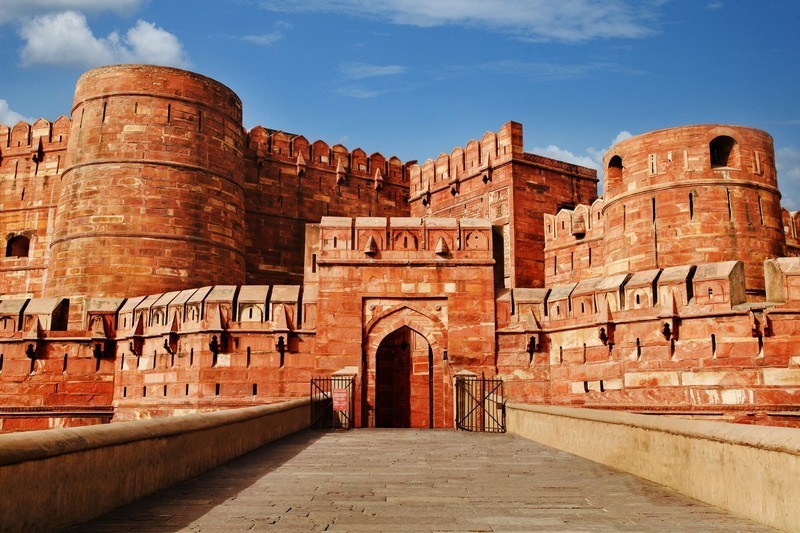
The architecture of Mandu, historically known as Shadiabad (The City of Joy), represents the independent evolution of the Malwa Provincial Style under the Ghuri and Khalji dynasties (1401–1561 CE). Situated on a detached plateau of the Vindhyan range in Madhya Pradesh, Mandu’s topography provided a natural fortress that dictated its defensive urban planning. The architectural style transitioned away from the ornate structural templates of the Delhi Sultanate, developing a distinct regional idiom marked by monumental scale, structural symmetry, and minimal surface ornamentation.
Core Architectural Idioms and Engineering Innovations
Arcuate-Trabeate Structural Synthesis
The Mandu builders successfully combined the indigenous Indian lintel-and-bracket (trabeate) engineering with the Islamic arch-and-dome (arcuate) system. This integration enabled the construction of wide, unobstructed prayer halls and multi-storied palaces without compromising structural stability.
The Batter (Tapering Wall Technique)
Influenced by the early Tughlaq architecture of Delhi, Mandu structures incorporated a pronounced slope or “batter” in their exterior walls. This technique gave buildings like the Hindola Mahal an appearance of massive strength and military permanence.
Polychromatic Glazed Tile Inlays
Mandu pioneered the large-scale use of architectural color in central India. Artisans inlaid locally manufactured glazed tiles in vibrant turquoise, deep blue, and emerald green into sandstone facades to break the visual monotony of the dark local basalt rock.
Advanced Subterranean Hydro-Engineering
Due to the lack of perennial rivers on the plateau, the city’s palaces and civic centers were integrated with interconnected water-harvesting networks. These included deep stepwells (vavs), siphon-fed pressure channels, and massive artificial lakes designed to regulate the microclimate of the royal quarters.
Structural Profiles of Major Architectural Masterpieces
Hoshang Shah’s Tomb
- Structural Attributes: Commenced by Hoshang Shah and completed by Mahmud Khalji I around 1440 CE, this is celebrated as India’s first monumental structure built entirely of pure white marble.
- Design Elements: It features a well-proportioned central dome, corner cupolas (chhatris), and intricate marble lattice screens (jalis) that filter natural light.
- Historical Impact: Imperial records note that Mughal Emperor Shah Jahan sent his court architects, including Ustad Ahmad Lahori, to inspect this tomb to derive structural layouts prior to designing the Taj Mahal.
Jami Masjid of Mandu
- Structural Attributes: Completed in 1454 CE, this congregational mosque stands on a raised plinth with a grand domed entrance porch.
- Design Elements: The vast interior courtyard is enclosed by pillared cloisters forming a series of uniform arches and crowned by 58 small domes. The western qibla wall features eleven niches (mihrabs) carved with intricate black marble borders showing distinct Hindu design motifs like lotus scrolls.
Jahaz Mahal (The Ship Palace)
- Structural Attributes: Built under Sultan Ghiyas-ud-din Khalji (1469–1500 CE) to house the royal harem, this narrow, two-storied palace is built between two artificial water bodies: the Kapur Talao and the Munj Talao.
- Design Elements: It features open pavilions, projecting balconies, and a highly creative system of open-air swimming pools with stepped spiral channels that served a functional cooling purpose during hot summers.
Hindola Mahal (The Swinging Palace)
- Structural Attributes: Constructed as the royal audience hall (Darbar-i-Aam), it derives its name from its exceptionally thick outer walls that slope inward at an angle of 77 degrees, creating an optical illusion of a swinging structure.
- Design Elements: The interior is a single transverse hall supported by a series of high, wide-spanned pointed arches without any central pillar obstruction.
Ashrafi Mahal (The Palace of Gold Coins)
- Structural Attributes: Originally built by Hoshang Shah as a madrasa, it was later modified by Mahmud Khalji I into a victory tower and a royal mausoleum.
- Design Elements: The complex contained a seven-storied marble victory tower designed to celebrate victories over Mewar, of which only the massive basement platform survives today.
Typological Classification of Mandu’s Monuments
| Monument Category | Primary Structural Materials | Notable Examples | Defining Architectural Feature |
| Religious Monoliths | Red Sandstone, Marble inlays | Jami Masjid, Malik Mughis Mosque | Hypostyle halls, uniform multi-domed roofs, high-perforated stone lattices. |
| Palatial Enclosures | Local Basalt, Sandstone, Glazed Tiles | Jahaz Mahal, Hindola Mahal, Baz Bahadur’s Palace | Tapering walls, integrated swimming pools, open terrace pavilions (baradaris). |
| Funerary Monuments | Pure White Marble, Basalt | Tomb of Hoshang Shah, Darya Khan’s Tomb | Squinch arches supporting massive central domes, corner kiosks. |
| Hydro-Civic Structures | Rubble Masonry, Finished Stone | Champa Baoli, Ujali Baoli, Helical Stepwell | Subterranean cooling chambers, deep circular well shafts, stone water channels. |
The Late Phase: Musical Landscapes and Pastoral Pavilions
During the final phase of the Sultanate under Baz Bahadur (1555–1561 CE), the architecture shifted toward lighter, more romantic structures that blended with the natural landscape.
Baz Bahadur’s Palace
Built at the foot of the hill, this palace features spacious courtyards surrounded by halls with high-sprung rings of arches and an octagonal pavilion on the terrace that overlooks the surrounding valleys.
Roopmati’s Pavilion
Originally constructed as a military observation post on the edge of a 360-meter cliff, it was later modified with open domed kiosks to allow Rani Roopmati, a celebrated musician and queen, to view the sacred Narmada River flowing through the plains below.
UPSC Prelims Historical Trivia
The Architectural Validation by Shah Jahan
An inscription on the doorway of Hoshang Shah’s tomb confirms that in 1659 CE, the Mughal architect Ustad Hamid, accompanied by other master builders, visited Mandu to pay homage to the craftsmanship of the structure, proving its role as an artistic bridge between the architecture of the provincial sultanates and classic Mughal structures.
The Eco-Cooling Mechanism of Champa Baoli
The Champa Baoli is a deep stepwell located within the royal complex that features an underground network of living rooms (taikhanas) connected directly to the water level. This layout used evaporative cooling to maintain temperatures inside the subterranean palace rooms up to ten degrees lower than the surface temperature during peak summer months.
The Epigraphic Synthesis in the Madrasa
The ruins of the Ashrafi Mahal madrasa contain marble door-frames decorated with Arabic inscriptions executed in a style derived from Persian calligraphy, placed alongside lintels that feature traditional Hindu temple chain-and-bell motifs, illustrating the deep cultural synthesis that occurred under the patronage of the Malwa Sultans.
Last Modified: June 22, 2026