
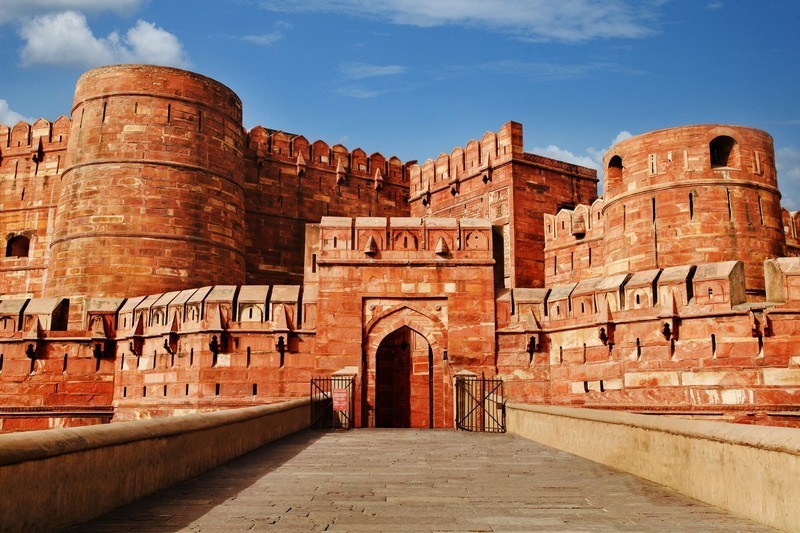
Bijapur (historically Vijayapura, the “City of Victory”) functioned as a premier province (Taraf) under the unified Bahmani Sultanate (1347–1527 CE). The region was strategically positioned on the western Deccan plateau, capturing rich agrarian revenues and trade routes. In 1489 CE, Yusuf Adil Khan, the Bahmani governor of Bijapur and a prominent leader of the Afaqis (foreign Muslim nobility), declared formal independence amidst the collapse of central Bahmani authority at Bidar. This act established the Adil Shahi dynasty, which ruled Bijapur as a sovereign kingdom for nearly two centuries until its final annexation by the Mughal Empire.
Geopolitical Matrix and Territorial Boundaries
The Adil Shahi Kingdom of Bijapur occupied a critical geopolitical position bordered by the Arabian Sea to the west, the Nizam Shahi kingdom of Ahmadnagar to the north, the Qutb Shahi domain of Golconda to the east, and the Hindu Vijayanagara Empire to the south across the Krishna River. At its territorial peak, Bijapur expanded southwards into the Karnataka and Tamil regions, absorbing the western Konkan coast, including the strategic ports of Goa, Dabhol, and Chaul, which facilitated international trade and military imports.
Chronology of the Adil Shahi Rulers of Bijapur
- 1489–1510 CE: Yusuf Adil Khan founds the dynasty, breaks away from the Bahmani Sultanate, and establishes Shia Islam as the state religion.
- 1510–1534 CE: Ismail Adil Shah defends the realm against early Portuguese incursions at Goa and engages in prolonged campaigns over the Raichur Doab.
- 1534–1558 CE: Ibrahim Adil Shah I replaces Persian with Hindavi (Deccani Urdu/Marathi) as the administrative language and restores Sunni traditions.
- 1558–1580 CE: Ali Adil Shah I constructs the city walls, the Jami Masjid, and joins the Deccan coalition against Vijayanagara.
- 1580–1627 CE: Ibrahim Adil Shah II (“Jagadguru Badshah”) presides over a cultural golden age, composing the Kitab-i-Nawras and patronizing Deccani painting.
- 1627–1656 CE: Muhammad Adil Shah commissions the iconic Gol Gumbaz and expands territorial conquests into the deep southern Carnatic region.
- 1656–1672 CE: Ali Adil Shah II encounters rising military resistance from the Maratha leader Chhatrapati Shivaji Maharaj and aggressive Mughal advances.
- 1672–1686 CE: Sikandar Adil Shah reigns as the final minor monarch; Bijapur falls to Mughal Emperor Aurangzeb in 1686 CE.
The Multi-Century Geopolitical Conflict over the Raichur Doab
Economic and Strategic Triggers
The defining geopolitical feature of Bijapur’s history was its multi-century military rivalry with the Vijayanagara Empire over the Raichur Doab, a highly fertile wedge of land situated between the Krishna and Tungabhadra rivers. Control over this territory provided vast agricultural tax revenues and gave direct access to the rich diamond mines of Golconda and the lower Krishna valley. Furthermore, the Doab served as a vital transit corridor for importing high-quality military warhorses from Arabia and Persia through western ports like Goa and Bhatkal.
The Battle of Raichur (1520 CE)
In 1520 CE, the Vijayanagara Emperor Krishnadevaraya launched a decisive campaign to reclaim the fortified outposts of Mudgal and Raichur from Ismail Adil Shah. The Battle of Raichur resulted in a severe defeat for Bijapur. Krishnadevaraya effectively deployed Portuguese mercenary musketeers and heavy shock infantry to breach the Adil Shahi lines, forcing Ismail Adil Shah to retreat north of the Krishna River and temporarily surrender control of the entire Doab.
The Coalition Shift and the Battle of Talikota (1565 CE)
Following decades of political manipulation by the Vijayanagara regent Aliya Rama Raya, who played the independent Deccan Sultanates against each other, the rival Muslim states formed a grand military alliance. Ali Adil Shah I of Bijapur united with the rulers of Ahmadnagar, Golconda, and Bidar to confront Vijayanagara. On January 23, 1565 CE, at the Battle of Talikota (also known as the Battle of Rakshasi-Tangadi), the allied Sultanates used superior heavy field artillery and mobile cavalry tactics to decisively defeat the Vijayanagara forces. This victory led to the destruction of Hampi and the permanent absorption of the Raichur Doab into the Bijapur and Golconda sultanates.
Cultural Golden Age: Art, Architecture, and Literature
The Bijapur Sub-Style of Architecture
Architecture under the Adil Shahi dynasty evolved into a distinct regional style characterized by a massive scale, bulbous hemispherical domes, lotus-bud plaster decorations, and slender minaret-like turrets.
- Gol Gumbaz: The mausoleum of Muhammad Adil Shah, built in 1656 CE, stands as one of the largest single-chamber spaces in the world. The massive dome, with an internal diameter of 144 feet, rests on a system of eight intersecting arches that form a circular platform (pendentive), eliminating the need for internal pillar support. The interior contains the “Whispering Gallery,” an acoustic marvel where the softest sound echoes multiple times across the chamber.
- Ibrahim Rauza: Completed in 1626 CE by architect Malik Sandal, this twin-monument complex serves as the tomb and mosque of Ibrahim Adil Shah II. It features delicate stone carvings, heavy hanging stone balconies, and flat stone ceilings held together by high-tensile lime mortar. It is frequently referred to as the “Taj Mahal of the South.”
- Jami Masjid of Bijapur: Initiated by Ali Adil Shah I following the victory at Talikota, this grand mosque features an expansive open courtyard, a massive central dome, and a highly decorated, gold-leafed mihrab (prayer niche) added later by Sultan Muhammad Adil Shah.
The Bijapur School of Miniature Painting
The Adil Shahi court patronized a brilliant school of Deccani miniature painting that developed independently of the contemporary Mughal atelier. It was distinguished by a rich, luminous color palette, heavy use of gold leaf, elongated human forms, and highly stylized representations of Deccani flora and fauna. The Nujum-ul-Ulum (Stars of Sciences), an encyclopedic manuscript illustrated in 1570 CE under Ali Adil Shah I, features 876 miniatures detailing Deccani innovations in astronomy, astrology, and medieval military technology.
Literary Innovations and Religious Syncretism
Sultan Ibrahim Adil Shah II was a celebrated poet, musician, and calligrapher who promoted a syncretic cultural environment. He composed the Kitab-i-Nawras (Book of Nine Rasas) in Dakhni Urdu, a collection of songs set to classical Indian musical modes (ragas) that opened with invocations to Hindu deities like Saraswati and Ganapati alongside Islamic Sufi saints. He assumed the titles of Jagadguru Badshah (World Teacher) and Abla Bali (Protector of the Poor) to reflect his pluralistic approach to governance.
Administrative, Fiscal, and Hydrological Systems
Administrative Hierarchy and the Maratha Interface
The Adil Shahi state maintained a highly centralized administrative structure at the capital, supported by a network of regional hereditary chiefs. The sultanate relied extensively on indigenous Hindu Maratha and Kannada aristocrats for local governance. Prominent Maratha families, such as the Bhonsles, Shirkes, and Ghatges, served as military commanders (Mansabdars) and controlled rural revenue collection as Deshmukhs and Deshpandes. This administrative experience provided the foundational military and institutional framework that later aided the rise of Chhatrapati Shivaji Maharaj’s independent Maratha Empire.
The Karez Hydrological Infrastructure
To support the growing urban population of Bijapur and maintain its extensive royal gardens, the Adil Shahi kings deployed advanced Persian engineering to construct the Karez system. This infrastructure consisted of subterranean, gravity-fed aqueducts that tapped into hilltop water tables miles outside the city walls. The water was directed through lined underground tunnels into the palaces, public stepwells (baolis), and fountains of the urban core, ensuring a reliable water supply in the semi-arid Deccani climate.
Comparative Matrix of Deccan Administrative Portfolios
| Portfolio Title | Core Administrative Responsibility | Role within the Adil Shahi State |
| Vakil-us-Sultanat | Prime Minister / Regent | Managed the central bureaucracy and directed foreign policy. |
| Amir-i-Jumla | Finance Minister | Oversaw land revenue assessments (Khiraj) and commercial taxes. |
| Kotwal | Chief of Police and Markets | Maintained urban law and order, inspected weights, and guarded fort gates. |
| Qiladar | Garrison Commander | Held direct independent control of strategic frontier fortresses like Mudgal. |
Essential Facts for UPSC Prelims and Historical Trivia
The Malik-i-Maidan Metallurgy
The Malik-i-Maidan (Lord of the Battlefield) cannon remains one of the largest authentic pieces of medieval ordnance in India. Cast in 1549 CE from bell metal (bronze alloy) by a Turkish engineer in Ahmadnagar, the weapon was secured by Bijapur as a war trophy. Measuring over 14 feet in length and weighing 55 tons, its surface was engineered to remain cool to the touch even under direct sunlight, representing a high point of medieval Deccani metallurgy.
The Language Shift of 1535 CE
In a major administrative departure from the traditional pro-Persian policies of the Bahmani state, Ibrahim Adil Shah I decreed in 1535 CE that Hindavi (Dakhni Urdu/early Marathi) would replace Persian as the official language for all local revenue, judicial, and village accounts, significantly empowering local indigenous scribes (Kulkarnis).
The Foreign Chronicle Inscriptions
The socio-economic prosperity, diamond trading, and military mobilization within the Bijapur Sultanate are extensively detailed in the journals of contemporary global travelers, including the Portuguese chronicler Duarte Barbosa (1518 CE), the Italian traveler Pietro Della Valle (1623 CE), and the Dutch merchant van den Broecke, all of whom verified that Bijapur operated as a crucial hub for global maritime commerce.
The Ultimate Fall to Aurangzeb
The sovereign history of Bijapur ended in September 1686 CE. After a grueling 15-month siege conducted by the Mughal forces under Prince Azam and Emperor Aurangzeb, the final Adil Shahi ruler, Sikandar Adil Shah, surrendered. The kingdom was dissolved and transformed into a Mughal province, closing the historic chapter of Adil Shahi rule in the Deccan.
Last Modified: June 22, 2026