
The term Environment is derived from the French word environner, meaning “to encircle” or “to surround.”
Components of Environment
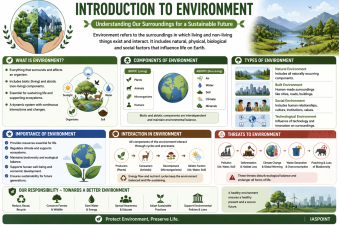
The environment is broadly classified into two primary components: Abiotic (Non-living) and Biotic (Living). The interaction between these two defines the functional unit known as an ecosystem.
Abiotic Components (Physical)
These factors provide the habitat and energy for biotic life.
- Lithosphere: The earth’s crust and upper mantle (soil, minerals, landforms).
- Hydrosphere: All water bodies covering approximately 71% of the earth’s surface.
- Atmosphere: The gaseous envelope (Nitrogen 78%, Oxygen 21%, Argon 0.93%, $CO_2$ 0.04%).
- Energy: Primarily solar radiation, which governs the Earth’s thermal regime.
Biotic Components (Biological)
These include all living organisms categorized by their functional roles.
- Producers (Autotrophs): Green plants and chemosynthetic bacteria that synthesize food.
- Consumers (Heterotrophs): Animals that depend on producers directly (primary) or indirectly (secondary/tertiary).
- Decomposers (Saprotrophs): Fungi and bacteria that break down organic matter into inorganic nutrients.
Environmental Segmentation: The Four Spheres
The environment operates through four interconnected spheres. A disturbance in one inevitably affects the others.
| Sphere | Description | Key Functions |
| Atmosphere | Multilayered gas cover | Protects from UV rays (Ozone); regulates temperature via Greenhouse Effect. |
| Hydrosphere | Water in all forms (solid, liquid, gas) | Facilitates the hydrological cycle; acts as a global heat sink. |
| Lithosphere | Solid outermost shell of the Earth | Provides minerals, soil for agriculture, and tectonic stability. |
| Biosphere | Narrow zone where Life exists | The interface where Air, Water, and Land interact to support life. |
Principles of Environmental Ecology
Levels of Organization
For Prelims, it is essential to understand the hierarchy of biological organization:
- Individual: The basic unit (e.g., a single Elephant).
- Population: Group of individuals of the same species in a specific area.
- Community: Assemblage of different populations interacting together.
- Ecosystem: Functional unit consisting of biotic communities and their abiotic environment.
- Biome: Large regional unit characterized by major vegetation types and climate (e.g., Tundra, Tropical Rainforest).
- Biosphere: The global sum of all ecosystems.
Concept of Ecotone and Niche
- Ecotone: A transition area between two diverse ecosystems (e.g., Mangroves between terrestrial and marine). It often harbors a higher number of species, a phenomenon known as the Edge Effect.
- Ecological Niche: The unique functional role or “profession” of a species in an ecosystem, including its habitat, activities, and resource use. No two species can occupy the exact same niche (Gause’s Principle).
Environmental Factors and Adaptations
Organisms adapt to environmental stressors through various mechanisms:
- Eurythermal vs. Stenothermal: Organisms that can tolerate a wide range of temperatures versus those restricted to narrow ranges.
- Euryhaline vs. Stenohaline: Classification based on tolerance to salinity levels.
- Morphological Adaptations: Sclerenchymatous tissues in desert plants (Xerophytes) or pneumatophores (respiratory roots) in Mangroves.
Significant Environmental Legislation and Facts
| Act/Event | Year | Key Significance |
| Stockholm Conference | 1972 | First global conference on the environment; led to the creation of UNEP. |
| Wildlife Protection Act | 1972 | Legal framework for protecting wildlife and habitats in India. |
| Project Tiger | 1973 | Centrally Sponsored Scheme for conservation of the national animal. |
| Water Act | 1974 | Provided for the prevention and control of water pollution and the CPCB. |
| Environment Protection Act | 1986 | Enacted under Article 253; known as an “Umbrella Legislation.” |
Trivia and Quick Facts for Prelims
- World Environment Day: Celebrated on June 5th (commemorating the 1972 Stockholm Conference).
- The Deep Ecology Concept: Coined by Arne Naess, it argues that all living beings have intrinsic value, regardless of their utility to humans.
- Gaia Hypothesis: Proposed by James Lovelock, suggesting that the Earth and its biological systems behave as a single, self-regulating entity.
- Biocentrism: An ethical standpoint that extends inherent value to all living things, contrasting with Anthropocentrism (human-centered view).