
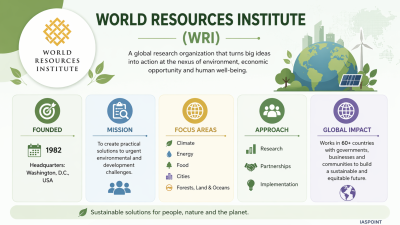
The World Resources Institute (WRI) is a global research organization that spans more than 60 countries. It is renowned for turning high-level data into practical tools and policy recommendations to balance environmental protection with economic opportunity.
Institutional Profile and Framework
Genesis and Mission
- Establishment: Founded in 1982 by James Gustave Speth with a grant from the MacArthur Foundation.
- Headquarters: Washington, D.C., USA.
- Nature: An independent, non-partisan, non-profit global research organization.
- Operating Philosophy: Follows a “Count It, Change It, Scale It” approach—using data to identify problems, piloting solutions, and scaling them globally.
WRI India
- WRI India was established as a separate legal entity in India to address the country’s unique challenges in urban design, climate resilience, and sustainable energy.
- It works closely with state governments (e.g., Tamil Nadu, Maharashtra) and central ministries on the energy transition and EV (Electric Vehicle) policy.
Flagship Tools and Platforms
WRI is highly regarded for its open-access data platforms which are frequently used by the UN and national governments.
| Tool / Platform | Purpose | UPSC Relevance |
| Aqueduct Water Risk Atlas | Maps and analyzes water risks such as water stress, floods, and droughts globally. | India is often ranked among the most “Water Stressed” countries in this atlas. |
| Global Forest Watch (GFW) | An online platform providing near real-time data on global forest loss and gain using satellite imagery. | Used to monitor illegal logging and the efficacy of forest conservation policies. |
| Resource Watch | A dynamic “dashboard” for the planet, featuring over 200 datasets on everything from air quality to human migration. | A central hub for multi-dimensional environmental data. |
| Climate Watch | Provides comprehensive data on national climate pledges (NDCs) and pathways to net-zero. | Essential for tracking global progress toward the Paris Agreement goals. |
| GHG Protocol | Establishes global standards for measuring and managing greenhouse gas emissions. | The most widely used accounting standard for corporate and city-level carbon footprints. |
Major Reports and Research
World Resources Report (WRR)
This is WRI’s flagship publication. Unlike many annual reports, each edition of the WRR focuses on a specific “Grand Challenge” (e.g., “Creating a Sustainable Food Future” or “Towards a More Equal City”).
Stories to Watch 2026
In its 2026 briefing, WRI has shifted focus toward the daily economic reality of the climate transition.
- Growth: Assessing if the energy transition is unlocking “inclusive prosperity” or slowing growth.
- Jobs: Monitoring the shift in the labor market, specifically the demand for green skills in EV supply chains (with a specific focus on India’s workforce).
- Affordability: Evaluating how climate action affects the cost of living and housing.
Key Initiatives and Global Programs
The Ross Center for Sustainable Cities
Focuses on making cities more resilient and inclusive. In India, this program has been instrumental in promoting Bus Rapid Transit (BRT) systems and the Safer Access initiative for pedestrians.
P4G – Partnering for Green Growth and the Global Goals 2030
A WRI-hosted initiative that facilitates public-private partnerships to deliver on the Sustainable Development Goals (SDGs), particularly in food, water, energy, and the circular economy.
Global Restoration Initiative
Works with governments and local partners to restore degraded forests and agricultural landscapes. It is a key supporter of the Bonn Challenge, which aims to bring 350 million hectares of degraded land into restoration by 2030.
WRI’s Recent Impact in India (2025–2026)
- Climate Resilient Villages (Tamil Nadu): WRI India co-designed a model that scaled climate adaptation solutions—like flood-proofing and solar installations—across 11 districts, impacting nearly 2.7 million people.
- EV Transition: WRI India is the primary research partner for several states to design the infrastructure for electric mobility, focusing on “charging demand” modeling and green jobs training.
- Sustainable Finance: Working with Indian financial institutions to align private capital with India’s Panchamrit goals (the five-fold climate targets announced at COP26).
Essential Trivia for UPSC Prelims
- Ani Dasgupta: The current President and CEO of WRI is of Indian origin, highlighting the organization’s strong link with emerging economies.
- The “Water-Food-Energy” Nexus: WRI was a pioneer in popularizing this concept, arguing that you cannot manage one of these resources in isolation from the others.
- Net-Zero Tracker: WRI, in collaboration with other partners, maintains a real-time tracker for countries that have committed to or legislated net-zero emissions targets.
- Building with Nature: A strategy promoted by WRI that uses natural infrastructure (like mangroves or wetlands) instead of “gray” infrastructure (concrete walls) for disaster resilience.