

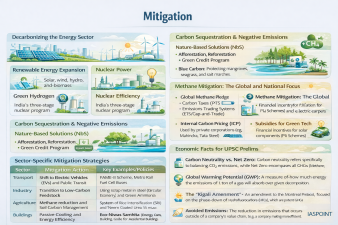
Mitigation refers to human interventions aimed at reducing the sources or enhancing the “sinks” of greenhouse gases (GHGs). While adaptation focuses on living with the impacts of climate change, mitigation addresses the root cause by limiting the magnitude of global warming.
Decarbonizing the Energy Sector
Energy production is the largest contributor to global GHG emissions. Mitigation in this sector involves a transition from fossil fuels to cleaner alternatives.
- Renewable Energy Expansion: Scaling up solar, wind, hydro, and biomass. India’s PM-KUSUM scheme mitigates emissions by solarizing agricultural pumps.
- Green Hydrogen: Utilizing electrolysis powered by renewables to produce hydrogen. The National Green Hydrogen Mission targets 5 MMT (Million Metric Tonnes) of production capacity by 2030.
- Nuclear Power: Acting as a “baseload” power source with zero operational carbon emissions. India’s three-stage nuclear program is a long-term mitigation strategy.
- Energy Efficiency: The Perform, Achieve and Trade (PAT) scheme reduces specific energy consumption in energy-intensive industries (Designated Consumers).
Carbon Sequestration and Negative Emissions
Mitigation also involves removing CO2 already present in the atmosphere or preventing its release at the source.
Nature-Based Solutions (NbS)
- Afforestation and Reforestation: Increasing forest cover to act as carbon sinks. Programs like the Green Credit Program incentivize this.
- Blue Carbon: Protecting coastal ecosystems like mangroves, seagrasses, and salt marshes, which sequester carbon at significantly higher rates than terrestrial forests.
Technological Solutions
- Carbon Capture, Utilization, and Storage (CCUS): Technology that captures CO2 emissions from industrial sources (like steel and cement plants) and either reuses it or stores it underground in geological formations.
- Direct Air Capture (DAC): Emerging technology that extracts CO2 directly from the ambient air.
Sector-Specific Mitigation Strategies
| Sector | Mitigation Action | Key Examples/Policies |
| Transport | Shift to Electric Vehicles (EVs) and Public Transit | FAME-II Scheme, Metro Rail expansion, and Fuel Cell Buses. |
| Industry | Transition to Low-Carbon Feedstock | Using scrap metal in steel (Circular Economy) and Green Ammonia in fertilizers. |
| Agriculture | Methane reduction and Soil Carbon Management | System of Rice Intensification (SRI) and “Neem Coated Urea” to reduce N2O. |
| Buildings | Passive Cooling and Energy Efficiency | Eco-Niwas Samhita (Energy Conservation Building Code for Residential Buildings). |
Methane Mitigation: The Global and National Focus
Methane (CH4) has a Global Warming Potential (GWP) over 80 times that of CO2 over a 20-year period, making its mitigation a “short-term win” for the climate.
- Global Methane Pledge: A global initiative to reduce methane emissions by 30% by 2030 (India is not a signatory but pursues domestic methane reduction).
- GOBARdhan Scheme: Converts cattle dung and organic waste into Biogas/CBG (Compressed Biogas), preventing methane escape from open decomposition.
- Landfill Gas Recovery: Capturing methane from municipal solid waste sites to generate electricity.
Economic Instruments for Mitigation
Governments use market signals to discourage high-carbon activities and reward low-carbon ones.
- Carbon Pricing: Includes Carbon Taxes (a fixed price on carbon content) and Emission Trading Systems (ETS/Cap-and-Trade).
- Internal Carbon Pricing (ICP): Used by private corporations (e.g., Mahindra, Tata Steel) to factor in climate risks during investment decisions.
- Subsidies for Green Tech: Financial incentives for solar components (PLI Schemes) and electric vehicle buyers.
Important Facts for UPSC Prelims
- Carbon Neutrality vs. Net Zero: Carbon neutrality refers specifically to balancing CO2 emissions, while Net Zero encompasses all GHGs (Methane, N2O, etc.).
- Global Warming Potential (GWP): A measure of how much energy the emissions of 1 ton of a gas will absorb over a given period of time, relative to the emissions of 1 ton of CO2.
- The “Kigali Amendment”: An amendment to the Montreal Protocol focused on the phase-down of Hydrofluorocarbons (HFCs), which are potent GHGs used in refrigeration.
- Avoided Emissions: The reduction in emissions that occurs outside of a company’s value chain (e.g., a company making more efficient lightbulbs helps others reduce their emissions).