
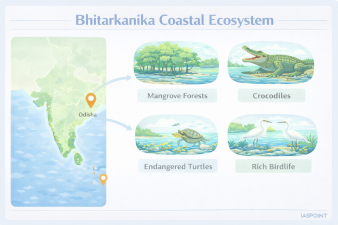
The Bhitarkanika ecosystem, located in the Kendrapara district of Odisha, represents one of the most significant deltaic regions in India. Formed by the alluvial deposits of the Brahmani, Baitarani, and Dhamra rivers, it is a critical intersection of riverine and marine environments.
- Designations: It was designated as a National Park in 1998 and a Ramsar Site in 2002.
- Global Importance: It is the second-largest mangrove ecosystem in India after the Sundarbans.
- Legal Protection: The core area is the Bhitarkanika National Park, surrounded by the Bhitarkanika Wildlife Sanctuary and the Gahirmatha Marine Sanctuary to the east.
Flora: The Mangrove Diversity
Bhitarkanika is often cited as having the highest diversity of mangrove species in India, even surpassing the Sundarbans in terms of species richness per unit area.
- Mangrove Species: It hosts over 60–70 species of mangroves and associated flora. Key genera include Avicennia, Excoecaria, and Rhizophora.
- Ecological Role: The mangroves act as a natural barrier against cyclones (common in the Bay of Bengal) and tsunamis, while preventing soil erosion and maintaining the saline-freshwater balance.
- Adaptations: The vegetation exhibits specialized features such as Pneumatophores (aerial roots for breathing) and Vivipary (seeds germinating while still attached to the parent tree).
Fauna: The Estuarine Giants and Migratory Guests
The ecosystem is globally renowned for its specialized reptilian and avian population.
| Species | Conservation Status (IUCN) | Significance in Bhitarkanika |
| Saltwater Crocodile | Least Concern | Bhitarkanika holds the largest population in India; famous for “white” (leucistic) crocodiles. |
| Olive Ridley Turtle | Vulnerable | Nest on the Gahirmatha beach, which forms the eastern boundary of the sanctuary. |
| King Cobra | Vulnerable | The sanctuary is one of the few mangrove habitats where King Cobras are frequently sighted. |
| Indian Python | Near Threatened | Frequently found in the swampy thickets of the park. |
| Black Ibis | Least Concern | Part of the massive congregation of resident and migratory waterbirds. |
Gahirmatha Marine Sanctuary Connection
Gahirmatha is the aquatic boundary of Bhitarkanika and is inseparable from its ecological health.
- Mass Nesting (Arribada): It is the world’s largest rookery for Olive Ridley Sea Turtles.
- Seasonal Migration: Every winter, hundreds of thousands of turtles travel from the South Pacific to nest here.
- Protection Measures: During the nesting season (November to May), fishing is strictly prohibited within 20 km of the coastline to prevent turtle mortality due to trawler nets.
Key Ecological Threats and Challenges
Despite its protected status, the Bhitarkanika ecosystem faces several anthropogenic and natural pressures.
- Salinity Changes: Alteration in freshwater discharge from the Brahmani and Baitarani rivers due to upstream dams and diversions impacts mangrove health.
- Illegal Shrimp Farming: Encroachment for aquaculture leads to the destruction of mangrove buffers and water pollution.
- Climate Change: Rising sea levels and increased frequency of high-intensity cyclones threaten the low-lying deltaic islands.
- Human-Wildlife Conflict: The high density of saltwater crocodiles often leads to conflicts with local communities residing on the fringes of the sanctuary.
Bhitarkanika Facts for UPSC Prelims
- The “Mini-Amazon”: It is often nicknamed the “Mini-Amazon of India” due to its dense canopy and intricate waterway network.
- Bagagahana: A famous heronry within the park where thousands of migratory birds, such as Open-billed Storks and Egrets, nest during the monsoon.
- Crocodile Census: The 2024-2025 census recorded over 1,800 saltwater crocodiles, confirming the success of the Crocodile Conservation Project launched here in 1975 with UNDP assistance.
- Connectivity: It is part of the East Coast Coastal Zone and is a key site under the MISHTI (Mangrove Initiative for Shoreline Habitats & Tangible Incomes) scheme for restorative plantation.