
The climate landscape of India in 2026 reflects a critical juncture where environmental shifts have become structural economic variables. As per the IMD (India Meteorological Department) and WMO reports, India is witnessing an unprecedented acceleration in extreme weather events, with 2024 and 2025 ranking among the warmest years on record.
Temperature Trends and Heatwaves
The thermal profile of India has shifted significantly, moving from episodic heat to chronic heat stress.
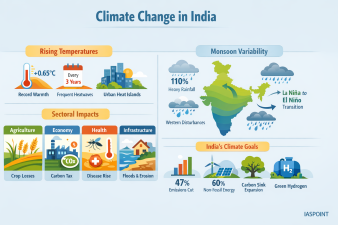
- Record Warmth: 2024 was the warmest year since 1901, with temperatures 0.65°C above the long-term average. 2025 followed as the eighth warmest, with mean temperatures 0.28°C higher than the 1991–2020 average.
- Heatwave Frequency: Heatwaves that historically occurred once every 300 years are now expected every 3 years. In 2026, IMD projects above-normal heatwave days across East, Central, and Northwest India.
- Urban Heat Islands (UHI): Cities like Delhi, Mumbai, and Bengaluru are experiencing localized warming due to concrete density, with night-time (minimum) temperatures showing a consistent upward trend.
Hydrological Shifts and Monsoon Variability
The Indian Summer Monsoon (ISM), which provides 75% of India’s annual rainfall, is becoming increasingly erratic.
- Precipitation Volatility: 2025 saw annual rainfall at 110% of the Long Period Average (LPA), yet seasonal distribution was highly skewed. Winter rainfall dropped to 52% of LPA, while pre-monsoon and monsoon rains were significantly above normal.
- Western Disturbances: There is an observed increase in the frequency of Western Disturbances, contributing to unseasonal rainfall and hailstorms in North India during the Rabi season.
- Triple Dip La Niña to El Niño: After a prolonged La Niña period, 2026 forecasts suggest a gradual transition toward El Niño conditions by July, raising concerns about potential monsoon deficits.
Sectoral Impacts of Climate Change
Climate change in 2026 is no longer just an environmental issue; it is a direct threat to India’s GDP and food security.
| Sector | Nature of Impact | Economic/Physical Data |
| Agriculture | Yield volatility in wheat and paddy due to heat stress and unseasonal rain. | Heat stress erodes 4-6% of GDP annually. |
| Economy | Transition risks for exporters under the EU’s Carbon Border Adjustment Mechanism (CBAM). | Industrial emissions now account for 50% of India’s total. |
| Health | Surge in vector-borne diseases and heat-related mortality. | Record 2.3 lakh Dengue cases reported by late 2024. |
| Infrastructure | Coastal erosion and urban flooding in tier-1 and tier-2 cities. | India lost 235 sq km of land to coastal erosion (1990-2016). |
India’s Revised Climate Commitments (2035 NDC)
In March 2026, India announced its new Nationally Determined Contribution (NDC) targets for 2035, accelerating its path toward Net Zero 2070.
- Emissions Intensity: Aiming for a 47% reduction in emissions intensity of GDP by 2035 (from 2005 levels).
- Non-Fossil Capacity: Target to reach 60% non-fossil installed electricity capacity by 2035. As of February 2026, India had already surpassed its 2030 goal, reaching 52.57%.
- Carbon Sink: A commitment to create an additional carbon sink of 3.5 to 4.0 billion tonnes of CO2 equivalent through forest and tree cover by 2035.
- Green Hydrogen: Scaling up the National Green Hydrogen Mission to decarbonize “hard-to-abate” sectors like steel and cement.
Key Policy Initiatives and Missions
- PM Surya Ghar: Muft Bijli Yojana: Scaling rooftop solar to reduce dependence on the traditional grid.
- Agri-Voltaics: Integrating solar panels over farmland to provide dual income and reduce water evaporation.
- India Carbon Market (ICM): Expected to be fully operational in 2026 to facilitate domestic emissions trading.
- Lifestyle for Environment (LiFE): Promoting sustainable consumption patterns as a core part of global climate mitigation.
UPSC Trivia for 2026
- Carbon Border Adjustment Mechanism (CBAM): A green trade tax by the EU entering its execution phase in 2026, specifically targeting Indian steel, aluminum, and cement.
- Blue Carbon: India is increasingly focusing on “Blue Carbon” through mangrove restoration projects like MISHTI (Mangrove Initiative for Shoreline Habitats & Tangible Incomes).
- Cryospheric Hazard: The 2025-26 period has seen heightened monitoring of GLOFs (Glacial Lake Outburst Floods) in Sikkim and Uttarakhand due to rapid Himalayan deglaciation.