
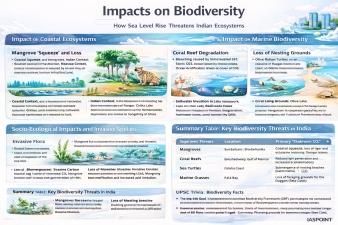
The impact of Sea Level Rise (SLR) on biodiversity is multifaceted, affecting both terrestrial and marine life through habitat loss, physiological stress, and disrupted ecological interactions.
Impact on Coastal Ecosystems
Coastal ecosystems serve as the first line of defense against rising seas but are the most vulnerable to permanent inundation.
- Mangrove “Squeeze” and Loss:
- Coastal Squeeze: As sea levels rise, mangroves naturally attempt to migrate inland. However, human infrastructure (roads, seawalls, agriculture) often blocks this movement, leading to the “squeeze” and eventual death of the forest.
- Indian Context: The Sundarbans (the world’s largest mangrove forest) is losing land at an estimated rate of 5.5 sq km per year. The loss of mangroves reduces the habitat for the Royal Bengal Tiger, which is increasingly forced into human settlements, escalating human-wildlife conflict.
- Saltwater Intrusion in Wetlands:
- Rising seas push saline water into freshwater coastal lagoons and marshes (e.g., Chilika Lake in Odisha or Vembanad Lake in Kerala).
- This alters the salinity gradient, killing freshwater-dependent flora and fauna and disrupting the migratory patterns of birds that use these wetlands as wintering grounds.
Impact on Marine Biodiversity
Marine life is threatened not just by the depth of the water, but by associated changes in temperature and chemistry.
- Coral Reef Degradation:
- Bleaching: Although primarily caused by rising sea surface temperatures (SST), SLR adds depth that can reduce the amount of sunlight reaching deeper reefs, affecting the photosynthetic ability of Zooxanthellae algae.
- Ocean Acidification: Since SLR is driven by increased CO2, the oceans become more acidic. This reduces the availability of carbonate ions, making it difficult for corals and mollusks to build their calcium carbonate skeletons/shells.
- Loss of Nesting Grounds:
- Many endangered species rely on specific beach zones for reproduction.
- Olive Ridley Turtles: India’s Odisha coast (Gahirmatha and Rushikulya) hosts one of the world’s largest mass nesting sites (Arribada). Sea level rise and associated coastal erosion shrink these beaches, directly threatening the survival of hatchlings.
Socio-Ecological Impacts and Invasive Species
The disruption of native ecosystems often paves the way for opportunistic and invasive species.
- Invasive Flora: As native coastal vegetation dies off due to increased salinity, salt-tolerant invasive species may take over, further reducing the quality of the habitat for native wildlife.
- Loss of “Blue Carbon” Sinks: Mangroves, salt marshes, and seagrasses are highly efficient at sequestering carbon (known as Blue Carbon). Their destruction releases stored CO2 back into the atmosphere, creating a “feedback loop” that further accelerates global warming and SLR.
Summary Table: Key Biodiversity Threats in India
| Ecosystem/Species | Location | Primary Threat from SLR |
| Mangroves | Sundarbans, Bhitarkanika | Coastal squeeze; loss of tiger and estuarine crocodile habitats. |
| Coral Reefs | Lakshadweep, Gulf of Mannar | Reduced light penetration and increased acidification. |
| Sea Turtles | Odisha Coast | Submergence of nesting beaches (Gahirmatha). |
| Marine Grasses | Palk Bay | Loss of foraging grounds for the Dugong (Sea Cow). |
UPSC Trivia: Biodiversity Facts
- The 30×30 Goal: Under the Kunming-Montreal Global Biodiversity Framework (GBF), countries aim to protect 30% of the world’s land and oceans by 2030 to mitigate climate impacts on biodiversity.
- Pneumatophores: These are the “breathing roots” of mangroves. Excessive sea level rise can keep these roots submerged for too long, essentially “drowning” the trees by preventing oxygen intake.
- Planetary Boundaries: According to the State of India’s Environment 2026 report, “Biosphere Integrity” (biodiversity) is one of the seven planetary boundaries already breached, with SLR being a major driver for coastal species.