
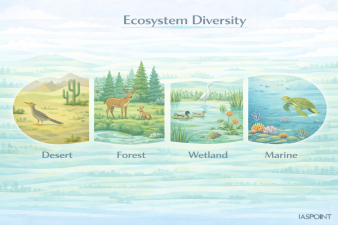
Ecosystem Diversity refers to the variety of habitats, biotic communities, and ecological processes occurring within a specific geographical area or across the entire biosphere. While genetic and species diversity focus on the “players,” ecosystem diversity focuses on the “stage” and the “interactions.” It is the highest level of biodiversity and encompasses the complexity of niches, trophic levels, and nutrient cycles across different environments.
Components of Ecosystem Diversity
Ecosystem diversity is analyzed through three primary structural lenses:
- Landscape Diversity: The spatial arrangement of different ecosystems (e.g., the mosaic of forests, wetlands, and grasslands in a river basin).
- Functional Diversity: The variety of ecological processes and services performed by different ecosystems, such as water filtration in wetlands or carbon sequestration in forests.
- Niche Diversity: The variety of specialized roles (niches) available for different species within a specific habitat.
Whittaker’s Indices for Measuring Ecosystem Diversity
Ecologists use three specific metrics to quantify how diversity is distributed across different scales:
| Metric | Definition | Focus |
| Alpha (α) Diversity | Diversity within a single, specific ecosystem. | Species richness in one spot. |
| Beta (β) Diversity | The rate of change in species composition between two ecosystems. | Species turnover across habitats. |
| Gamma (γ) Diversity | The total diversity of an entire landscape or region. | The “Big Picture” biodiversity. |
Ecosystem Diversity in the Indian Context
India is one of the 17 megadiverse countries, largely due to its immense ecosystem diversity. The country is divided into 10 Biogeographic Zones, each representing a unique ecosystem type:
- Trans-Himalayas: Cold deserts (Ladakh, Lahaul-Spiti).
- Himalayas: From subtropical foothills to alpine meadows.
- Desert: Arid regions of Thar (Rajasthan) and Kutch (Gujarat).
- Semi-Arid: Transitional zones between deserts and forests.
- Western Ghats: Tropical evergreen forests and Sholas.
- Deccan Peninsula: Central highlands and plateau (the largest zone).
- Gangetic Plain: Alluvial plains with high agricultural productivity.
- Coasts: Mangroves, estuaries, and sandy beaches.
- North-East India: Transition zone between Indian, Indo-Malayan, and Indo-Chinese regions.
- Islands: Andaman, Nicobar, and Lakshadweep (Coral reefs and marine ecosystems).
Classification by Habitat Type
Ecosystem diversity is broadly categorized into Terrestrial and Aquatic systems.
1. Terrestrial Ecosystems
Determined primarily by climate (Temperature and Precipitation).
- Forest Ecosystems: Tropical, Temperate, Boreal.
- Grassland Ecosystems: Savannas (Tropical) and Steppes (Temperate).
- Desert Ecosystems: Hot (Thar) and Cold (Gobi/Ladakh).
2. Aquatic Ecosystems
Determined by salinity and depth.
- Freshwater: Lentic (Lakes) and Lotic (Rivers).
- Marine: Oceans, Coral Reefs, and the Pelagic zone.
- Brackish: Mangroves and Estuaries (Ecotonal ecosystems).
Significance of High Ecosystem Diversity
- Ecosystem Services: Diverse ecosystems provide a wider array of services, including pollination, climate regulation, and flood control.
- Ecological Resilience: A landscape with multiple ecosystem types is better at absorbing shocks (e.g., a coastal area with both mangroves and coral reefs is more protected from tsunamis than an area with only one).
- Evolutionary Lab: Varied ecosystems provide different selective pressures, leading to higher rates of speciation.
UPSC Prelims Trivia: The Concept of Ecotone
The point where two distinct ecosystems meet is called an Ecotone (e.g., a marshland between a river and dry land).
- Edge Effect: Ecotones often have higher species richness and density than either of the individual ecosystems.
- Niche Overlap: In an ecotone, species from both ecosystems coexist, creating a unique ecological niche.
Comparison: Ecosystem vs. Biome
While often used interchangeably, there is a technical difference:
- Biome: A larger regional unit characterized by a specific climate and “climax vegetation” (e.g., Tropical Rainforest Biome).
- Ecosystem: A more specific functional unit where biotic and abiotic components interact (e.g., a specific pond or a specific patch of forest within that biome).