

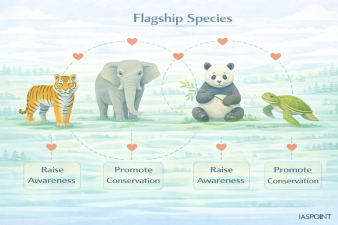
A Flagship Species is a species chosen to raise support, awareness, and funding for conservation efforts in a particular locality or for a specific environmental cause. These are typically “charismatic” animals that possess high public appeal and can serve as an icon or symbol for a campaign.
Core Objectives of the Flagship Concept
The primary goal is not always purely ecological; it is often socio-economic and political.
- Public Engagement: Utilizing the emotional connection people feel toward “cute” or “majestic” animals to drive conservation.
- Fundraising: Organizations like the WWF use flagship species to attract donations.
- Policy Influence: Using a high-profile species to pressure governments into creating protected areas.
Characteristics of a Flagship Species
- Charismatic Megafauna: Usually large, recognizable animals (though not exclusively).
- Cultural Significance: Often has deep roots in the culture or mythology of the region.
- Threatened Status: Most flagship species are listed as Endangered or Vulnerable on the IUCN Red List.
- Symbolic Value: Represents the “health” or “spirit” of an entire ecosystem.
Major Examples of Flagship Species
| Species | Associated Organization/Region | Ecosystem Represented |
| Giant Panda | World Wildlife Fund (WWF) | Global Conservation Symbol |
| Tiger | Project Tiger (India) | Tropical Forest Ecosystems |
| African Elephant | Various African Nations | Savanna and Grasslands |
| Red Panda | Eastern Himalayas | Temperate Broadleaf Forests |
| Snow Leopard | High Altitude Himalayas | Mountainous/Alpine Ecosystems |
| Great Indian Bustard | Rajasthan (State Bird) | Grassland and Arid Ecosystems |
The “Conservation Suite”: Comparing Roles
It is common for a single species to fall into multiple categories. For instance, the Tiger is a Flagship, Umbrella, and Keystone species simultaneously.
| Category | Primary Function | Primary Motive |
| Flagship | To act as an ambassador/icon. | Socio-Political / Funding |
| Umbrella | To protect wide habitats. | Spatial / Landscape Planning |
| Keystone | To maintain ecological balance. | Biological / Functional Integrity |
Potential Risks and Criticisms
1. The “Charismatic Bias”
The focus on flagship species can lead to the neglect of “non-charismatic” species such as insects, fungi, or small reptiles, which might be more ecologically important (Keystone) but are less “marketable.”
2. Resource Misallocation
Funds may be disproportionately directed toward a few high-profile animals while the broader ecosystem or less “attractive” endangered species remain underfunded.
3. Local Discontent
In some cases, protecting a flagship species (like the Tiger or Elephant) can lead to human-wildlife conflict, causing local communities to view conservation efforts negatively if they feel the animal is prioritized over their livelihoods.
Important UPSC Trivia: Local and Cultural Flagships
- State Animals: In India, various states use flagship species as state symbols to promote regional pride and conservation (e.g., the Sangai or Brow-antlered deer in Manipur).
- Project Dolphin: Recently, the Ganges River Dolphin was designated as a flagship species for the health of the entire Ganga river ecosystem, moving beyond just terrestrial animals.
- Olive Ridley Turtles: Act as a flagship for marine conservation in Odisha, mobilizing thousands of local volunteers for beach protection during the Arribada (mass nesting).
Strategic Use in India
India uses the Integrated Development of Wildlife Habitats (IDWH) scheme, where 22 species have been identified for recovery programs. While these are biological priorities, many are selected because they function as flagships for their respective habitats, such as the Dugong (Sea Cow) for seagrass meadows and the Hangul for the Kashmir Valley forests.
Last Modified: April 18, 2026