

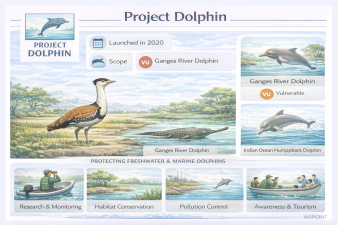
Project Dolphin is a landmark conservation initiative launched by the Government of India to protect both riverine and marine dolphins. Announced on August 15, 2020, the project is modeled after the successful “Project Tiger” and “Project Elephant” frameworks. It aims to address the conservation of dolphins and the aquatic habitat through modern technology, community participation, and scientific research. The project falls under the administrative ambit of the Ministry of Environment, Forest and Climate Change (MoEFCC).
Taxonomic Classification and Distribution
The project primarily focuses on the Gangetic River Dolphin, though it extends to marine species found in India’s coastal waters.
- Scientific Name: Platanista gangetica (Gangetic Dolphin).
- Local Names: Often referred to as ‘Susu’ due to the noise it makes while breathing.
- Habitat: Specifically found in the Ganges-Brahmaputra-Meghna and Karnaphuli-Sangu river systems of India, Nepal, and Bangladesh.
- Indicator Species: It is considered an “Indicator Species” for the health of the entire river ecosystem; its presence signifies a clean and vibrant riverine environment.
Conservation Status and Legal Protection
The Gangetic Dolphin enjoys the highest level of legal protection under various national and international frameworks, making it a frequent subject for UPSC Prelims.
| Framework | Status/Category |
| IUCN Red List | Endangered |
| Wildlife Protection Act, 1972 | Schedule I (Highest Protection) |
| CITES | Appendix I (Prohibits commercial international trade) |
| CMS (Bonn Convention) | Appendix II (Migratory species requiring conservation) |
| National Status | National Aquatic Animal of India (Declared 2009) |
Objectives of Project Dolphin
The project is designed with a multi-pronged strategy to ensure the long-term survival of the species.
- Habitat Restoration: Reducing pollution levels in rivers and ensuring adequate “environmental flow” (e-flow) to allow dolphins to move freely.
- Technology Integration: Utilization of Deep-Water Motion Sensors and Remotely Operated Vehicles (ROVs) for population estimation and monitoring.
- Anti-Poaching Measures: Strengthening patrolling in dolphin-rich stretches to prevent accidental entanglement in fishing nets (bycatch) and deliberate poaching for oil.
- Community Engagement: Developing “Dolphin Mitras” (Friends of Dolphins) among local fishing communities to reduce human-wildlife conflict and promote eco-tourism.
Major Threats to Dolphin Populations
Understanding the stressors is vital for evaluating the efficacy of Project Dolphin.
- Dams and Barrages: These structures fragment the population, restricting gene flow and movement.
- Pollution: High levels of agricultural runoff (pesticides), industrial waste, and plastic pollution lead to bioaccumulation of toxins.
- Bycatch: Accidental trapping in nylon gillnets remains a leading cause of mortality.
- Siltation: Excessive dredging for inland waterways disturbs the dolphin’s echolocation capabilities and alters their natural habitat.
Key Protected Areas and Sanctuaries
Specific geographic zones are critical for the survival of the species and are high-priority areas under Project Dolphin.
- Vikramshila Gangetic Dolphin Sanctuary (VGDS): Located in the Bhagalpur district of Bihar, it is the only sanctuary specifically designated for dolphins in India.
- National Chambal Sanctuary: Spanning Madhya Pradesh, Rajasthan, and Uttar Pradesh, it hosts a significant population of dolphins alongside Gharials.
- Ganges River Dolphin Day: Observed annually on October 5th to commemorate the date the dolphin was declared the National Aquatic Animal.
Comparative Study: Gangetic vs. Indus River Dolphin
While Project Dolphin focuses heavily on the Ganges, UPSC aspirants must distinguish between these two subspecies.
| Feature | Gangetic Dolphin | Indus River Dolphin |
| Scientific Name | Platanista gangetica gangetica | Platanista gangetica minor |
| Primary Location | Ganga-Brahmaputra (India/Nepal) | Indus River (Pakistan); Beas River (Punjab, India) |
| State Animal | Not applicable (National Animal) | State Aquatic Animal of Punjab |
| Key Characteristic | Functionally blind; uses echolocation | Functionally blind; uses echolocation |
Trivia and Key Facts for Prelims
- Echolocation: Dolphins emit ultrasonic sounds which bounce off objects, allowing them to “see” and hunt in murky river waters.
- Breathing Pattern: They are mammals and must surface every 30 to 120 seconds to breathe.
- Arthrobacter and Health: Recent studies suggest the presence of specific bacteria in dolphin skin that may have antimicrobial properties, though this is still under research.
- First Census: The first unified dolphin census using a standardized methodology was initiated under the “My Ganga My Dolphin” campaign.