

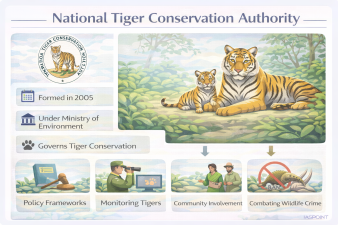
The National Tiger Conservation Authority (NTCA) is a statutory body under the Ministry of Environment, Forest and Climate Change (MoEFCC). It was established in December 2005 following the recommendations of the Tiger Task Force, which was constituted by the Prime Minister of India to address the systemic failures in tiger protection (notably the Sariska crisis).
Legal Framework and Origin
The NTCA derived its legal mandate through the Wildlife (Protection) Amendment Act, 2006, which inserted Chapter IV B into the original 1972 Act. This amendment transformed Project Tiger (launched in 1973 as an administrative scheme) into a statutory program with enforceable standards.
Organizational Structure and Composition
The authority operates on a federal structure to ensure coordination between the Union and the States.
- Chairperson: Union Minister for Environment, Forest and Climate Change.
- Vice-Chairperson: Minister of State for Environment, Forest and Climate Change.
- Members: ” Three Members of Parliament (two from Lok Sabha, one from Rajya Sabha).
- Secretary, MoEFCC.
- Eight experts or professionals with qualifications in wildlife conservation.
- Member Secretary: Inspector General of Forests (in charge of Project Tiger).
Powers and Functions under WPA 1972
The NTCA is the nodal agency for all matters related to tiger conservation in India. Its powers are binding on state governments in specific contexts:
- Approval of Tiger Conservation Plans (TCP): States are mandated to prepare a TCP for each reserve, which must be approved by the NTCA.
- Standard Setting: Lays down normative standards for tiger reserve management, including the “Core-Buffer” strategy.
- Ecological Oversight: Evaluates and assesses the sustainable ecology and ensures that no environmentally destructive activities (like mining or industry) are carried out near tiger reserves.
- Boundary Alteration: No alteration in the boundaries of a tiger reserve can be made without the recommendation of the NTCA and the approval of the National Board for Wild Life (NBWL).
- De-notification: States cannot de-notify a tiger reserve except in public interest, with the approval of both the NTCA and the NBWL.
Project Tiger and Management Strategy
Project Tiger is a Centrally Sponsored Scheme (CSS). The NTCA provides central assistance to tiger states for “in-situ” conservation in designated tiger reserves.
- Core Area: Dedicated to tiger conservation; must be kept “inviolate” without compromising the rights of Scheduled Tribes or other forest dwellers.
- Buffer Area: Surrounds the core; aims to provide a balance between wildlife conservation and the livelihood of local people.
All India Tiger Estimation (AITE)
The NTCA, in collaboration with the Wildlife Institute of India (WII) and state forest departments, conducts a national assessment of tigers, co-predators, and prey every four years.
| Census Cycle | Tiger Population | Key Highlight |
| 2006 | 1,411 | First scientific estimation using camera traps. |
| 2010 | 1,706 | Significant growth observed in Central India. |
| 2014 | 2,226 | 30% increase recorded. |
| 2018 | 2,967 | India met the TX2 goal (doubling population) 4 years early. |
| 2022 | 3,167 | Released on the 50th anniversary of Project Tiger. |
Key Technological Initiatives
- M-STrIPES: (Monitoring System for Tigers – Intensive Protection and Ecological Status) A software-based monitoring tool using GPS and GPRS for patrol tracking and ecological data collection.
- e-Eye: An intelligent surveillance system using thermal cameras for 24/7 monitoring in high-sensitivity zones (e.g., Jim Corbett).
- CaTRAT: (Camera Trap Data Repository and Analysis Tool) Used for processing massive volumes of camera trap photos.
Tiger Reserves: Quick Facts for Prelims
India currently has 58 notified Tiger Reserves (as of early 2026).
- Largest Tiger Reserve: Nagarjunsagar-Srisailam (Andhra Pradesh).
- Smallest Tiger Reserve: Orang (Assam) by core area; Bor (Maharashtra) is also among the smallest.
- First Tiger Reserve: Jim Corbett (Uttarakhand).
- State with Most Reserves: Madhya Pradesh (9 reserves).
- Tiger State of India: Madhya Pradesh (highest tiger population as per 2022 census).
- Newest Additions (2024-25): ” 56th: Guru Ghasidas-Tamor Pingla (Chhattisgarh).
- 57th: Ratapani (Madhya Pradesh).
- 58th: Madhav (Madhya Pradesh).
Global Role and Trivia
- TX2 Goal: A global commitment by tiger range countries to double the wild tiger population by 2022 (St. Petersburg Declaration).
- International Big Cat Alliance (IBCA): Launched by India in 2023 to protect 7 big cats: Tiger, Lion, Leopard, Snow Leopard, Cheetah, Jaguar, and Puma.
- Umbrella Species: The tiger is considered an “umbrella species” because its conservation ensures the protection of the entire ecosystem and myriad other species.
- Global Tiger Day: Observed annually on July 29.