

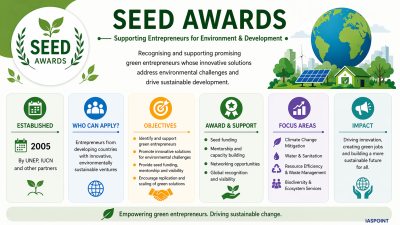
The SEED Awards (Supporting Entrepreneurs for Environment and Development) is a prestigious global program designed to support small and growing enterprises that deliver environmental, social, and economic benefits. Founded at the 2002 World Summit on Sustainable Development in Johannesburg, SEED is a primary driver for the “Green Economy” at the grassroots level.
Institutional Framework and Partners
Genesis and Founding
- Established: 2002 by UNEP, UNDP, and IUCN.
- Nature: An international partnership for action on sustainable development and the green economy.
- Hosting: The SEED Secretariat is hosted by adelphi research (Germany).
- Core Philosophy: SEED operates on the principle that “eco-inclusive” enterprises—those that are both environmentally friendly and socially inclusive—are the keys to sustainable development.
Global Partnership Network
SEED is supported by a robust network of governments and international bodies, including:
- Founder Partners: UNEP, UNDP, and IUCN.
- Supportive Governments: Historically supported by the governments of Germany, India, the Netherlands, South Africa, and the United Kingdom.
- Collaborative Partners: Conservation International, European Confederation of Junior Enterprises, and various national-level agencies.
Award Categories and Support Model
Unlike typical awards that provide only a cash prize, the SEED Awards offer a comprehensive “Business Laboratory” to scale enterprises.
| Award Type | Target Group | Support Provided |
| SEED Africa Awards | Enterprises in selected African countries (e.g., Ghana, Kenya, Malawi). | Business tools, mentorship, and global visibility. |
| SEED Gender Equality Awards | Women-led or women-empowering enterprises globally. | Targeted support for gender-responsive business models. |
| SEED Low Carbon Awards | Enterprises focused on mitigating climate change. | Technical assistance for low-carbon tech and carbon financing. |
| SEED South Asia Awards | Emerging eco-inclusive enterprises in India and neighbors. | Tailored “Starter” and “Catalyser” programs. |
The SEED Support Tiers
SEED categorizes its support based on the maturity of the enterprise:
- SEED Starter: For those with just a business idea, providing three-day workshops to build a viable business model.
- SEED Catalyser: For early-stage enterprises ready to scale, offering one-on-one business coaching and peer-to-peer networking.
- SEED Accelerator: For established enterprises looking for external investment and advanced growth strategies.
SEED in India: Recent Trends (2025–2026)
India is one of SEED’s most active regions due to its vibrant social entrepreneurship ecosystem.
Focus Areas in India
- Circular Economy: Waste-to-energy and waste-to-resource ventures in urban centers like Bengaluru and Mumbai.
- Sustainable Agriculture: Solar-powered irrigation and organic supply chain startups in rural India.
- Clean Energy: Decentralized solar grids and biogas solutions for off-grid communities.
Notable Indian Laureates (Examples)
- Kudumbashree (Past recognition): For its waste management and sustainable livelihood models.
- Aakar Innovations: Recognized for its production of affordable, compostable sanitary pads.
- 2025–2026 Context: Recent awardees have focused heavily on “Precision Agriculture” using IoT to reduce water and pesticide usage, aligning with India’s “Digital Agriculture Mission.”
Global Impact and 2026 Priorities
As of April 2026, SEED has pivoted its global strategy to align with the “Post-2020 Global Biodiversity Framework” and the “UN Decade on Ecosystem Restoration.”
- Green Jobs: A primary metric for 2026 is the creation of “quality green jobs” for youth and women.
- Biodiversity-based Enterprises: Increased focus on enterprises that utilize non-timber forest products (NTFPs) sustainably, protecting the livelihood of indigenous communities.
- Climate Adaptation: Prioritizing businesses that help communities adapt to climate shocks (e.g., drought-resistant seeds, flood-resilient housing materials).
Essential Trivia for UPSC Prelims
- Triple Bottom Line: The SEED Awards are the gold standard for recognizing the “Triple Bottom Line”—People, Planet, and Profit.
- Symbiosis with SDGs: SEED directly contributes to SDG 8 (Decent Work and Economic Growth), SDG 12 (Responsible Consumption and Production), and SDG 13 (Climate Action).
- The “Unbanked” Sector: SEED specifically targets the “missing middle”—enterprises too large for micro-finance but too small/risky for traditional commercial banks.
- Policy Influence: SEED uses data from its laureates to inform the UNEP Green Economy Report and national green growth strategies.