
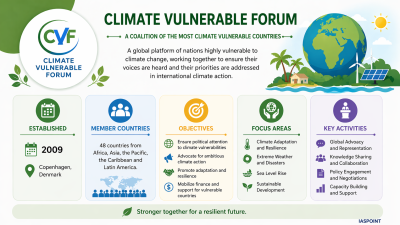
The Climate Vulnerable Forum (CVF) is an international partnership of countries that are disproportionately affected by the global climate crisis. Unlike traditional blocs based on geography or income, the CVF is unified by a shared existential threat from climate change.
Institutional Profile and Leadership
Genesis and Evolution
- Establishment: Founded in November 2009 by the Maldives government under the Malé Declaration, just prior to the COP15 Copenhagen Summit.
- Founding Chair: Mohamed Nasheed (then President of the Maldives).
- Secretariat: Located in Gland, Switzerland (shared with the V20).
- Membership Growth: Started with 11 founding countries; as of 2026, it has grown to 74 member states representing nearly 1.7 billion people.
Leadership and Chairmanship
The CVF is led by a rotating chair from among its member states.
- Current Chair (2024–2026): Barbados (Prime Minister Mia Mottley has been a central figure in the CVF’s recent global financial reform efforts).
- Former Chairs: Ghana (2022–24), Bangladesh (2020–22), Marshall Islands (2018–20), Ethiopia (2016–18).
The V20 Group (Vulnerable Twenty)
The V20 is the dedicated cooperation initiative of Finance Ministers from the member states of the CVF.
- Purpose: To address the financial challenges associated with climate change, including fiscal stability, insurance, and investment mobilization.
- Status: While it started with 20 nations, its membership now mirrors the CVF (74 countries), though it retains the “V20” name as a brand for its economic and financial advocacy.
Core Goals and Strategic Pillars
| Goal / Pillar | Objective | Key Target |
| 1.5°C Limit | Advocating for the strictest interpretation of the Paris Agreement. | Ensuring global temperatures do not rise beyond 1.5°C above pre-industrial levels. |
| Climate Prosperity Plans (CPPs) | National strategies to transition from “vulnerability” to “prosperity.” | Decoupling economic growth from carbon emissions while building resilience. |
| Financial Reform | Transforming the global financial architecture. | Campaigning for lower capital costs and debt-for-climate swaps. |
| Carbon Neutrality | Leading by example through domestic action. | Achieving Net Zero by 2050 (or sooner for founding members). |
Recent Key Initiatives (2025–2026)
Climate Prosperity Plans (CPP)
CVF countries are moving beyond “National Adaptation Plans” to “Climate Prosperity Plans.”
- Ghana (2026): Recently validated an updated CPP aligned with its “24-Hour Economy Policy” to scale green investments.
- Bhutan (2026): Launched a resource mobilization plan to become a high-income Gross National Happiness (GNH) economy by 2034 through climate action.
- Pakistan (2026): Advancing its Climate Prosperity Agenda to secure green infrastructure funding.
The “Lifeline Fund”
In 2026, the V20 released reports on External Fragility, proposing the Lifeline Fund. This fund is designed to provide rapid liquidity support to vulnerable nations facing “idiosyncratic” climate shocks, preventing balance-of-payments crises.
Global Renewable Boom
According to 2026 data, CVF countries are outpacing many developed nations in renewable adoption. Nearly one-third of CVF countries have surpassed the United States in the share of electricity generated from solar power within their national energy mixes.
India’s Relationship with the CVF
- Status: India is not a formal member of the CVF. As a major economy and one of the world’s largest emitters, India is often viewed as a “partner” or “supporter” rather than a “vulnerable-only” state.
- Alignment: India frequently aligns with the CVF in international forums (like COP summits) to demand that developed nations meet their $100 billion climate finance commitments.
- The Bridgetown Initiative: India has shown support for the Barbados-led Bridgetown Initiative, which shares the CVF’s goal of reforming the IMF and World Bank to benefit climate-vulnerable nations.
Key Reports and Monitoring Tools
The Climate Vulnerability Monitor (CVM)
Published by the CVF, this report assesses the global impact of climate change on health, industry, and the economy.
- CVM-3 (Latest): Highlights that climate change is already costing vulnerable economies approximately 20% of their GDP growth over the last two decades.
V20 Debt Review
The Third Edition (2025) of the V20 Debt Review revealed that external debt servicing costs for member states reached $120 billion in 2024, effectively doubling since 2018. This underscores the CVF’s demand for a “two-year standstill” on debt payments during disasters.
Essential Trivia for UPSC Prelims
- Member Composition: Includes Least Developed Countries (LDCs), Small Island Developing States (SIDS), and landlocked nations (like Nepal and Bhutan).
- The 350 ppm Target: Early CVF declarations famously called for reducing atmospheric CO₂ concentrations to 350 parts per million (we are currently above 420 ppm).
- Global Shield against Climate Risks: A joint initiative between the G7 and V20 to provide rapid-access insurance and financial protection for people in vulnerable countries.
- Accra-To-Marrakech Agenda: A roadmap developed by CVF-V20 to move toward a more “climate-aligned” international financial system.