
The IUCN Red List of Threatened Species, established in 1964, is the world’s most comprehensive inventory of the global conservation status of biological species. It acts as a “Barometer of Life,” used by the Indian government and international bodies to prioritize conservation efforts.
- Headquarters: Gland, Switzerland.
- India’s National Initiative (Vision 2025–2030): Launched at the 2025 IUCN World Conservation Congress, India is currently implementing a “National Red List Roadmap.” Spearheaded by the MoEFCC, ZSI, and BSI, this initiative aims to assess 11,000 priority Indian species and publish National Red Data Books by 2030.
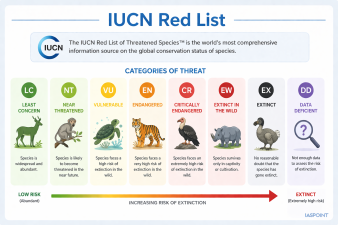
The Nine IUCN Categories
Species are classified into nine categories based on five quantitative criteria: population size reduction, geographic range, small population size, very small/restricted population, and quantitative analysis of extinction probability.
| Category | Definition | Example (Indian Context) |
| Extinct (EX) | No reasonable doubt that the last individual has died. | Indian Cheetah (Acinonyx jubatus venaticus) – Regionally Extinct since 1952. |
| Extinct in the Wild (EW) | Survives only in captivity or as a naturalized population outside its historic range. | No prominent Indian animal; globally includes the Hawaiian Crow. |
| Critically Endangered (CR) | Extremely high risk of extinction in the wild (e.g., population decline >90% in 10 years). | Gharial, Great Indian Bustard, White-bellied Heron. |
| Endangered (EN) | Very high risk of extinction in the wild (e.g., population decline >70% in 10 years). | Tiger, Asiatic Lion, Red Panda, Sangai. |
| Vulnerable (VU) | High risk of extinction in the wild (e.g., population decline >50% in 10 years). | One-horned Rhino, Olive Ridley Turtle, Snow Leopard. |
| Near Threatened (NT) | Close to qualifying for or likely to qualify for a threatened category soon. | Blackbuck, Lesser Flamingo. |
| Least Concern (LC) | Evaluated but does not qualify for any of the above; widespread and abundant. | Common Myna, House Sparrow. |
| Data Deficient (DD) | Inadequate information to make an assessment. | Many deep-sea fish and specific invertebrate species. |
| Not Evaluated (NE) | Has not yet been assessed against the criteria. | Most of India’s newly discovered insects. |
Understanding the “Threatened” Cluster
In UPSC Prelims, the term “Threatened” specifically refers to the combination of three categories:
- Critically Endangered (CR)
- Endangered (EN)
- Vulnerable (VU)
Qualitative vs. Quantitative Criteria for CR Status
For a species to be listed as Critically Endangered, it must meet one of the following (simplified for UPSC):
- Population Reduction: >90% over the last 10 years or three generations.
- Geographic Range: Extent of occurrence <100 km2 or area of occupancy <10 km2.
- Population Size: <50 mature individuals.
- Probability of Extinction: At least 50% within 10 years or three generations.
The Green Status of Species
Introduced recently to complement the Red List, the Green Status measures “Conservation Success.”
- It assesses the recovery of species’ populations.
- Categories range from Extinct in the Wild to Fully Recovered.
- This helps in understanding how much a species has recovered thanks to conservation interventions like Project Tiger or Project Elephant.
Vital Facts for Prelims
- Bird Proportions: According to the 2025-2 update, more than half of bird species globally are in decline.
- The Pink Pages: Historically, Red Data Books used pink pages for critically endangered species and green pages for those that were recovering.
- Invertebrates Gap: While mammals and birds are well-assessed, only a small fraction of invertebrates and fungi have been evaluated globally.
- National Parks and IUCN: IUCN also provides a classification for Protected Areas. National Parks in India generally correspond to IUCN Category II.
Recent Status Shifts (2024-2026)
- Iberian Lynx: Improved from Endangered to Vulnerable due to successful conservation.
- Emperor Penguin: Now listed as Endangered primarily due to climate change impacts on Antarctic ice.
- Dugong: India officially recognized its first Dugong Conservation Reserve in Tamil Nadu (September 2025) to prevent the species from sliding further into the “Vulnerable” category